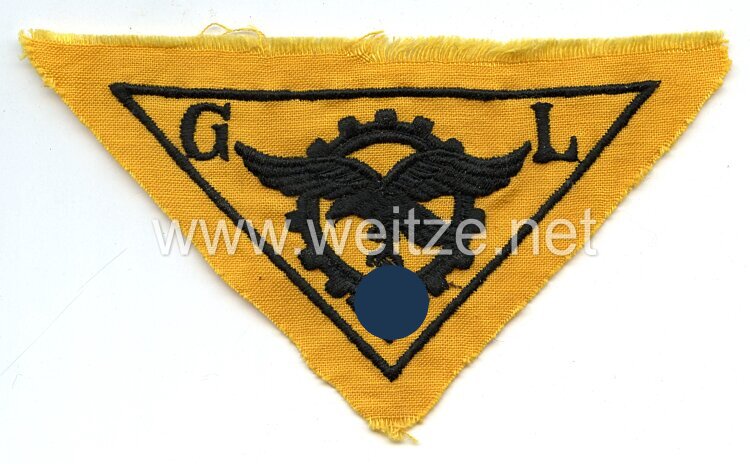
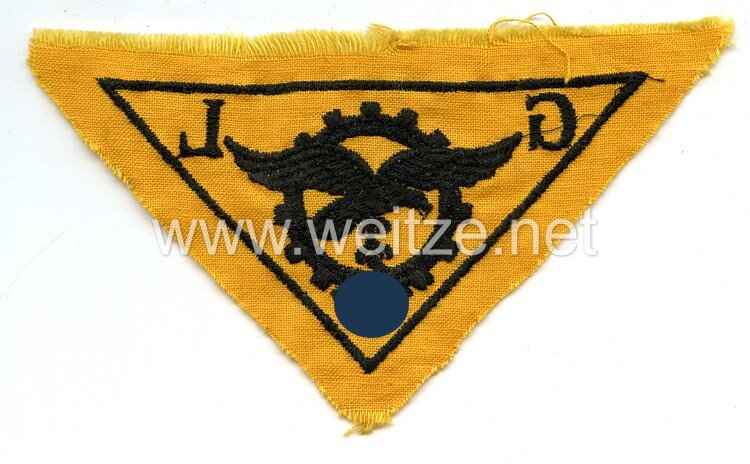
Luftwaffe Breast Eagle for Enlisted Men General-Luftzeugmeister

Machine-embroidered version on yellow wool base, unissued condition, Condition 2.
464298
65,00

Luftwaffe Breast Eagle for Enlisted Men General-Luftzeugmeister

The Luftwaffe Breast Eagle for Enlisted Men in the General-Luftzeugmeister version represents a significant example of military insignia and uniform identification of the German Luftwaffe during World War II. This machine-embroidered specimen on yellow background represents the technical services within the Luftwaffe hierarchy.

The Luftwaffe was officially founded on March 1, 1935, as an independent branch of the Wehrmacht, after the German Reich rejected the military restrictions of the Treaty of Versailles. With its establishment, a comprehensive system of uniforms, rank insignia, and service identification was introduced, drawing on military traditions while incorporating new elements.

The Breast Eagle (also known as the national emblem or Hoheitsadler) was the central national symbol of the Wehrmacht and was worn on the right breast of the uniform. For the Luftwaffe, the eagle with outstretched wings and a swastika in its talons was characteristic. The design and color of the background varied according to branch of service and position.

The Office of the General-Luftzeugmeister was created in 1936 and was responsible for all technical development, procurement, and equipment of the Luftwaffe. Ernst Udet held this position from 1939 until his death in 1941, followed by Erhard Milch. The General-Luftzeugmeister had far-reaching authority over aircraft production, weapons development, and technical innovation.

The yellow Waffenfarbe (branch color) was assigned to the technical services of the Luftwaffe. In the Wehrmacht's complex system of branch colors, yellow (later golden-yellow) designated flying personnel, signals troops, and technical services. This color coding manifested itself in various uniform elements: collar patches, shoulder straps, and indeed in the background of breast eagles for certain ranks.

The machine-embroidered version for enlisted men differed significantly from the hand-embroidered or woven versions for officers. While officers frequently wore high-quality eagles embroidered in aluminum or silver thread on their uniforms, enlisted ranks and non-commissioned officers received standardized, machine-manufactured versions. These were more cost-effective to produce and met the need for mass supply to a rapidly growing Luftwaffe.

The manufacture of such insignia was carried out by various authorized manufacturers who were subject to strict quality and design guidelines of the Reich Air Ministry (RLM). RLM regulations precisely governed the dimensions, materials, and execution of all uniform components. Despite standardization, there were manufacturing variations in details such as embroidery density, thread thickness, and exact color tone.

An unworn specimen like the one described offers an authentic insight into the original quality and workmanship of these militaria. Such pieces were either procured as replacements but never used, or came from warehouse stocks that survived the end of the war. The state of preservation allows for an accurate assessment of manufacturing technique and material quality.

The wearing of the breast eagle was precisely defined in uniform regulations. It was attached to the right breast of the field tunic, flying blouse, and other uniform jackets, at a specific height and position. Attachment was by sewing, with the insignia applied directly to the uniform fabric.

After 1945, the collecting and possession of such military-historical objects in Germany was regulated by various laws. Today, such artifacts in museums and collections serve as important testimonies of military history and enable scholarly examination of this period. They document material culture, production techniques, and organizational structures of the Wehrmacht.

For military-historical research, such original pieces are of considerable value, as they provide insights into uniforming regulations, manufacturing processes, material procurement, and the everyday reality of the armed forces. The connection to the Office of the General-Luftzeugmeister also emphasizes the importance of the technical and logistical dimensions of air warfare.