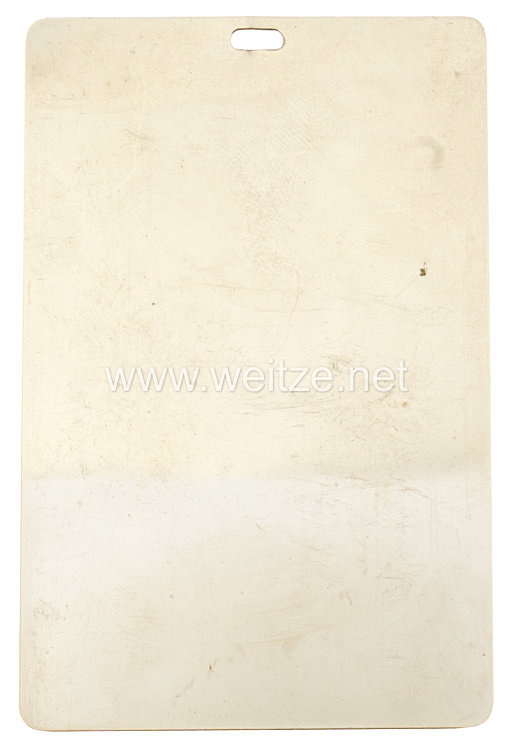
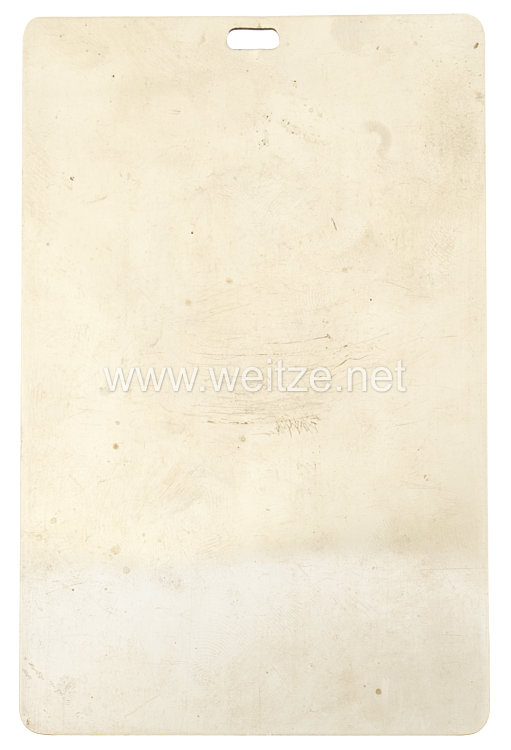
Luftwaffe Signal Mirror for Air-Sea Rescue Equipment
The Luftwaffe Blendspiegel (signal mirror) represented an essential element of the German Air Force's sea rescue equipment during World War II. This compact survival tool, typically measuring approximately 7 x 11 cm, served downed or ditched aircrew to attract attention by reflecting sunlight, significantly increasing their chances of rescue.
The Luftwaffe's sea rescue equipment evolved continuously throughout the war, as increasing operations over water – particularly over the North Sea, English Channel, and Mediterranean – highlighted the necessity for effective rescue systems. After the first years of the war, Luftwaffe leadership recognized that crew survival rates in water could be significantly improved through enhanced equipment. This led to the standardization of various sea rescue items, including life vests, inflatable boats, dye markers, and signal mirrors.
The signal mirror operated on a simple yet highly effective principle: by reflecting direct sunlight, signals could be transmitted over distances of several kilometers, detectable by rescue aircraft, ships, or coastal observation posts. Under clear weather and favorable conditions, such a light signal was visible over distances of 15 to 20 kilometers. Most versions featured a central sighting device – often a small hole or crosshair – enabling the user to aim the reflected light precisely at a specific target.
There were fundamentally two procurement channels for such equipment items: official issue by the Luftwaffe and private procurement. While standardized, officially issued signal mirrors were subject to specific manufacturing and quality specifications, many aircrew acquired additional or alternative equipment at their own expense. These privately procured versions varied considerably in material, workmanship, and quality. Some were manufactured by specialized producers, others came from private production or local craftsmen.
Privately procured examples often reflected the individual preferences and experiences of crew members. Pilots and crew who had already experienced emergency situations over water or heard of such incidents frequently invested in additional safety equipment. The fact that private procurement was so widespread suggests a certain distrust in the completeness of official equipment or the desire for redundant safety systems.
The Luftwaffe's Seenotdienst (Air-Sea Rescue Service), officially established in 1935 and continuously expanded, coordinated rescue operations for downed aircrew. This organization deployed specialized rescue aircraft such as the Heinkel He 59 and later the Dornier Do 24, as well as fast rescue boats. The effectiveness of these rescue operations depended critically on whether and how quickly the position of survivors could be located – here, signaling devices like the signal mirror played a decisive role.
The materials of signal mirrors varied depending on availability and time of manufacture. Early models often consisted of polished metal, typically chrome-plated brass or aluminum. As the war progressed and metal shortages increased, versions with mirrored glass also came into use. Housings were made from various materials – from Bakelite to leather to simple metal frames. Privately procured examples showed particular diversity here, as they were not subject to standardized material specifications.
The practical significance of such signal mirrors is underscored by numerous documented rescue cases in which downed crews were successfully located. In the operational reports of the Seenotdienst, there are repeated references to the successful use of light signals for locating survivors in the water.
The use of signal mirrors was not unique to the German Luftwaffe – all major air forces of World War II included similar devices in their survival equipment. The British RAF, US Army Air Forces, and other services recognized the value of this simple yet effective signaling method. The international similarity of these devices demonstrates the universal acknowledgment of their utility in survival situations.
Documentation regarding the specific regulations governing sea rescue equipment can be found in various Luftwaffe service manuals and directives from the period. These documents specified the contents of emergency kits and survival equipment, though the degree of standardization varied throughout the war, particularly as resource constraints increased.
Today, these signal mirrors represent significant military-historical collectibles that document the technical and organizational aspects of air warfare and associated rescue systems. They testify to the constant concern for crew survival and the development of specialized equipment to increase survival chances under extreme conditions. The distinction between officially issued and privately procured items adds an additional layer of historical interest, revealing the personal initiative of aircrews in ensuring their own survival.