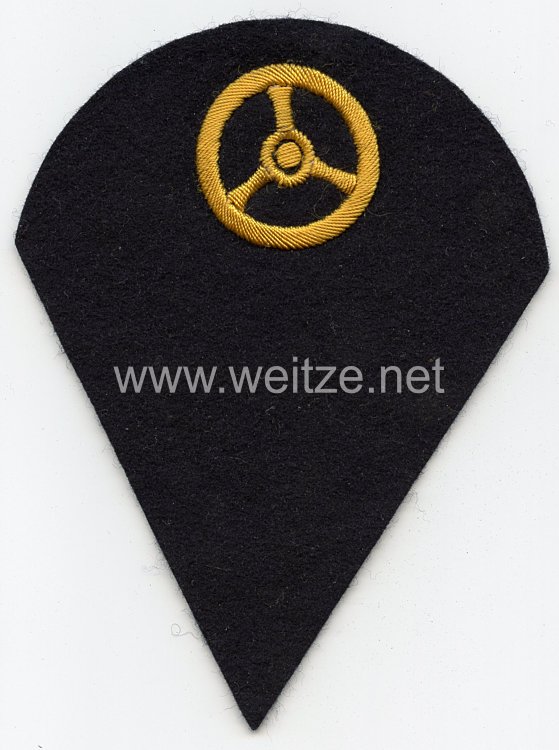
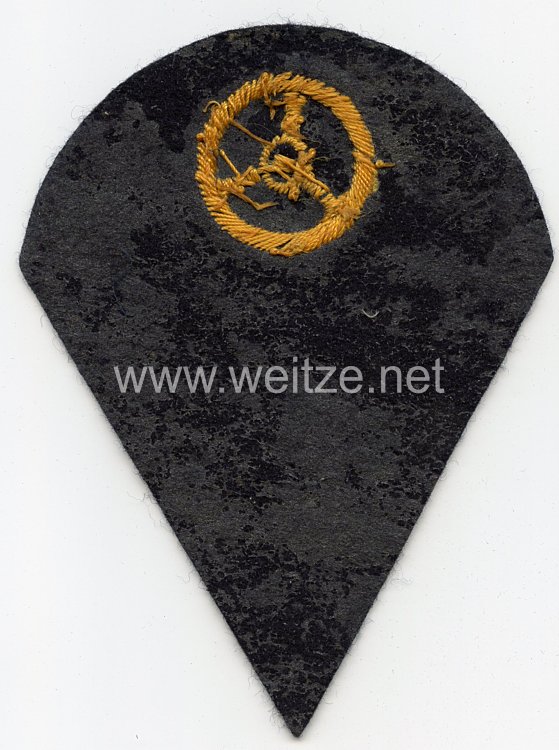
Kriegsmarine Enlisted Men's Sleeve Insignia Motor Vehicle Personnel Career Track

Version for blue uniform, hand-embroidered, condition 2-.
377698
15,00

Kriegsmarine Enlisted Men's Sleeve Insignia Motor Vehicle Personnel Career Track

The Kriegsmarine Sleeve Badge for Enlisted Personnel of the Motor Vehicle Career Path represents a significant example of the career insignia worn within the German Kriegsmarine during World War II. These specialized badges served to identify the professional qualifications and area of activity of naval personnel in the enlisted ranks.

The Kriegsmarine, as the naval force of the German Reich from 1935 to 1945, developed a complex system of uniform insignia and markings. Following the reintroduction of conscription in March 1935 and the associated buildup of the Wehrmacht, the Navy was also considerably expanded. The Dress and Uniform Regulations of the Kriegsmarine detailed the wearing of rank insignia, career badges, and specialty insignia.

This badge identified members of the Motor Vehicle Career Path, those naval personnel responsible for operating, maintaining, and driving motor vehicles. Although the Kriegsmarine was primarily a naval force, it maintained extensive shore-based facilities, including naval bases, shipyards, training establishments, and administrative offices. Qualified drivers were essential for transporting personnel, materials, and equipment between these facilities.

The version for the Kollani (Kollani uniform) is particularly noteworthy. The Kollani was a special uniform tunic made of blue cloth, worn in certain service situations. The hand-embroidered construction indicates high-quality workmanship. During the war years, many uniform insignia were machine-manufactured or woven, but hand-embroidered examples remained common, especially for versions intended for better uniform types.

Kriegsmarine sleeve badges were typically worn on the left upper arm and consisted of various symbols representing the respective career path or specialization. For the motor vehicle career path, this was usually a stylized steering wheel or similar symbol, executed in yellow embroidery on a dark blue background, corresponding to the colors of the enlisted career path.

The introduction of such career badges occurred as part of the comprehensive reorganization of the Kriegsmarine in the late 1930s. Service Regulation M.Dv. No. 53 and subsequent amendments regulated the appearance and manner of wearing these badges. The system of career badges made it possible to recognize a soldier's qualifications at a glance, which was of considerable practical importance in military organization.

These badges were manufactured by specialized producers, often marked with RZM numbers (Reichszeugmeisterei) or other approval markings. Hand-embroidered execution required considerable craftsmanship and was more time-consuming than machine production. This was reflected in the quality and durability of the pieces.

In the context of war history, such badges document the sophisticated organizational structure of the Kriegsmarine. The fact that special career badges existed even for seemingly subordinate functions such as drivers underscores the high degree of specialization and professionalization within the Navy. Kriegsmarine drivers were not simply drivers, but trained specialists who had undergone special training.

The preservation of such uniform items is of historical value today, as they represent authentic testimonies of military history. The stated condition of 2- indicates a well-preserved example that has survived the decades. Many of these badges were lost or destroyed in the chaos of the war's end and the post-war period.

From a collector's and historical perspective, these objects offer insights into the everyday reality of naval personnel. They remind us that a naval force encompassed far more than just ship crews – it required extensive infrastructure with numerous specialized professional groups, of which drivers played an important, albeit often overlooked, role.