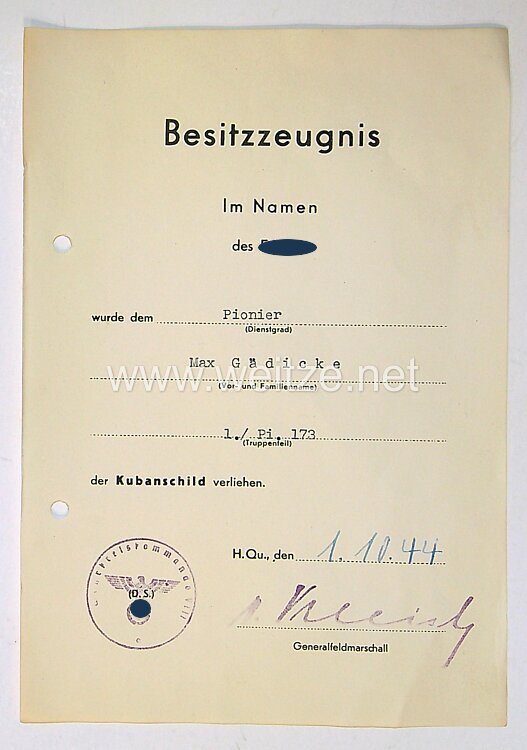
Army - Award Document for Kuban Shield, for a Pioneer of 1. / Pionier 173

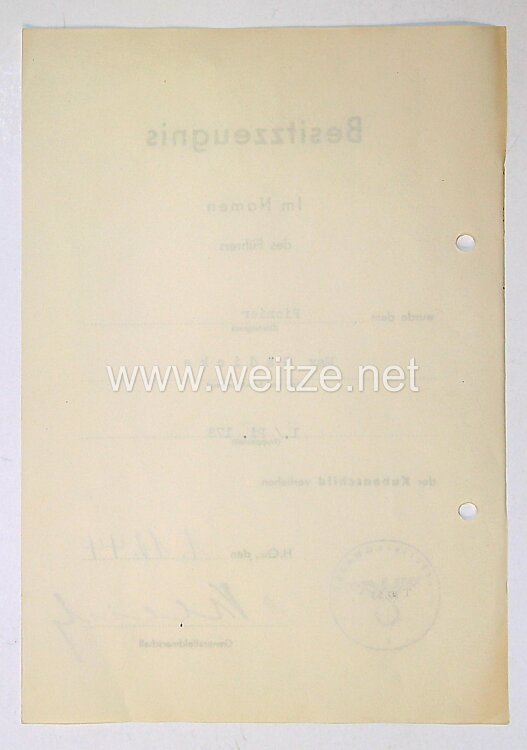
Award certificate for the Kuban Shield, issued on 1.10.1944 with facsimile signature of Generalfeldmarschall v. Kleist, hole-punched, used condition.
455198
150,00

Army - Award Document for Kuban Shield, for a Pioneer of 1. / Pionier 173

The Kuban Shield (officially: Ärmelschild Kuban or Kuban Arm Shield) was a German military decoration of World War II, instituted by Adolf Hitler on September 21, 1943. This award honored Wehrmacht soldiers who participated in the fierce battles on the Kuban Peninsula in the Caucasus between February and October 1943.

The award certificate for a pioneer (combat engineer) of the 1st Company, Pioneer Battalion 173, issued on October 1, 1944, documents recognition for participation in one of the most intense defensive battles of the Eastern Front. The date of issue, more than a year after the end of the Kuban battles, was not unusual, as administrative processes for award conferrals were frequently delayed.

Army Group A, under the command of Generalfeldmarschall Ewald von Kleist, conducted operations on the Kuban Peninsula. Von Kleist, whose facsimile signature appears on this certificate, was commander of this army group from November 1942 to March 1944. The battles at the Kuban bridgehead were part of the larger German withdrawal movements following the failure of the Caucasus offensive and the catastrophe at Stalingrad.

Pioneer Battalion 173 belonged to the 73rd Infantry Division, a unit heavily involved in fighting in the Caucasus and Crimea. Pioneers played a crucial role in the Kuban battles: they built fortifications, cleared minefields, constructed and demolished bridges, and conducted assault operations. The geographical features of the Kuban Peninsula, with its numerous rivers, swamps, and difficult terrain, made pioneer units indispensable.

The Kuban Shield itself was a trapezoidal cloth badge worn on the left upper arm. It displayed a stylized representation of the Kuban bridgehead with an eagle. To qualify for the award, participation in battles from January 31 to October 9, 1943 was required, with specific periods and deployments precisely defined. Wounded soldiers could receive the decoration even with shorter service time.

The possession certificate, as presented here, was the official document confirming entitlement to wear the arm badge. It was issued on pre-printed forms containing standardized text and space for entering the recipient's personal data. The holes punched in the certificate indicate it was filed in the soldier's personnel records, a common practice for documenting awards and decorations.

The battles at the Kuban bridgehead were of particular strategic importance. After withdrawing from the northern Caucasus, the Wehrmacht held the bridgehead to protect Crimea and possibly prepare for a renewed offensive. Soviet forces made massive efforts to drive the German troops into the sea. The fighting was characterized by intense artillery duels, air attacks, and bloody infantry engagements.

The used condition of this certificate and its hole-punching tell their own story. It passed through military bureaucracy, was kept in files, and possibly preserved or salvaged during the chaotic final months of the war. Such documents today are important historical sources connecting individual fates with major military events.

The issue date of October 1944 falls during a period when the Wehrmacht was already deeply on the defensive. Army Group A had already abandoned the Kuban bridgehead in October 1943, and the front was moving inexorably westward. The conferral of the decoration at this late date shows that despite the military situation, formal recognition procedures continued.

For collectors and historians, such certificates are of great value as they establish concrete connections to specific units, battles, and individuals. They supplement our understanding of military organization, administrative practices, and individual experiences during World War II. The signature of von Kleist, even in facsimile form, links this document to one of the most prominent German commanders of the Eastern Front.

These award documents serve as tangible evidence of the bureaucratic machinery that continued functioning even as the Third Reich faced collapse, and they provide researchers with invaluable data for reconstructing unit histories and individual service records.