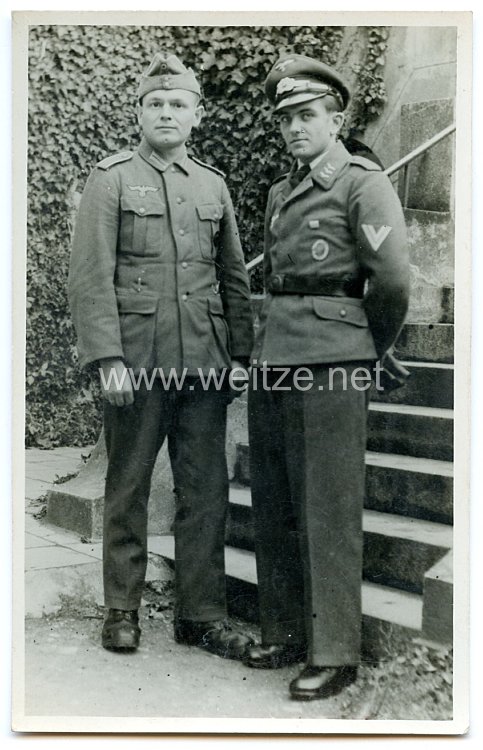
Luftwaffe Photograph, Obergefreiter with Paratrooper Badge
This postcard-sized photograph depicts a Luftwaffe Obergefreiter (Senior Lance Corporal) during World War II, wearing the coveted Fallschirmschützenabzeichen (Paratrooper Badge). Such private portrait photographs were widespread among soldiers and served as mementos for family members and comrades.
The Fallschirmschützenabzeichen was instituted on November 5, 1936, by Reichsmarschall Hermann Göring as Commander of the Luftwaffe. It was one of the most prestigious decorations of the German armed forces and was awarded only to soldiers who had successfully completed the demanding paratrooper training. The badge featured a gilded eagle with spread wings, clutching an oak wreath with swastika in its talons, set against a stylized silver parachute.
The wearers of this badge belonged to the elite of the German armed forces. Paratrooper training was extraordinarily rigorous and took place primarily at the parachute schools in Stendal and Wittstock. Candidates first had to complete basic military training, followed by intensive physical conditioning, theoretical instruction on parachute techniques, and finally several jumps. Only after successfully completing six jumps did a soldier earn the right to wear the Fallschirmschützenabzeichen.
The rank of Obergefreiter was a lower enlisted rank, roughly comparable to a senior private or lance corporal. This rank was frequently awarded to soldiers who had proven themselves but had not yet attained a non-commissioned officer position. The combination of Obergefreiter with the paratrooper badge suggests a combat-experienced soldier who had possibly participated in various airborne operations.
German paratroopers, known as “Grüne Teufel” (Green Devils) due to their characteristic uniform color, participated in some of the most dramatic operations of World War II. Among the most famous deployments were the capture of the Belgian fortress Eben-Emael in May 1940, the airborne assault on Crete in May 1941 (Operation Mercury), and various operations in North Africa, Italy, and on the Eastern Front.
The Battle of Crete marked a turning point for German paratroopers. Although the operation was ultimately successful, casualties were so severe that Hitler prohibited large-scale airborne operations in the future. Thereafter, paratroopers were increasingly employed as elite infantry in conventional ground combat, particularly in the defense of Monte Cassino in Italy in 1944.
Photographs like this one were of great personal and propagandistic significance during the war. Soldiers frequently had themselves photographed in professional studios or by regimental photographers to document their decorations and rank. These images were then sent as postcards to the home front or kept in family albums. The postcard format was standardized and allowed for easy mailing through military postal services.
From a collector's perspective, such photographs are important historical documents today. They offer authentic insights into the uniforms, rank insignia, and decorations of the Wehrmacht. The stated “Condition 2” indicates, according to standard collector grading, a good state of preservation with possibly minor signs of use.
The portrayal of paratroopers in contemporary photographs often followed certain conventions. Soldiers presented themselves in full uniform with visible decorations, serving both personal pride and the regime's propagandistic goals. These images were intended to convey strength, courage, and military excellence.
Today, such photographs are important sources for military-historical research and help document the lives and experiences of individual soldiers. They supplement official military records and provide a more personal insight into the reality of military service during World War II.