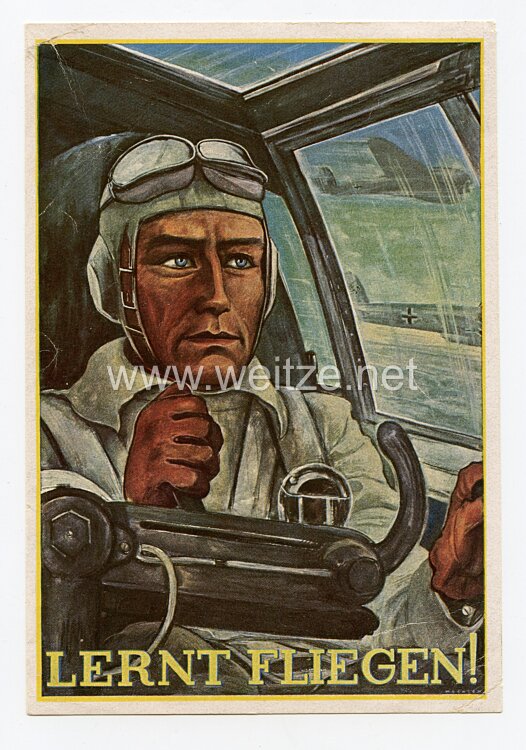
NSFK - Color Propaganda Postcard - “Learn to Fly!”
NSFK Propaganda Postcard “Learn to Fly!” - Historical Context
This colored propaganda postcard from the National Socialist Flying Corps (NSFK) bearing the inscription “Learn to Fly!” represents a characteristic example of National Socialist aviation propaganda from the 1930s and early 1940s. Such postcards were deliberately employed to foster enthusiasm for aviation among the German population and to recruit young people for the Luftwaffe.
The National Socialist Flying Corps
The NSFK was founded on April 17, 1937, uniting various civilian aviation sport organizations under National Socialist leadership. As the successor organization to the German Air Sports Association (DLV), it was directly subordinate to the Corps Leader, who worked closely with the Reich Minister of Aviation and Commander-in-Chief of the Luftwaffe. Hermann Göring, who held both of the latter positions, utilized the NSFK as a paramilitary preparatory school for the Luftwaffe.
The organization had several primary objectives: the aviation training of young Germans, the dissemination of aeronautical ideas among the population, and the preparation of recruits for military aviation. By 1939, the NSFK had already trained over 5,000 glider students and maintained an extensive network of training facilities throughout the German Reich.
Propaganda Postcards as an Instrument
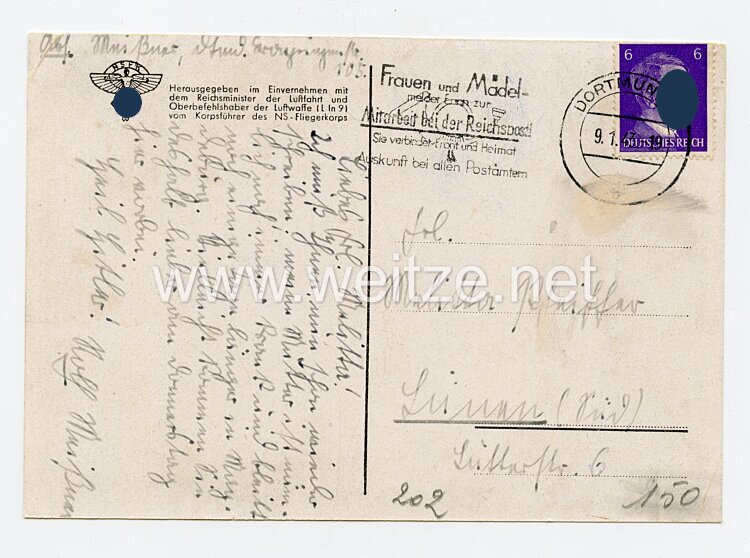
Postcards were a popular and effective propaganda medium in the Third Reich. They were inexpensive to produce, easy to distribute, and reached a broad cross-section of the population through the postal system. The designation “L In 9” refers to official approval by the Aviation Ministry and demonstrates the close integration between state agencies and propaganda activities.
Such postcards were distributed on various occasions: at aviation exhibitions, air shows, in schools, and at NSFK events. The inscription “Learn to Fly!” was a direct appeal to youth to dedicate themselves to aviation - an appeal that combined both romantic notions of flying and military purposes.
Design and Iconography
Colored postcards were more elaborate to produce at that time than simple black-and-white prints, which underscores their special propaganda value. Typically, NSFK propaganda cards showed motifs such as gliders, young aviators in uniform, aircraft formations, or symbolic representations of flying. The color design often followed National Socialist color codes with prominent use of red, white, and the organizational colors of the NSFK.
The Role of Preparatory Flight Training
The NSFK system of flight training was organized in multiple stages. It began with theoretical instruction in local aviation groups, continued with glider training, and could culminate in motorized aviation. This training was often free or heavily subsidized for participants - a significant incentive for young people from all social classes.
Training in the NSFK was officially considered “pre-military” but factually served the systematic preparation for service in the Luftwaffe. With the outbreak of war in 1939, this function became even more evident, and the NSFK became an indispensable component of Luftwaffe recruitment.
Historical Context
The postcard must be seen in the context of National Socialist rearmament policy. After the reintroduction of conscription in 1935 and the open proclamation of the Luftwaffe, the regime intensified its efforts to provide a large number of trained aviators. The NSFK played a key role in this endeavor.
At the same time, the postcard reflects the interwar period's fascination with aviation. Aviators were regarded as modern heroes, and aviation symbolized technical progress and national strength. This romantic glorification was skillfully instrumentalized by the regime for its military purposes.
Collector Value and Historical Significance
Today, such NSFK postcards are important historical documents. They document the propaganda methods of the Third Reich and the militarization of society. The condition “used” (gelaufen) means that this card was actually employed in postal service, which increases its documentary value - it was not merely propaganda material but was used as a regular postcard, thus fulfilling its dual function as a means of communication and propaganda vehicle.
For military historians and collectors, such objects offer insights into the everyday propaganda of the NS regime and the methods of mass mobilization for military purposes.