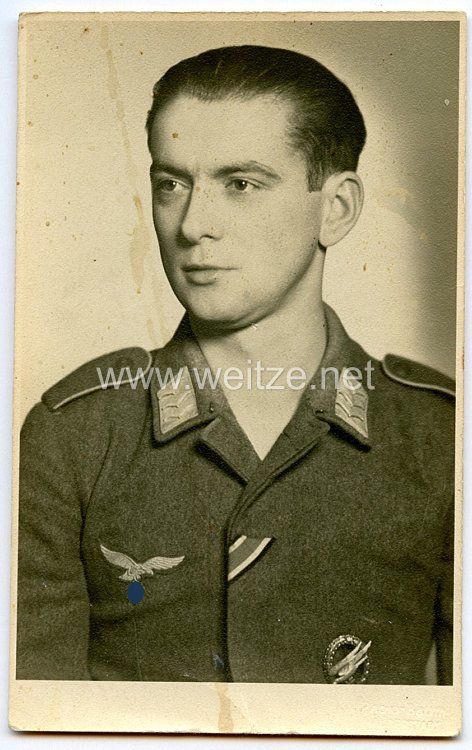
Luftwaffe Photograph, Fallschirmjäger with Paratrooper Badge

Postcard size. Condition 2.
444996
100,00

Luftwaffe Photograph, Fallschirmjäger with Paratrooper Badge

This postcard-sized photograph depicts a member of the German Fallschirmjäger (paratroopers) during World War II, identifiable by his Fallschirmschützenabzeichen (Paratrooper Badge). Such photographs document one of the most elite and simultaneously controversial units of the Luftwaffe during the Second World War.

The Paratrooper Badge was instituted on November 5, 1936, by Hermann Göring, Commander-in-Chief of the Luftwaffe. It was one of the most coveted awards of the German armed forces and could only be awarded after successful completion of paratrooper training and at least six jumps. The badge features a golden eagle in a diving position, surrounded by a silver oak leaf wreath, and was worn on the left breast of the uniform.

The German paratroopers, also called “Green Devils” by their opponents, were originally established in 1935/36. They were subordinate to the Luftwaffe rather than the Army, which organizationally distinguished them from other infantry units. Training was extraordinarily rigorous and included not only parachute jumping but also intensive combat training, as paratroopers had to fight as light infantry without heavy weapons after landing.

The first major deployments of the paratroopers occurred during the Western Campaign of 1940, particularly in the capture of the Belgian fort Eben-Emael on May 10, 1940. This spectacular success made the paratrooper force world-famous. Further successful operations took place in the Netherlands and the capture of the Moerdijk bridge.

The most famous and simultaneously most costly operation was the Battle of Crete in May 1941, Operation Mercury. Although the island was ultimately conquered, the paratroopers suffered such severe losses (over 4,000 killed) that Hitler never again authorized major airborne operations. From that point on, the paratroopers were predominantly employed as elite infantry.

The paratroopers' uniform differed significantly from the regular Wehrmacht uniform. They wore the characteristic Knochensack (bone sack), as the paratrooper helmet was colloquially called, as well as the special jump smock, a practical overall worn during jumps. The equipment was specifically adapted to the needs of airborne operations.

Photographs like this one were frequently produced as mementos or for family members. In postcard format, they could be easily mailed. Many soldiers had themselves photographed in full uniform with their decorations, reflecting pride in their achievements and membership in the elite unit. The visible Paratrooper Badge was of particular significance, as it documented successful completion of the demanding training.

After 1941, the paratroopers fought on various fronts. Particularly noteworthy is their deployment in North Africa, at Monte Cassino in Italy in 1944, where they offered fierce resistance, and during the Ardennes Offensive. Paratrooper divisions were also involved in defending against the Allied invasion in Normandy.

From a military-historical perspective, photographs of paratroopers represent important period documents. They show not only the uniforms and equipment but also the self-perception of these soldiers. Wearing the Paratrooper Badge was associated with great prestige, and the paratroopers enjoyed high regard within the German armed forces.

Such photographs are today sought-after collector's items and study materials for military historians. They provide detailed insights into uniforming, the wearing of decorations, and the photographic conventions of the era. The condition grade 2 indicates a well-preserved photograph with light signs of use, which is remarkable for a document over 80 years old.