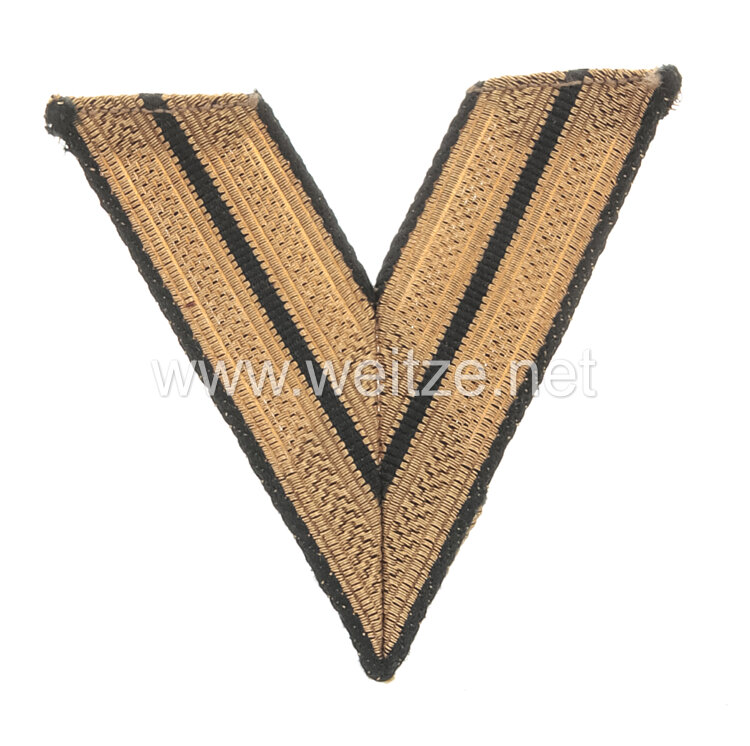
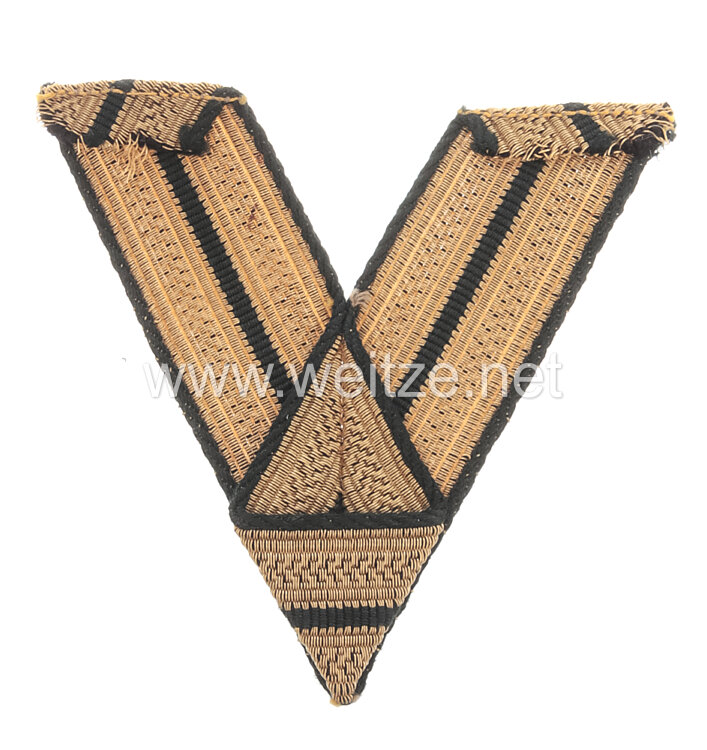
Kriegsmarine Sleeve Insignia Senior Lance Corporal (Obergefreiter) Land Units
The Kriegsmarine sleeve badge for Obergefreiter (Senior Lance Corporal) of land units represents a fascinating example of the complex rank identification system within the German Wehrmacht during World War II. This particular badge, manufactured as a Cellon chevron for the field-grey field blouse, illustrates the organizational structure of the Kriegsmarine and its land-based units between 1935 and 1945.
The Kriegsmarine, as one of the three branches of the Wehrmacht, maintained not only ship crews but also extensive land units. These included coastal artillery, naval infantry, harbor defense units, and various support formations. These land units were identified by their field-grey uniforms, which distinguished them from the dark blue uniforms worn by ship crews.
The rank of Obergefreiter represented the second enlisted rank in the German military hierarchy, above the simple Gefreiter (Lance Corporal). In the Kriegsmarine, this rank was indicated by specific sleeve badges worn on both upper sleeves of the uniform jacket. The rank insignia for Obergefreiter typically consisted of a chevron pointing downward, executed in the characteristic color of the Navy.
The use of Cellon as a material for these badges was widespread during World War II. Cellon, a celluloid-like plastic, offered several practical advantages: it was inexpensive to manufacture, weather-resistant, and easy to sew onto uniform fabric. Unlike embroidered or woven badges, Cellon chevrons were particularly popular with field units because they were more durable and easier to maintain.
The field-grey field blouse of Kriegsmarine land units generally followed the cut of Army uniforms but featured specific naval elements. This uniform variant was introduced to meet the special requirements of naval units operating on land. The coloring matched the field-grey of the Army, offering practical advantages in field deployment and improving camouflage effectiveness.
Rank identification in the Kriegsmarine was subject to strict regulations established in the corresponding dress regulations. These regulations precisely determined which badges, in what form, at which position, and with which uniform could be worn. Modified provisions applied to land units, taking into account special operational conditions.
The production of uniform badges was carried out by numerous manufacturers throughout the German Reich. During the course of the war, various simplifications and material alternatives were introduced due to material shortages and production bottlenecks. Cellon badges represented such a practical alternative, especially in the later war years when high-quality materials were needed for other purposes.
The naval infantry and coastal defense units played an important role in German warfare. They defended strategically important harbors, naval bases, and coastal sections. Particularly notable were the naval divisions formed in the final years of the war, which were deployed on various fronts. These units wore field-grey uniforms with corresponding naval rank insignia.
From a collector's perspective, such sleeve badges are important military-historical documents today. They enable the identification of uniform parts, provide information about wearing methods and manufacturing techniques, and document the complex organizational structure of the Wehrmacht. The indicated condition 2-3 suggests a well-preserved specimen showing typical signs of use but still displaying all essential characteristics.
Research into such militaria contributes to understanding the everyday reality of soldiers and illustrates the bureaucratic precision with which the Wehrmacht was organized. Every detail of the uniform, every badge had its designated meaning and place in the hierarchical system. These objects serve today as important sources for military-historical research and help paint a more complete picture of the era.
The study of rank insignia and uniform regulations provides insight into the Wehrmacht's meticulous attention to detail and hierarchy. The distinction between naval personnel serving at sea and those in land units reflected the complex nature of modern naval warfare, which required extensive shore-based support infrastructure and combat units capable of defending naval installations and participating in land operations when necessary.