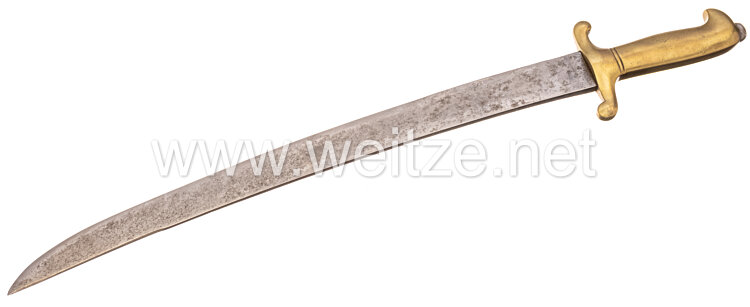
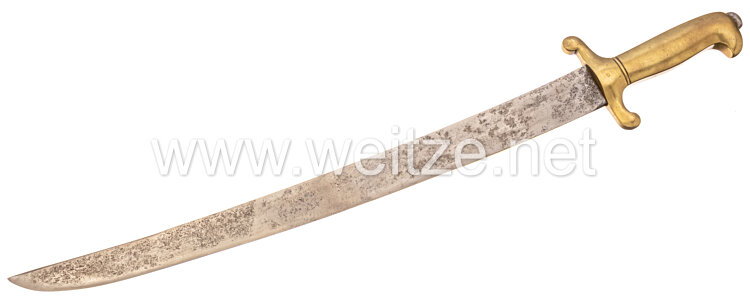
Italian Infantry Faschinenmesser (Fascine Knife) M 1843

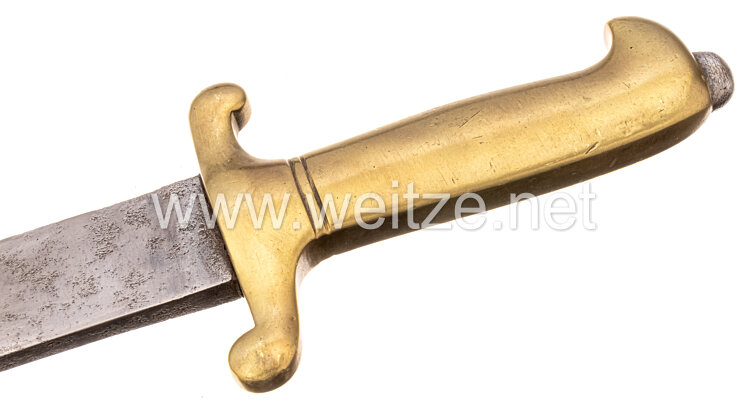
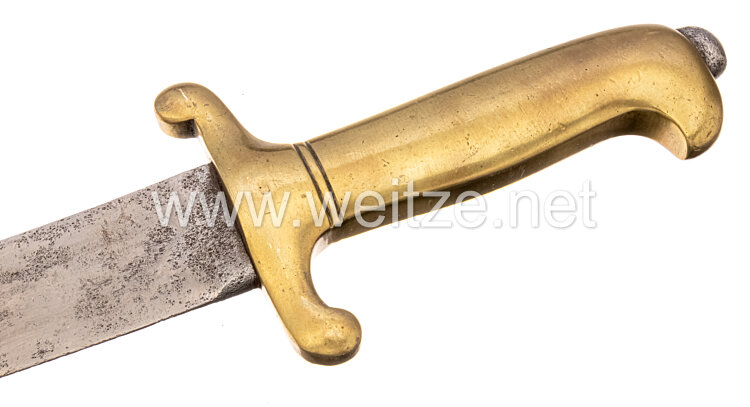
Slightly curved wedge-shaped blade without maker's mark, somewhat pitted, one-piece brass hilt with steel pommel screw, without buffer leather, without scabbard, used piece in quite good condition. Condition 2-
465296
250,00

Italian Infantry Faschinenmesser (Fascine Knife) M 1843

The Italian Infantry Faschinenmesser Model 1843 represents a significant example of Italian military equipment from the 19th century. This versatile tool embodies the European tradition of pioneer implements and served both as a weapon and as an indispensable working instrument for infantry soldiers.

In the mid-19th century, Italy was experiencing a phase of profound political and military upheaval. The Italian states, not yet unified into a single nation, maintained various armies with different equipment standards. The Model 1843 was developed during this transitional period and represents an attempt to standardize and modernize military equipment.

The faschinenmesser, also known as a pioneer knife or sword-bayonet in English military terminology, originated from the military necessity to equip soldiers with multifunctional tools. The term “faschine” refers to bundles of brushwood used in fortification construction and for crossing ditches. Soldiers equipped with such knives could cut and process these materials.

The slightly curved wedge-shaped blade of the Model 1843 is characteristic of Italian military knives from this era. This blade shape combined cutting performance with penetrating power, enabling both slashing and thrusting movements. The curvature improved efficiency when cutting wood and other materials, while the wedge shape of the blade ensured stability and durability.

The one-piece brass hilt with steel pommel screw represents the typical construction method of Italian military weapons in the 19th century. Brass was preferred for its corrosion resistance and relative economy. The steel pommel screw served both structural integrity and the ability to disassemble and maintain the weapon when necessary. These construction details demonstrate the practical approach of Italian weaponsmiths to manufacturing military equipment.

The absence of maker's marks on the blade is not unusual for weapons from this period. Many Italian military weapons were produced by various regional manufactories, and not all manufacturers consistently marked their products. In the 1840s, numerous weapon producers existed in Italian states such as the Kingdom of Sardinia-Piedmont, the Kingdom of the Two Sicilies, and other territories.

The military function of the faschinenmesser was multifaceted. Infantry soldiers used it in constructing field camps, erecting fortifications, clearing paths, and various other pioneer-like tasks. In combat, it could serve as a close-quarters weapon, although this was not its primary function. The versatility of such tools made them an indispensable component of infantry equipment.

The Model 1843 was introduced during a significant historical period. The 1840s were characterized by growing nationalist consciousness in the Italian states. The Revolutions of 1848, which also affected Italy, led to military conflicts in which such equipment items were deployed. During the First Italian War of Independence (1848-1849) against Austria, Italian soldiers carried weapons and equipment of this type.

The construction and design of the Model 1843 show the influence of French military tradition on the Italian armies. France was considered the leader in military affairs in the 19th century, and many Italian states modeled themselves on French examples. The curved blade and brass grip design show similarities to French briquet sabers and pioneer tools.

With the Unification of Italy between 1859 and 1871 under the leadership of the Kingdom of Sardinia-Piedmont, the various armies of the Italian states were gradually integrated into the new Italian army. This led to further standardization of equipment, and older models like the Faschinenmesser M 1843 were gradually replaced by newer designs or continued to be used until they wore out.

The present specimen, worn and without original scabbard and buffer leather, shows clear signs of use. The blade described as “somewhat pitted” indicates intensive use, which was quite common for tools of this type. The loss of the scabbard is frequent with historical militaria, as leather and similar materials fall victim to weathering over the decades.

Today, Italian faschinenmesser of the Model 1843 are sought-after collector's items that represent an important aspect of Italian military history. They document not only the technical development of military tools but also the complex history of Italian unification and the military traditions of the various Italian states before the formation of the nation-state.