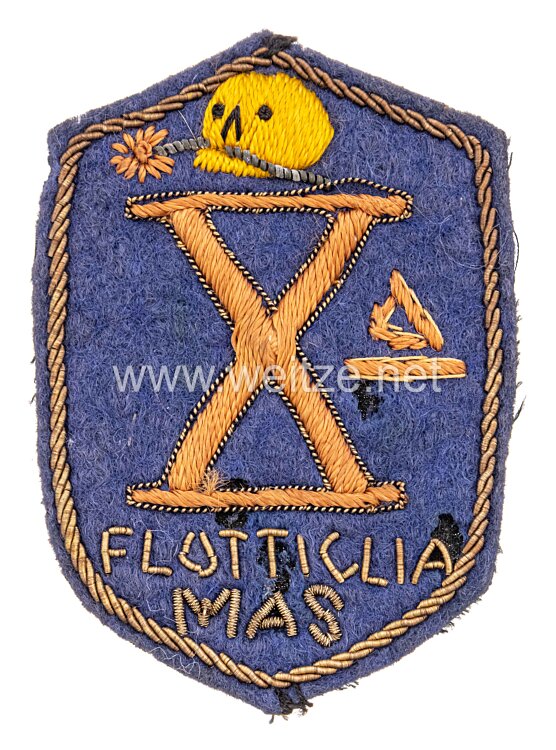
Italy World War II RSI from 1943: Sleeve Insignia for Officers of the "Xa Flottiglia MAS"

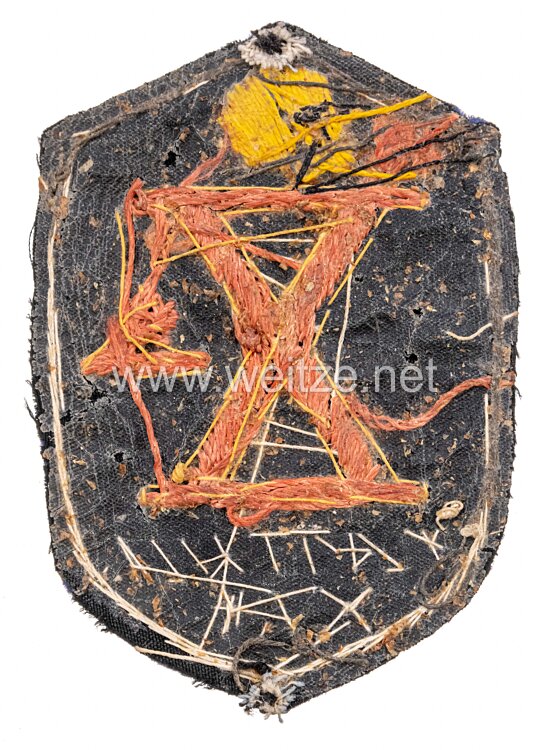
circa 1944. The sleeve shield is of classic manufacture, hand-embroidered on dark blue cloth. Clearly worn, condition 2. Extremely rare.

The Decima Flottiglia MAS (English: Tenth MAS Flotilla) was a special operations unit of the Italian Navy in World War II.

The abbreviation MAS typically stood in the Navy for Motoscafo Armato Silurante, a motor torpedo boat type equipped with torpedoes that was deployed with various MAS flotillas. However, the 10ª Flottiglia MAS was a cover name, as the unit was primarily equipped with explosive boats and manned torpedoes. In this case, MAS also stood for mezzi d'assalto or special assault craft.


After the Armistice of Cassibile and the subsequent occupation of Italy by German troops, a traumatic split of the flotilla occurred in September 1943. In the Italian Social Republic under German protection, a large formation designated as Xª Flottiglia MAS under Junio Valerio Borghese continued fighting alongside the Wehrmacht until the end of the war. Borghese concluded an agreement with German authorities that granted the Xª MAS extensive autonomy under German supreme command. Over the following months, the formerly small special operations unit grew into a large formation of approximately 18,000 men that operated almost exclusively on land. It consisted of 14 infantry battalions, three artillery detachments, one engineer battalion, and several smaller support units. Additionally, there were the remaining special forces, whose surface and underwater units were stationed in La Spezia and Genua.
465396
2.500,00

Italy World War II RSI from 1943: Sleeve Insignia for Officers of the "Xa Flottiglia MAS"

The sleeve insignia of the Xa Flottiglia MAS from the period of the Italian Social Republic (RSI) represents one of the most complex and controversial chapters in Italian military history of World War II. These hand-embroidered badges on dark blue cloth were characteristic insignia of an elite unit that underwent a dramatic transformation after the Armistice of Cassibile in September 1943.

The Decima Flottiglia MAS (Tenth MAS Flotilla) was originally founded in 1941 as a special unit of the Italian Royal Navy. Under the command of Junio Valerio Borghese, a corvette captain in the Italian Navy, the unit developed into a highly specialized formation for underwater operations. The abbreviation MAS traditionally stood for Motoscafo Armato Silurante (armed torpedo motorboat), but served as a cover name for this unit, actually meaning mezzi d'assalto (assault craft).

In the first phase of its existence, from 1941 to September 1943, the Xa Flottiglia MAS conducted spectacular maritime operations. The unit was equipped with innovative weapons, including manned torpedoes called Maiali (Pigs) and explosive motorboats. Their most notable operation was the attack on Alexandria harbor in December 1941, in which two British battleships were severely damaged. These maritime successes established the unit's legendary reputation.

The Armistice of Cassibile on September 8, 1943, marked a turning point in Italian history and that of the Xa Flottiglia MAS. When the Italian government under Marshal Pietro Badoglio concluded a separate peace with the Allies, the unit faced a fateful decision. Commander Borghese chose to continue fighting under German protection in the newly proclaimed Italian Social Republic (Repubblica Sociale Italiana, RSI) under Benito Mussolini.

The sleeve badges from this period, such as the described example from circa 1944, differ fundamentally in their significance from those of the royal phase. They symbolize membership in a unit that had dramatically departed from its original purpose. From the small, highly specialized maritime elite unit of about 500 men, a large formation of approximately 18,000 men developed under the RSI, primarily involved in land operations.

The RSI-phase structure comprised 14 infantry battalions, three artillery detachments, one pioneer battalion, and numerous support units. Only a small part of the formation retained the original maritime specialization, with surface and underwater units stationed in La Spezia and Genoa. Borghese had negotiated an agreement with German authorities that guaranteed the Xa MAS remarkable autonomy under German supreme command.

The hand-embroidered execution of officers' sleeve badges on dark blue cloth corresponded to Italian military traditions. Unlike enlisted ranks' badges, which were often machine-made, officers' badges were typically hand-embroidered in higher quality. The dark blue cloth referenced the unit's maritime origins, although it was increasingly involved in land operations during the RSI phase.

The unit operated mainly in Northern Italy, particularly in the regions of Liguria, Veneto, and along the Adriatic coast. Their duties included combating partisan units, coastal defense, and occasionally regular combat operations against Allied forces. Participation in anti-partisan operations remains particularly controversial historically, as these missions were often associated with war crimes and reprisals against the civilian population.

The military equipment and uniforms of the Xa Flottiglia MAS in the RSI phase showed a mixture of Italian and German influences. While the unit formally remained part of the RSI armed forces, it often received German weapons and equipment. However, the badges and insignia emphasized Italian identity and the unit's tradition.

The end of the Xa Flottiglia MAS came in April 1945 with the collapse of the Italian Social Republic. Borghese attempted to surrender his unit intact to the Allies, which only partially succeeded. Many members of the unit were interned, some fled, others were executed by partisans. Borghese himself was initially arrested but later released.

The historical assessment of the Xa Flottiglia MAS remains controversial to this day. While the maritime operations of 1941-1943 are recognized as militarily impressive achievements, the unit's role in the RSI phase is highly problematic. Its involvement in anti-partisan operations and loyalty to the fascist regime have made the unit a symbol of Italy's memoria divisa (divided memory) of World War II.

Sleeve badges like the one described are today extremely rare collector's items that are significant not only from a military-historical perspective but also as testimonies to a tragic period in Italian history. They document Italy's division after 1943 and the difficult decisions Italian soldiers faced during this time.