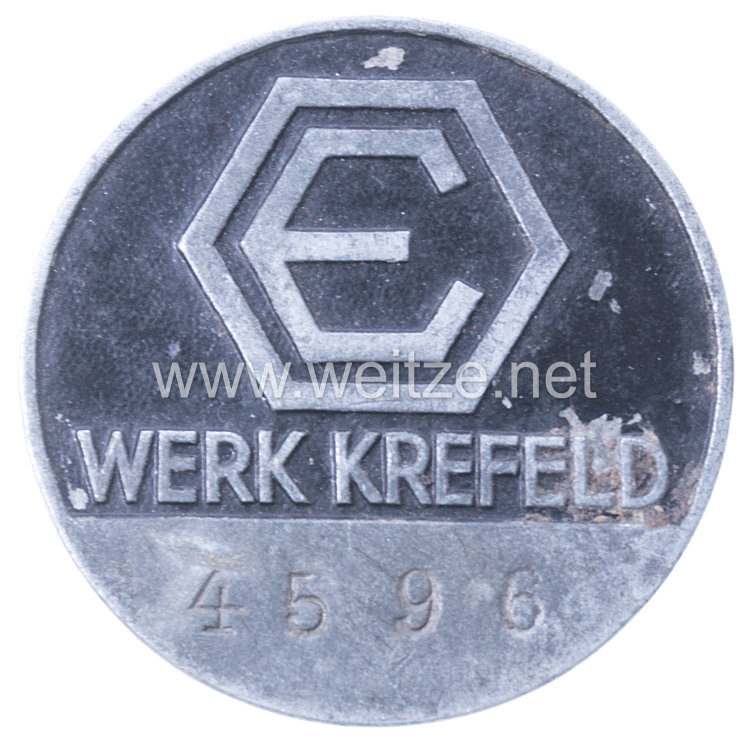
The works badge for civilian employees of Deutsche Edelstahlwerke AG (DEW) represents a fascinating chapter in German industrial history during World War II. These badges were issued to civilian workers employed in the company's war-essential production facilities, particularly at the Krefeld plant.
Deutsche Edelstahlwerke AG was formed in 1926 through the merger of several steel mills and quickly developed into one of Germany's most important producers of high-quality steel products. With the Nazi seizure of power in 1933 and the increasing rearmament of the Wehrmacht, the company gained considerable strategic importance. Under the leadership of Walter Rohland, an influential board member, armaments production was massively expanded.
During World War II, DEW produced war-critical materials and equipment: armor plating for tanks, gun barrels, shells, steel helmets, and other military equipment. The quality of the special steel produced by DEW was crucial to the German armaments industry, as modern armor and weapons required special metallurgical properties.
The works badges themselves served multiple purposes. Primarily, they were proof of identification that granted wearers access to strictly guarded factory premises. The embossed identification number allowed for unambiguous identification of each individual employee. In times of strict security regulations and total war, control over persons with access to war-essential facilities was of highest priority.
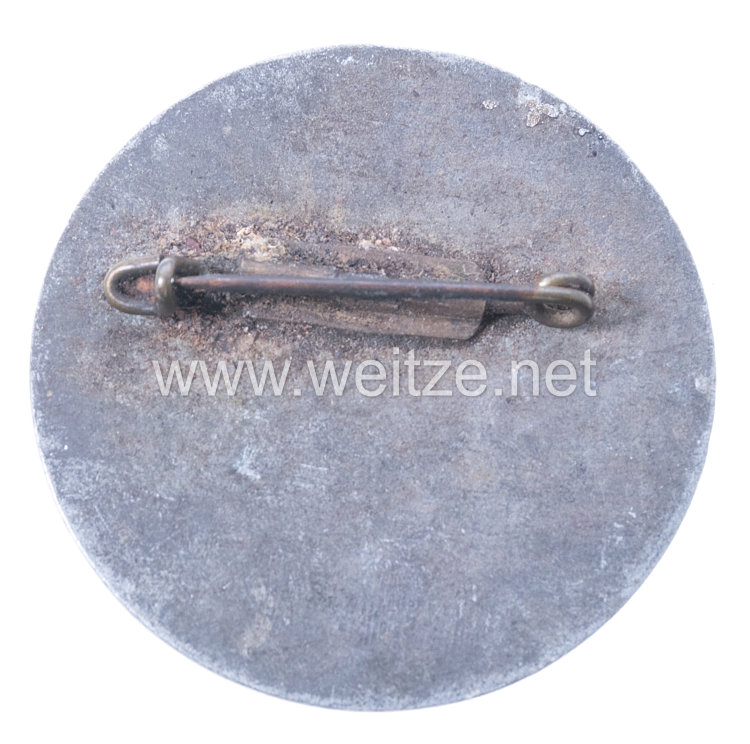
The technical execution of these badges reflects the resource scarcity of wartime. The described example is made of zinc, a material frequently used in the war industry as a substitute for more valuable metals such as brass or bronze. The partial lacquering likely served both aesthetic and preservative purposes. Attachment by pin was typical for badges of this type and enabled daily putting on and taking off.
The dark side of this production must not be concealed: DEW employed forced laborers and concentration camp prisoners on a large scale. The Neubrücke concentration camp subcamp near Hoppstädten-Weiersbach is a documented example of this inhumane practice. There, prisoners were forced to work in armaments production under catastrophic conditions. The connection between civilian plant management, represented by wearers of such badges, and the system of forced labor raises complex questions about responsibility and complicity.
Walter Rohland, who became known after the war as the “tank blacksmith,” played a key role in integrating DEW into the National Socialist war economy. His career illustrates the close intertwining of industry and the Nazi regime. After 1945, he nevertheless became an important figure in rebuilding the German steel industry.
The plant in Krefeld was one of several DEW production sites. The city on the Lower Rhine had a long tradition in the metal industry and offered both infrastructural advantages and skilled workers. During the war, the plant was repeatedly targeted by Allied bombing raids, which temporarily impaired production.
Today, such works badges are important historical artifacts that provide insights into the organization of the German war economy. The “worn condition” of the described piece – with signs of use and possibly worn lacquering – makes it an authentic testimony to the daily reality of a civilian employee in the armaments industry. Each of these badges tells the story of a person who was part of this system, whether from conviction, economic necessity, or compulsion.
The historical evaluation of such objects requires differentiation. They are neither glorifying memorabilia nor mere curiosities, but material witnesses of a complex and often tragic history. Their preservation and scientific documentation is important for understanding the total mobilization of German society in World War II and the mechanisms that bound millions of people into war production.
The existence of individual identification numbers on these badges also illustrates the bureaucratic thoroughness that characterized the Nazi state even in its industrial operations. This systematization was typical of the regime's approach to controlling both military and civilian aspects of the war effort, reflecting a society organized entirely around the demands of total war.