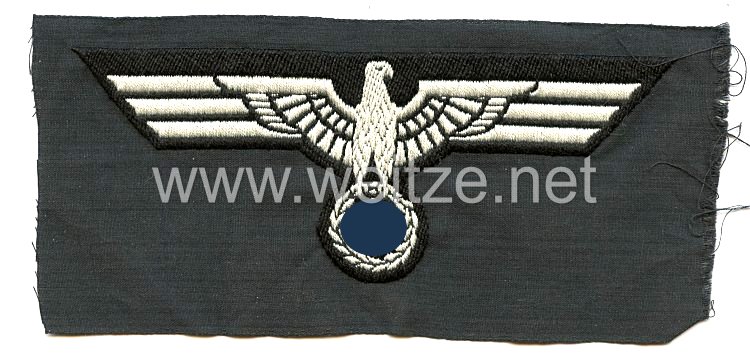
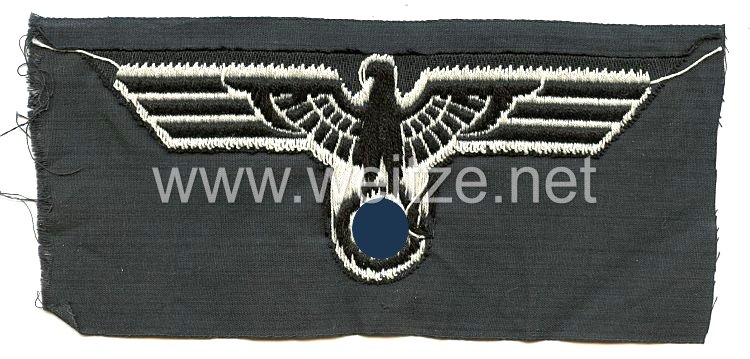
Wehrmacht Heer Breast Eagle for Enlisted Men Panzer Troops
The Wehrmacht Heer Brustadler (Breast Eagle) for enlisted men of the Panzer troops represents a significant example of military uniform insignia from the Third Reich. This badge was worn by enlisted men and non-commissioned officers of the German armored forces during World War II and embodies the iconographic elements of National Socialist military symbolism.
The present version displays a white eagle on a black background in the characteristic BeVo weaving technique. BeVo was the abbreviation for Bandweberei Ewald Vorsteher from Wuppertal-Barmen, a company specialized in producing woven textile badges. This technique enabled mass production while maintaining high detail accuracy and durability. Unlike embroidered variants, woven eagles were more cost-effective to manufacture and therefore particularly suitable for enlisted ranks.
The 1st Model of the breast eagle was introduced in 1935 when the Wehrmacht was officially founded, replacing the Reichswehr. Different branches of service were distinguished by the background color: while infantry used a field-gray or dark green background, members of the Panzer troops wore the eagle on a black background - the characteristic color of the armored forces. This coloring corresponded to the black uniform worn by tank crews, a practical choice due to the oil-stained working environment inside tanks.
The eagle itself followed the National Socialist national emblem: a stylized imperial eagle with spread wings, clutching a swastika in its talons. The eagle's rightward gaze (heraldically speaking) was characteristic of Wehrmacht insignia and distinguished it from the leftward-facing eagles of the SS and other party organizations. This national emblem was worn on the right breast side of the field tunic, above the breast pocket.
Regulations for wearing the breast eagle were precisely defined in the Heeresdienstvorschrift (Army Service Regulation). From 1935 onwards, wearing it was mandatory for all army members. The position on the uniform was exactly specified: approximately 14-15 centimeters below the shoulder seam, centered over the right breast pocket. Enlisted men and non-commissioned officers without portepee used the woven variant, while officers often wore hand-embroidered eagles of superior quality.
The Panzer troops themselves held special significance in Wehrmacht military strategy. Developed according to theories by Heinz Guderian and other proponents of armored warfare, they played a central role in Blitzkrieg tactics. The fast-moving armored units were meant to break through enemy lines and achieve deep penetrations into enemy rear areas. This revolutionary tactic led to early German successes in Poland in 1939 and France in 1940.
Production of uniform insignia during the war was subject to various rationalization measures. While high-quality materials were still used at the beginning of the war, material shortages increasingly forced the use of substitute materials. However, BeVo-woven badges remained in production throughout the entire war, as the weaving technique was material- and labor-efficient.
Authentication of such badges today requires detailed knowledge of manufacturing techniques, materials, and details. Experts examine the weaving density, color intensity, eagle proportions, and the type of backing. Original BeVo eagles show characteristic weaving features that are often missing or executed differently in reproductions.
After 1945, wearing National Socialist symbols was prohibited in Germany. Criminal Code ยง86a forbids the use of symbols of unconstitutional organizations, including the swastika. Exceptions exist for historical, scientific, and educational purposes. Militaria collectors and museums may possess and display such objects provided this occurs within the framework of historical documentation.
Today, such badges have exclusively historical and museum value. They serve to document and research the military history of World War II. For military historians and uniform specialists, they are important sources for understanding the organization, hierarchy, and visual culture of the Wehrmacht. In this context, they contribute to historical education and critical examination of this era.