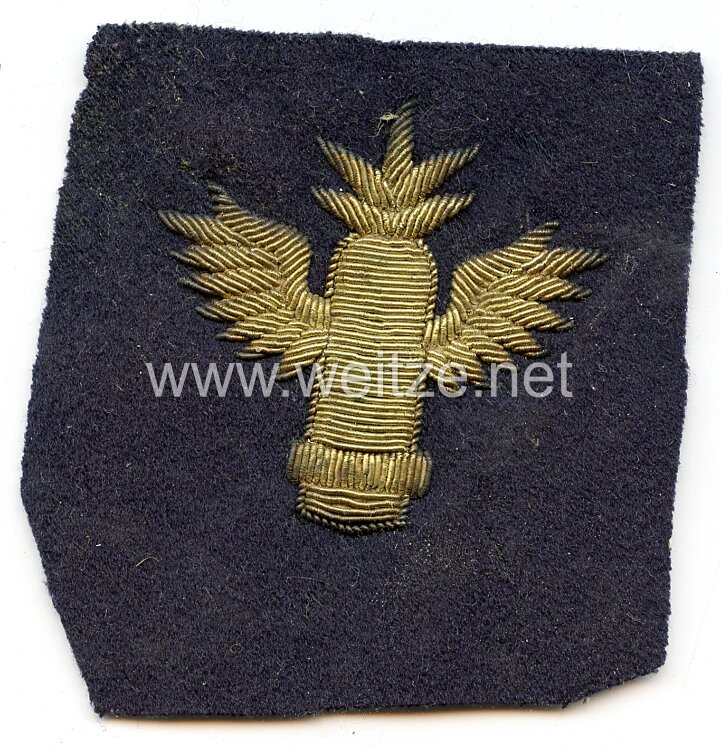
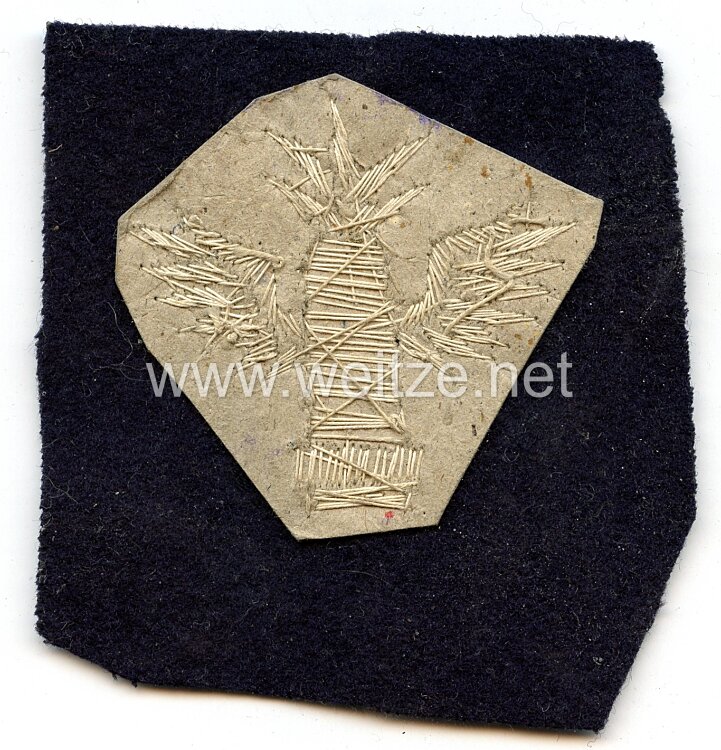
Kriegsmarine Enlisted Ranks Sleeve Insignia for Naval Artillery Career Path in Deluxe Execution (Blank)
The Kriegsmarine sleeve badge for enlisted personnel of the naval artillery career path represents a significant example of the complex uniform identification system of the German Navy during World War II. These special badges, particularly in the luxury version presented here, illustrate the sophisticated hierarchy and specialization within the German naval forces between 1935 and 1945.
The Kriegsmarine was officially established on June 1, 1935, when the German Reich under Adolf Hitler broke the Treaty of Versailles and publicly announced its rearmament. With the renaming of the Reichsmarine to Kriegsmarine began a comprehensive reorganization and expansion of German naval forces. Part of this reorganization was a detailed system of uniform regulations and insignia that clearly identified the rank, career path, and specialization of every naval serviceman.
The sleeve badges (also called trade badges) were worn on the blue uniform and indicated the professional career path of the wearer. The present badge for the naval artillery career path identified enlisted ranks who served in the field of ship artillery and gunnery. Naval artillery encompassed all guns and weapons aboard warships, from light anti-aircraft guns to heavy naval guns on battleships and cruisers.
The luxury version differed significantly from the standard version. While regular sleeve badges were machine-made or manufactured from simple cloth, the luxury variant was distinguished by hand embroidery with metal thread. These high-quality badges were purchased privately from specialized craftsmen and were not part of the official equipment. Officers and wealthier petty officers and enlisted men could afford such luxury versions to enhance their uniforms.
The term “Rohling” (blank) in this context refers to a not-yet-sewn, factory-new badge. It was manufactured by the maker without backing fabric and had to be sewn onto the uniform by the wearer or a tailor. These blanks were often sold in specialized naval outfitting shops in port cities such as Kiel, Wilhelmshaven, or Hamburg.
The blue uniform (working dress or walking-out uniform) was the standard clothing for service and representative occasions. Unlike the white tropical uniform or the field-gray land service uniform, the blue uniform was worn most frequently. The sleeve badges were typically placed on the left upper arm, approximately halfway between shoulder and elbow.
The production of such luxury badges required considerable craftsmanship. Specialized embroiderers used metal threads of aluminum or silver-plated copper to create the characteristic symbols of the respective career path. For the naval artillery career path, this was typically a crossed gun symbol or a stylized shell symbol. Hand embroidery enabled finer details and a three-dimensional effect that could not be achieved with machine-made badges.
The legal basis for these badges was found in various uniform regulations of the Kriegsmarine, particularly in the “Anzugvorschrift für die Kriegsmarine” (Uniform Regulations for the Navy), which was updated several times. These regulations precisely governed which badges could be worn where and in what form.
After the end of World War II in May 1945, all units of the Wehrmacht, including the Kriegsmarine, were dissolved. The wearing of military insignia and uniforms was prohibited by the Allies. Many uniform items and badges were destroyed, hidden, or lost in the chaos of the post-war period. Surviving examples, especially high-quality luxury versions, became sought-after military historical collectibles.
Today, such badges are important witnesses to naval history and the artisanal tradition of military outfitters. They document not only the organizational structure of the Kriegsmarine but also the social differences within the ranks of those who could or wanted to afford such luxury items. For military historians and collectors, they offer valuable insights into the daily life, hierarchy, and material culture of the German Kriegsmarine.
The condition rating of 2 indicates a well-preserved specimen showing minimal wear, making it particularly valuable for historical study and documentation. Such artifacts serve as tangible connections to a complex period of naval history and remind us of the importance of preserving material culture for future generations.