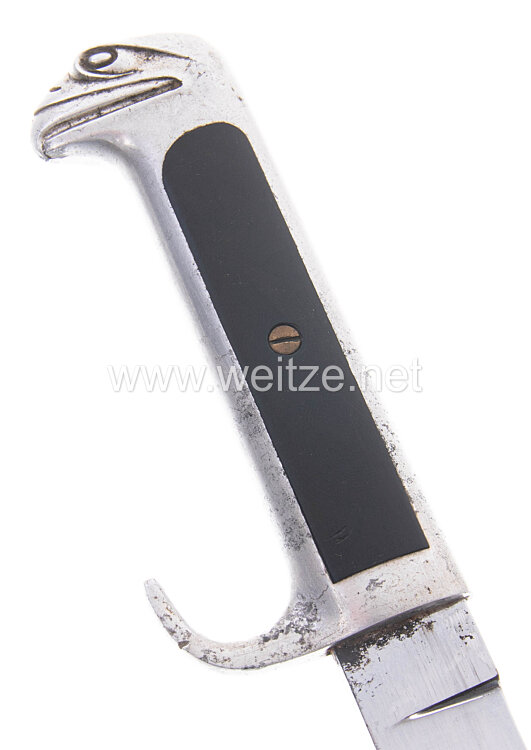
Italian Dagger for Leader of the Fascist Militia MVSN

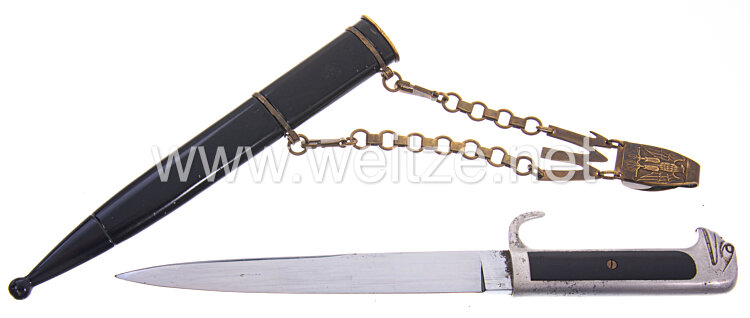
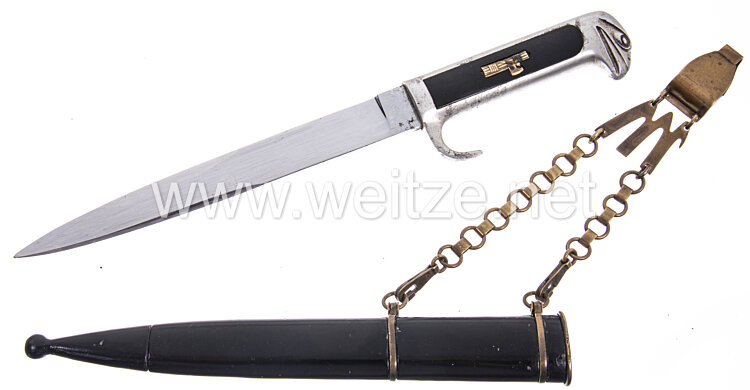
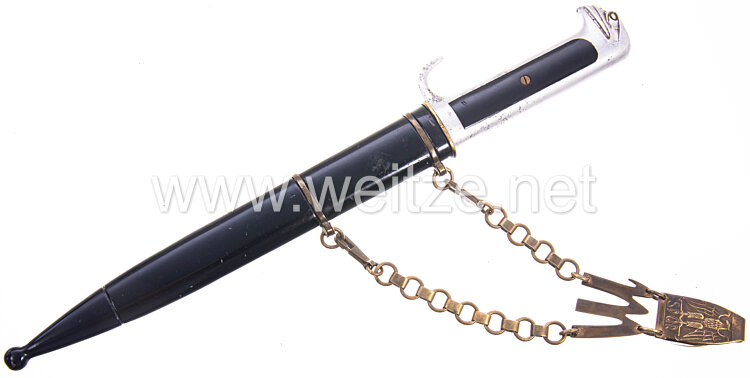
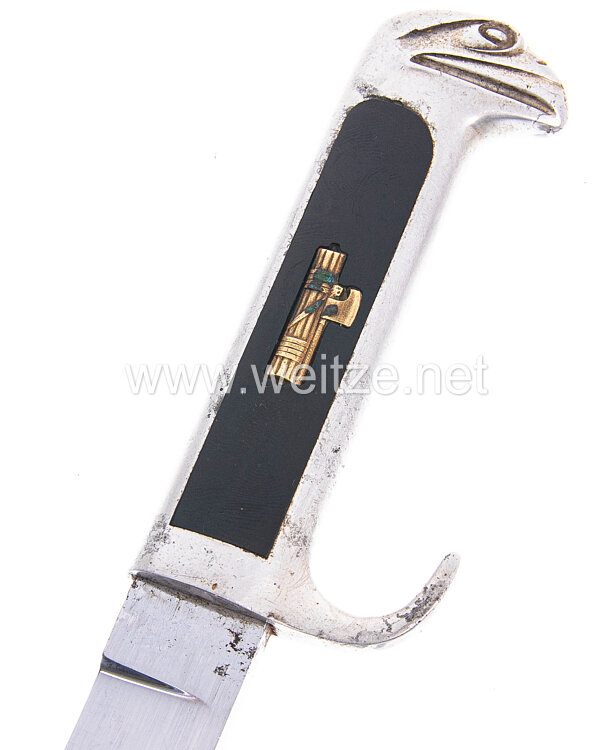
Nickel-plated wedge blade without maker's mark. Aluminum hilt with bird's head pommel, black grip scales with inlaid gilt fasces. Black lacquered scabbard, complete with chain suspension, snap hook with “SPQR” above the “M”, worn but otherwise very fine condition. Condition 2
458595
1.650,00

Italian Dagger for Leader of the Fascist Militia MVSN

The Dagger for Leaders of the Fascist Militia (MVSN) represents a significant symbol of the fascist era in Italy under Benito Mussolini. The Milizia Volontaria per la Sicurezza Nazionale (MVSN), also known as the Blackshirts or Camicie Nere, was founded in 1923 as a paramilitary organization of the Fascist Party and played a central role in maintaining fascist rule in Italy from 1922 to 1943.

The MVSN emerged from the Squadristi, the violent shock troops of the early fascist movement who played a decisive role in the March on Rome in October 1922. After Mussolini's seizure of power, the organization was formalized and transformed into a state militia directly subordinate to the Duce. The militia served both for internal security and as an ideological instrument for enforcing fascist values.

The dagger described here was a badge of distinction for leaders within the MVSN hierarchy. The design of the dagger combines several symbolic elements of Italian Fascism. The Fasces (Fascio Littorio), inlaid in gilded form on the black grip scales, was the central symbol of the fascist movement. This symbol, adopted from Roman antiquity, consisted of a bundle of rods with an axe and symbolized the power, unity, and authority of the Roman state.

The bird-head pommel made of aluminum is a characteristic feature of these dagger types and references the Roman Aquila standards of the ancient legions. The use of aluminum was typical for Italian militaria of this era, as the material was lightweight yet durable. The nickel-plated wedge blade without manufacturer's marking followed the standardized patterns prescribed for MVSN leader daggers.

Particularly noteworthy is the chain hanger with snap hook bearing the inscription “SPQR” above the “M”. SPQR stands for Senatus Populusque Romanus (The Senate and People of Rome) and was a deliberate reference to Roman antiquity. The fascist regime systematically used Roman symbolism to construct an ideological continuity between the ancient Roman Empire and modern fascist Italy. The “M” stands for Mussolini or Milizia.

The black lacquered scabbard corresponds with the color of the Blackshirts' uniforms and was a deliberate identifying mark of the organization. Black became the identity-defining color of Italian Fascism, in contrast to the brown shirts of the German National Socialists.

The MVSN was organized into various ranks and units. Leadership positions within the militia ranged from Capo Manipolo (squad leader) through Centurione (centurion) to Console Generale (general consul). The dagger was part of the equipment of this leadership level and was worn at official occasions, parades, and ceremonies.

During World War II, the MVSN fought on various fronts, including North Africa, the Balkans, and the Soviet Union. After Mussolini's fall in July 1943 and the Italian capitulation, the MVSN was officially dissolved. In the German occupation zone of Northern Italy, it was reformed as part of the Italian Social Republic (Repubblica Sociale Italiana) under the name Guardia Nazionale Repubblicana.

From a collector-historical perspective, such daggers are today important testimonies to Italian military history of the 20th century. The described condition 2 (worn but very good preservation) indicates an authentic piece that was actually used in service. The completeness of the chain hanger and the preserved gilding of the fasces make such examples particularly valuable for historical collections.

These objects serve today as material reminders of a dark period in European history and are important for the study of totalitarian regimes, their symbolism, and power structures.