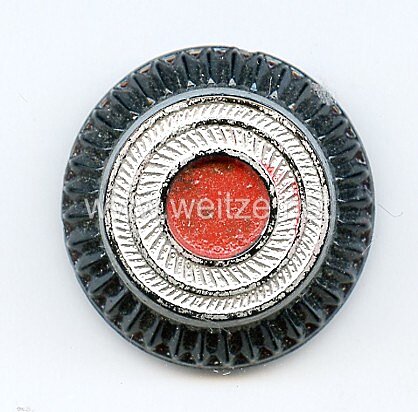
Kriegsmarine Cockade for Enlisted Men's Visor Cap

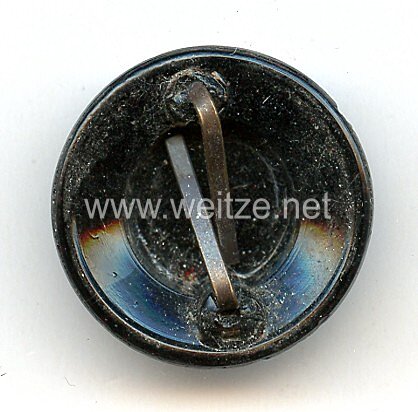
circa 1943/44. Manufactured from glass (!), color lacquered, reverse with 2 attachment prongs. Unissued, Condition 2.
451094
20,00

Kriegsmarine Cockade for Enlisted Men's Visor Cap

The Kriegsmarine cockade for the peaked cap represents a fascinating example of German naval uniforms from World War II. This particular specimen, manufactured around 1943/44, exhibits a special material composition characteristic of late-war production.

The Tellermütze (peaked cap or visor cap) formed an essential component of Kriegsmarine uniforms for enlisted ranks. The cockade, mounted centrally on the front of the cap, served as a national emblem and identified the wearer as a member of the German Navy. Traditionally, the cockade consisted of the national colors black-white-red in concentric circles, surrounded by a golden or yellow wreath.

This particular piece is manufactured from glass, which represents a remarkable peculiarity. While the early war years saw cockades made from metal, enameled or from other high-quality materials, increasing resource scarcity from 1943 onwards led to significant changes in uniform production. The use of glass as a substitute material reflects the economic constraints and material shortages under which the German Reich suffered during the final phase of the war.

The colored lacquering of the glass body enabled the representation of the required national colors, while the rear attachment with two fastening prongs ensured secure mounting on the cap fabric. This construction method was standardized and complied with the regulations of the Kriegsmarine's clothing ordinances.

The Kriegsmarine, as the naval force of the German Reich from 1935 to 1945, maintained strict uniform regulations that were defined in various service regulations and clothing orders. The cockade as a national emblem was subject to precise specifications regarding size, coloring, and placement. Different versions applied to enlisted ranks compared to non-commissioned officers and officers, who frequently wore more elaborate embroidered or metal variants.

The unworn condition of this specimen is remarkable, as most uniform items from this period were used intensively. This could indicate that the piece was either stored as a spare part or that production survived the end of the war without entering active service. The fact that it is a glass manufacture makes it a rare testament to the improvisations and adaptations of the German armaments industry in the final war years.

From 1943 onwards, the raw material situation in the German Reich deteriorated dramatically. Metals such as copper, brass, and bronze were needed as a priority for weapons production. This led to a variety of substitute materials in uniform manufacturing: synthetic fibers replaced wool, artificial leather replaced genuine leather, and as in this case, glass replaced metal. The use of glass was not entirely uncommon – it was also used for other badges and equipment items, but remained relatively rare compared to other materials.

The production of such cockades took place in various facilities that worked for the Wehrmacht and its branches. Quality control was subject to military standards, even though the materials used represented wartime compromises. The colored lacquering had to be durable and withstand the requirements of naval service, including saltwater, moisture, and mechanical stress.

For collectors and historians, such objects represent important primary sources that document the material culture and economic realities of wartime. They illustrate how the effects of war were reflected down to the smallest details of military equipment. The glass manufacture stands symbolically for the increasing pressure on the German war economy and the creative, if not always practical, solutions that were found to maintain military supply.

This cockade, in its unworn condition, provides insight into the final years of the Third Reich's military production, when even the smallest uniform components bore witness to the resource crisis. It represents not merely a uniform accessory, but a material document of the desperation and ingenuity that characterized German military production in 1943-44.