The Nation in Arms - Volume Two: The Fleet

Dachau, Der Gelbe Verlag, no date (1913), softcover, 47 + 88 pages, with numerous illustrations, softcover binding, condition 2-
467494
30,00

The Nation in Arms - Volume Two: The Fleet

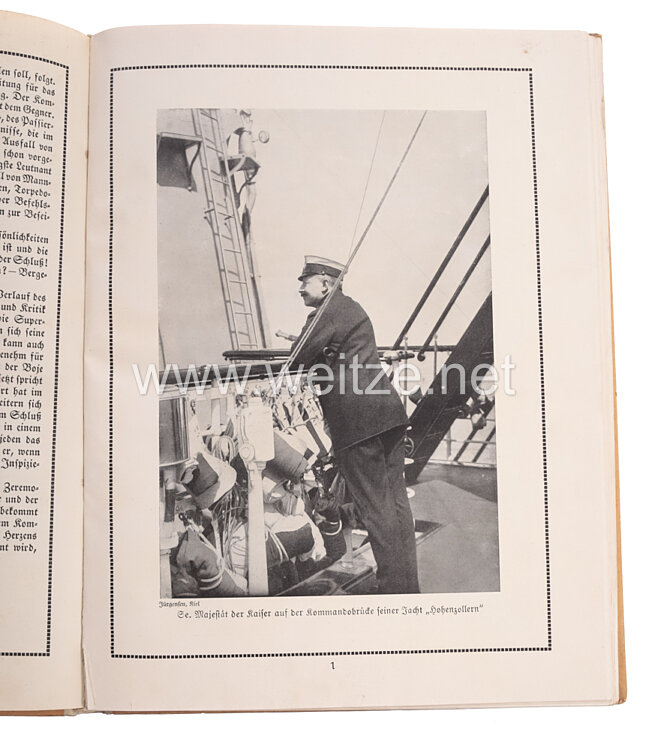
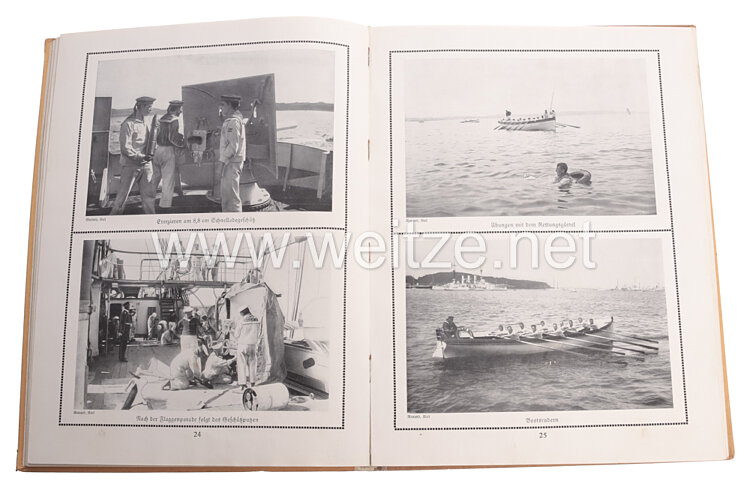
Das Volk in Waffen - Zweiter Band: Die Flotte (The Nation in Arms - Second Volume: The Fleet) is a military-historical work from the pre-World War I period, published in 1913 by the Gelber Verlag (Yellow Publishing House) in Dachau. This two-volume work documents the military state of the German Empire during a crucial phase of its history, with the second volume specifically devoted to the Imperial German Navy. Historical Context and Origins The publication year of 1913 marks a high point of German naval armament and maritime power projection under Kaiser Wilhelm II. German naval policy, significantly shaped by Grand Admiral Alfred von Tirpitz and the Naval Laws of 1898 and 1900, had led the German Empire into a costly arms race with Great Britain. “Das Volk in Waffen” appeared during a time of intense nationalist propaganda and military enthusiasm that had gripped wide segments of German society. The Gelber Verlag in Dachau was among those publishers producing popular scientific and propagandistic literature aimed at militarizing society. Such publications served to mobilize public opinion in favor of armament policies and were intended to familiarize the population with the military institutions of the Empire. Content and Structure The present work comprises 47 and 88 pages in two parts and is richly illustrated with pictorial material. These photographic and graphic representations were typical of popular military literature of the Wilhelmine era and were meant to demonstrate the technical superiority and modernity of the German Imperial Navy. The illustrations typically included photographs of battleships, cruisers, torpedo boats, and military training. Such publications typically covered the organization of the fleet, its ship classes, the training of sailors and officers, and the strategic importance of sea power for the German Empire. The title “The Nation in Arms” reflects the contemporary ideology that the entire nation must be militarily organized and ready. The Naval Policy of the Empire German naval armament was a central element of Wilhelm II's Weltpolitik (world policy). The first Naval Law of 1898 envisioned building a fleet that would make Germany the second-largest sea power after Great Britain. Admiral von Tirpitz propagated the Risk Theory, according to which a strong German fleet would deter Britain from attacking. By 1913, the Imperial Navy had expanded considerably. It possessed modern Dreadnought battleships, including ships of the Kaiser class and König class. The fleet also included numerous cruisers, torpedo boats, and submarines that would become important weapons in the coming world war. Propaganda and Militarization Publications like “Das Volk in Waffen” were part of a comprehensive propaganda campaign supporting naval armament. The German Navy League, founded in 1898, had over one million members and conducted intensive public relations work. Textbooks, magazines, postcards, and such brochures spread the message of Germany's maritime greatness. The cardboard binding and relatively inexpensive production standard indicate that the work was intended for a broad audience. It was meant to reach not only military specialist circles but the entire population and generate enthusiasm for naval policy. Collector Value and Historical Significance Today, such publications are important sources for researching the mentality history of the Empire. They document the militarization of society, the propagandistic methods of the time, and the visual culture of Wilhelmine Germany. The stated condition of “2-” (good to very good) makes this copy a valuable collector's item. For military historians, these works offer insights into the self-representation of the Imperial Navy and the manner in which military power was presented to the public. The selection of images, the language, and the thematic priorities reflect the priorities and anxieties of the time. Conclusion Only one year after this book's publication, World War I broke out, in which the Imperial Navy would play a limited role despite enormous investments. The Battle of Jutland in 1916 remained the only major naval battle, and the High Seas Fleet spent most of the war in its ports. The hopes and expectations expressed in works like “Das Volk in Waffen” would prove deceptive. Nevertheless, this publication remains a fascinating contemporary document of an era in which Germany attempted to establish its place as a world power on the world's oceans as well.