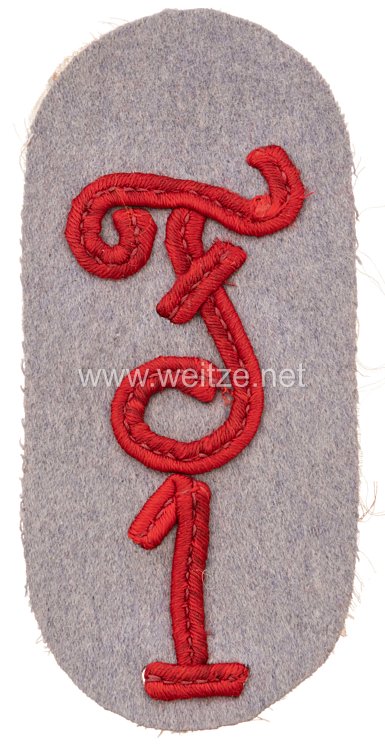
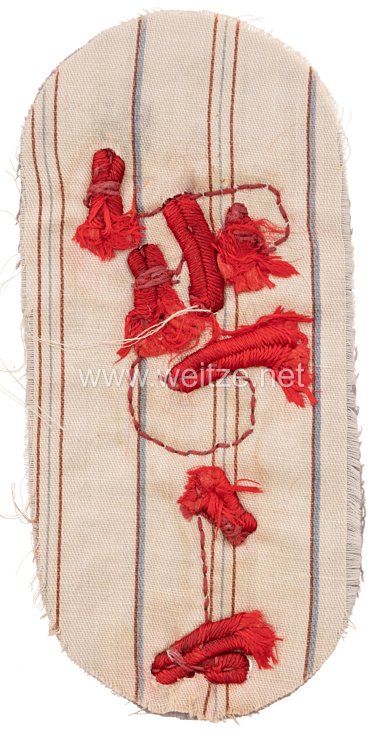
World War I Aviation Troops: Sleeve Insignia Feldflieger Abteilung 1

circa 1914. Red piping “F 1” sewn onto light gray wool backing. Lightly worn, condition 2+. Very rare.
434794
650,00

World War I Aviation Troops: Sleeve Insignia Feldflieger Abteilung 1

This sleeve insignia of Feldflieger-Abteilung 1 (Field Aviation Section 1) represents a significant artifact from the early phase of military aviation during World War I. This textile distinction embodies the emergence and development of the German aviation troops, which evolved from an experimental arm of service into a strategically decisive combat unit.

The Feldflieger-Abteilungen (abbreviated FFA or Fl.Abt.) were established as independent units of the Prussian and later German Army even before the outbreak of war in 1914. Feldflieger-Abteilung 1 belonged to the first such formations and was established already in the pre-war period. At the beginning of the war in August 1914, the German Empire possessed a total of 41 Feldflieger-Abteilungen, which were assigned to various army corps.

The sleeve insignia itself follows the military uniform regulations of that time. The red piping on light gray cloth corresponds to the color specifications for aviation troops members. The inscription “F 1” stands for “Flieger 1” or “Feldflieger 1” and identified the wearer as a member of this specific section. Such insignia were typically worn on the upper arm of the field tunic and served for quick identification of unit affiliation.

The primary task of the Feldflieger-Abteilungen initially consisted mainly of reconnaissance. With their mostly two-seater aircraft, pilot and observer conducted reconnaissance flights over enemy terrain, photographed positions, and reported troop movements. This information was of inestimable value to the army command and fundamentally changed warfare. For the first time in military history, commanders could obtain an overview of the entire battlefield almost in real-time.

During the course of the war, the range of tasks expanded considerably. The Feldflieger-Abteilungen were increasingly deployed for artillery observation, transmitting firing instructions to their own artillery. Furthermore, specialized formations such as fighter squadrons (Jastas) and bomber squadrons developed from these units.

The organization of a typical Feldflieger-Abteilung comprised approximately six aircraft as well as the associated ground personnel: mechanics, armourers, radio operators, and administrative staff. The pilots and observers were often officers or non-commissioned officers who had undergone special aviation training. This took place at flying schools such as those in Döberitz, Johannisthal, or Schleißheim.

The material culture of the early aviation troops is characterized by remarkable diversity. Besides officially prescribed insignia, numerous privately procured or locally manufactured variants existed. Sleeve insignia like the present one were partly produced by regimental tailors, but also by civilian craft businesses near the airfields. This explains the different execution qualities and material variants found in collections today.

The rarity of such early sleeve insignia results from several factors. First, they were heavily used during active service and often replaced. Second, many textile militaria did not survive the turmoil of the war and post-war period. Third, the number of members of a single section was limited, so only a manageable quantity of such insignia existed from the beginning.

From a uniformological perspective, these insignia document the transition from traditional cavalry- and infantry-dominated warfare to the modern, technology-supported warfare of the 20th century. The aviation troops rapidly developed their own identity and tradition, which also manifested itself in their material culture.

For collectors and historians, such objects offer important insights into the everyday reality of early military aviation. They complement official military history with personal and material dimensions and help to understand the lives and experiences of aviation troops members. The preservation of such an insignia in worn condition makes it an authentic witness to this revolutionary phase of military history.

r