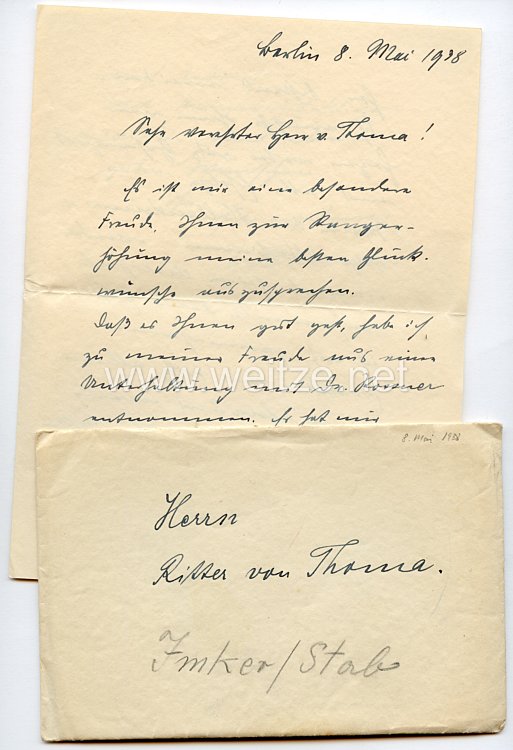
This field post letter from May 1938 addressed to Oberst Wilhelm Ritter von Thoma represents a significant historical document from the era of the Legion Condor, the German volunteer unit that fought during the Spanish Civil War (1936-1939) on the side of the Nationalist forces under General Franco.
The Legion Condor was officially established in November 1936 after the German Reich decided to provide military support to Franco. The unit comprised air force squadrons, tank units, anti-aircraft artillery, and other specialized troops. Approximately 19,000 German soldiers served in the Legion overall, with maximum troop strength at any given time reaching about 5,500 men.
Oberst Wilhelm Ritter von Thoma (1891-1948) was one of the most important tank commanders of the Legion Condor. He commanded the Panzergruppe Drohne, one of the cover designations for the German armored units in Spain. German units operated under various code names: “Imker” (Beekeeper) designated the tank troops in general, while “Drohne” (Drone) was specific to von Thoma's command. These cover names were intended to conceal German participation, as the German Reich officially maintained a non-intervention policy.
The field post system of the Legion Condor was specially organized for security reasons. Letters to and from legionnaires were not addressed directly to Spain but routed through cover addresses in Berlin. This was intended to prevent the public and foreign intelligence services from recognizing the true extent of German involvement in the Spanish Civil War. The soldiers themselves were officially designated as “vacationers” or “volunteers,” although they were regular Wehrmacht members.
The present letter dates from May 8, 1938, a time of intense combat operations in Spain. At this point, the Civil War was in a decisive phase. Republican troops had just lost their offensive in Aragon, and Nationalist forces were pushing toward the Mediterranean, which would lead to the division of the Republican zone.
Von Thoma had already gained extensive experience in Spain. He had commanded German tank units in several major operations and acquired valuable tactical insights for armored warfare that would later be applied in the German Wehrmacht. Spain served as a testing ground for new weapons and tactics, particularly for the Blitzkrieg strategy.
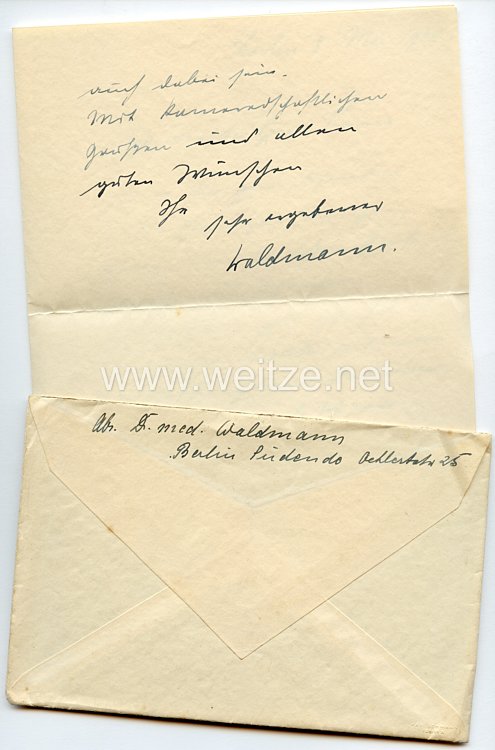
The letter itself comes from a Doctor Waldmann and contains private content. Such personal correspondence provides insight into the human side of war and shows that despite the military mission, personal connections to home were maintained. The addressing “Herrn Oberst Ritter von Thoma Imker/Stab” shows the typical use of cover designations in official correspondence.
The use of field post was of great importance for troop morale. Letter writing offered soldiers a connection to home and helped cope with the psychological stress of wartime deployment. At the same time, all letters were censored to ensure that no militarily sensitive information leaked out.
After his time in Spain, von Thoma continued his military career and commanded armored units in Poland and France during World War II, later commanding the German Afrika Korps, where he was captured by the British at El Alamein in 1942.
Documents like this field post letter are important historical sources today. They document not only the military structures and operations of the Legion Condor but also the personal experiences and networks of those involved. They help historians better understand German intervention in the Spanish Civil War and trace the development of German military doctrine in the interwar period.
The Legion Condor was officially dissolved on May 26, 1939, after Franco won the Civil War. The Legion's return home was celebrated in Germany with large parades. The experience gained in Spain flowed directly into preparations for World War II and significantly influenced the tactical and operational leadership of the Wehrmacht.