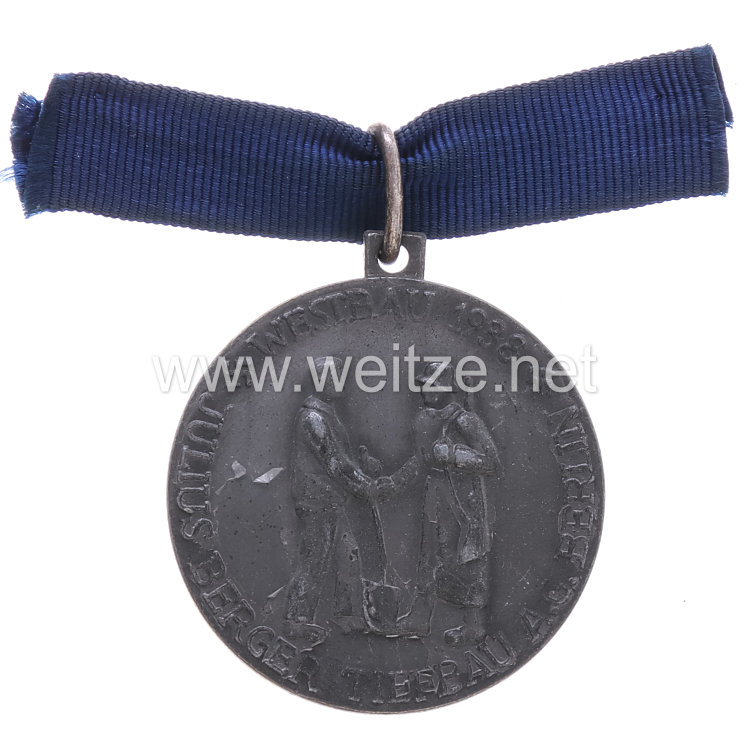
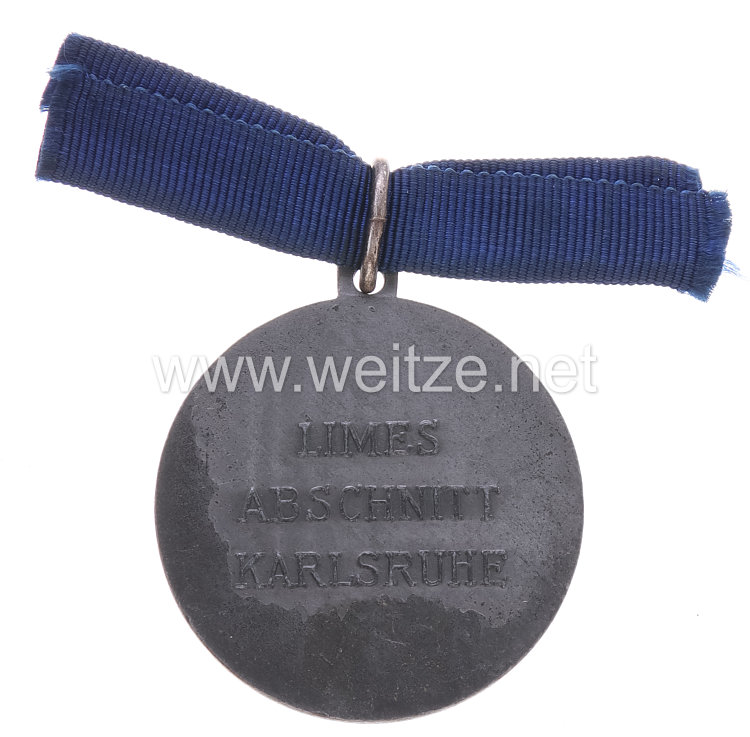
Commemorative Medal of Julius Berger Tiefbau AG Berlin Westbau 1938 "Limes Section Karlsruhe"
The commemorative medal of Julius Berger Tiefbau AG represents a fascinating testimony to German construction history and the extensive fortification works on the Westwall (West Wall) in the late 1930s. This medal, made of fine zinc with a diameter of 36 mm, was issued in 1938 to commemorate the construction work on the Karlsruhe Limes section and documents the participation of one of Germany's most significant construction companies in this monumental defense project.
Julius Berger Tiefbau AG, headquartered in Berlin, was among the leading construction companies of the German Reich and played a major role in building German infrastructure. The company, later internationally known as the Berger Group, had particularly made a name for itself in civil engineering and was commissioned for numerous large-scale projects.
The Westwall, also known as the Siegfried Line, was a defensive system approximately 630 kilometers long along Germany's western border, stretching from Kleve on the Lower Rhine to Basel on the Swiss border. Construction began in May 1938 under the direction of Organisation Todt, named after its leader, Inspector General Fritz Todt. The project was pursued with the highest priority and at times mobilized over 500,000 workers.
The Karlsruhe Limes section mentioned in the medal's inscription refers to a specific construction section of the Westwall in the Karlsruhe region. The use of the term “Limes” is noteworthy and represents a deliberate connection to the Roman border wall, the Limes Romanus, which once protected the borders of the Roman Empire. This naming was intended to suggest historical continuity and place the project within a grand historical tradition.
Such commemorative medals were issued by participating construction companies as mementos for their employees, chief engineers, and project managers. They served several purposes: on one hand, they were meant to honor work performance and strengthen team spirit; on the other, they documented the company's participation in this project, which was portrayed as nationally significant. The issuance of such medals was quite common in the German construction industry and followed a tradition dating back to the 19th century.
The choice of fine zinc as material was typical for the period. Zinc was cost-effective, easy to work with, and still allowed for detailed embossing. Unlike more precious metals such as silver or bronze, zinc could be produced in larger quantities, which was of practical importance given the presumably high mintage of such corporate medals. The diameter of 36 mm corresponds to a standard format for commemorative medals of this type.
The year 1938 marked the peak of Westwall construction activities. After the Munich Agreement in September 1938 and the associated international crisis, the project was advanced with utmost urgency. Propaganda portrayed the Westwall as the “strongest fortification wall of all time,” although it would never achieve the military significance attributed to it.
The participating construction companies such as Julius Berger Tiefbau AG benefited considerably from the large contracts. They were responsible for erecting bunkers, anti-tank barriers, dragon's teeth systems, and other fortifications. The technical challenges were considerable: massive concrete structures had to be erected in difficult terrain, extensive earthworks had to be carried out, and complex logistical problems had to be solved.
Today, such medals are important contemporary historical documents that provide insight into the economic and construction history of the Third Reich. They document the involvement of German industry in rearmament policy and preparations for World War II. For collectors and historians, they offer valuable information about the companies involved, the organization of construction work, and the self-representation of businesses during this period.
The preservation in condition 2 (very good) is remarkable and testifies to careful storage for more than eight decades. Such medals are now sought-after collector's items, not out of glorification of the era, but as material witnesses to a complex and dark epoch of German history.