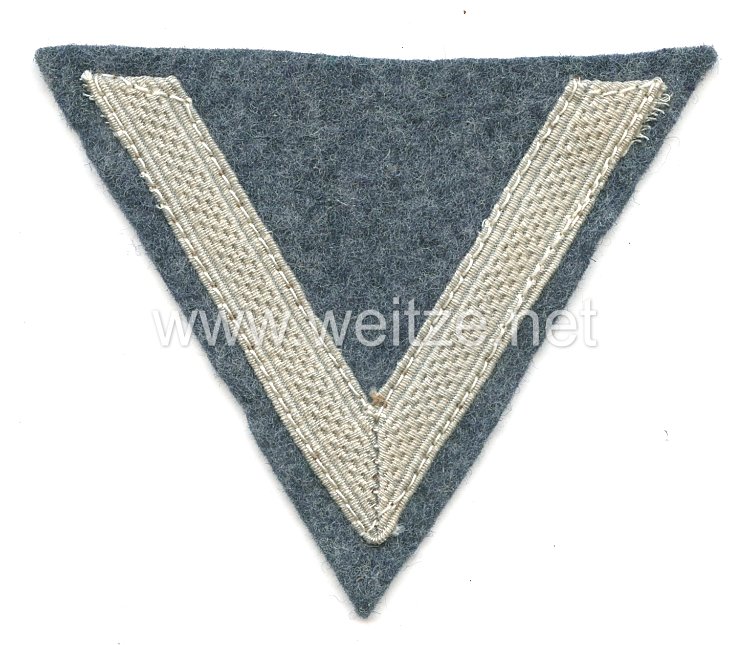
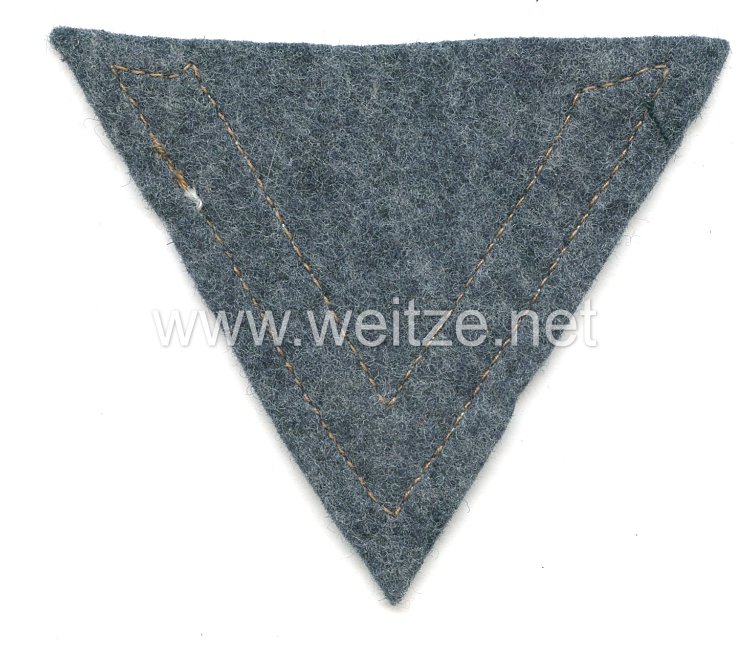
Luftwaffe Sleeve Insignia Lance Corporal

, Condition 2
338192
15,00

Luftwaffe Sleeve Insignia Lance Corporal

The Luftwaffe sleeve rank badge for Gefreiter (lance corporal) represents a significant element of military rank identification in the Third Reich. These textile rank insignia were used throughout the existence of the Wehrmacht from 1935 to 1945 and designated one of the most fundamental enlisted ranks within the German air force.

The Luftwaffe was officially founded on February 26, 1935, after the German Reich publicly announced rearmament and thus violation of the Treaty of Versailles. Under the leadership of Reichsmarschall Hermann Göring, the Luftwaffe developed into one of the most modern air forces of its time. With its establishment, a comprehensive system of rank insignia was created, based on traditional Prussian and German military conventions.

The rank of Gefreiter (literally “freed one”) has deep roots in German military history. Originally, the term designated soldiers who were exempted from certain menial duties. In the Wehrmacht and specifically in the Luftwaffe, the Gefreiter was the second enlisted rank after the basic Flieger (airman). A soldier could be promoted to Gefreiter after approximately six months of satisfactory service, representing initial recognition of his military abilities and reliability.

The sleeve badge was worn on the right upper arm of the uniform according to the Heeresdienstvorschrift (Army Service Regulation) and corresponding Luftwaffe regulations. It typically consisted of a single braided or woven chevron in silver or aluminum-colored execution on a dark blue background, the characteristic branch color of the Luftwaffe. This insignia was to be worn on all types of uniforms, including the service uniform, tunic, and flight jacket.

The production of these badges was carried out by both state and private manufacturers. Various manufacturers and textile companies produced these rank insignia according to standardized specifications. Quality could vary depending on the manufacturer and year of production, with later war years frequently showing simplification and quality reduction due to material shortages. Early examples from 1935 to 1939 are often characterized by high-quality materials and careful workmanship.

The wearing method was precisely regulated. The badge was sewn approximately 10 to 12 centimeters below the shoulder seam on the right upper sleeve. Correct positioning and proper appearance were part of military discipline and were checked during inspections. The chevron shape opened upward and was uniform for all branches of the Wehrmacht, but differed in the base color of the fabric.

In the context of the military hierarchy, the Gefreiter formed the foundation for further promotions. After Gefreiter came the ranks of Obergefreiter (senior lance corporal) and Hauptgefreiter (leading lance corporal) before the jump to non-commissioned officer ranks occurred. This graduated structure enabled differentiated performance recognition and motivated soldiers to further engagement.

The rank system of the Luftwaffe reflected the meticulous organizational structure that characterized German military forces. Each rank carried specific responsibilities and privileges, creating a clear chain of command from the lowest enlisted man to the highest officers. The Gefreiter, while still among the junior ranks, had already proven himself worthy of trust and could be assigned minor leadership tasks or specialized duties.

Today, such sleeve badges are important military-historical collectibles that provide insight into the organizational structure and rank system of the German Luftwaffe during World War II. They are valued by militaria collectors, museums, and historians as objects of study. In evaluation, factors such as condition, rarity of variant, manufacturer markings, and authenticity play an essential role. The indicated condition 2 suggests a well-preserved example with only minor signs of use.

Academic engagement with such objects requires an objective, historically-critical perspective. They serve as material witnesses of a dark epoch in German history and help to better understand the military structures and daily life of soldiers of that time, without relativizing or glorifying the crimes of the Nazi regime.