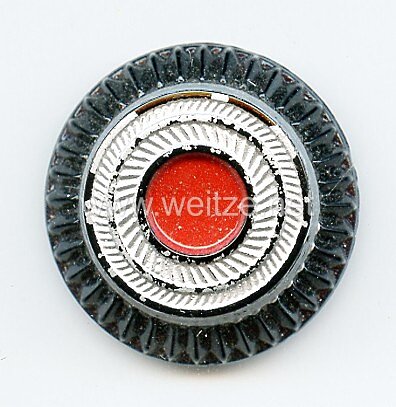
Kriegsmarine Cockade for Enlisted Men's Visor Cap

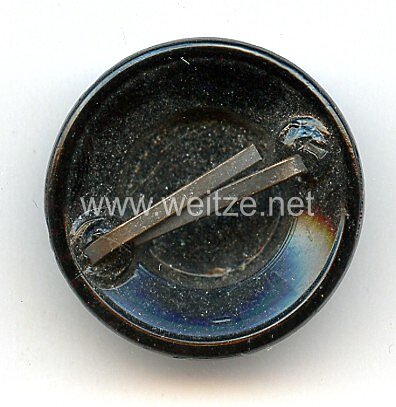
circa 1943/44. Manufactured from glass (!), color lacquered, reverse with 2 attachment prongs. Unissued condition, Condition 2.
451092
20,00

Kriegsmarine Cockade for Enlisted Men's Visor Cap

The Kriegsmarine cockade for the sailor's peaked cap represents a fascinating example of material substitution in German armament production during World War II. This particular specimen, manufactured around 1943/44 from glass and colored lacquer, impressively documents the increasing shortage of raw materials in the German Reich during the late war years.

The Tellermütze (peaked cap) was the official headgear of the Kriegsmarine for enlisted personnel and non-commissioned officers. The cockade formed the central national insignia on the cap and displayed the national colors of black, white, and red in concentric circles. According to the Dress Regulations for the Kriegsmarine of 1935 and its subsequent amendments, the cockade was a mandatory component of the uniform.

During the early war years, cockades were typically manufactured from metal, usually enameled aluminum or zinc alloys. These badges were robust, durable, and met the high quality standards of German uniform regulations. However, as the war progressed and the Allied blockade intensified, the supply situation deteriorated dramatically.

From 1943 onwards, the critical raw material situation led to drastic changes in the production of military equipment. Non-ferrous metals such as copper, zinc, and aluminum were reserved for war-critical purposes like ammunition production, aircraft construction, and U-boat manufacturing. The Reich Office for Economic Development issued numerous directives for material conservation that also affected uniform production.

The use of glass as a substitute material for uniform badges initially appears unusual but was a logical consequence of the war economy. Unlike metals, glass was available in sufficient quantities, and the German glass industry possessed highly developed manufacturing techniques. Through colored lacquering, the required national colors could be precisely represented. However, the mounting pins on the reverse still had to be manufactured from metal, as glass was unsuitable for this mechanical function.

The manufacture of glass badges required specialized production techniques. The glass first had to be formed into a round shape, the concentric rings precisely applied, and the colors applied through multiple layers of lacquer. The black center, white (silver) middle ring, and red outer ring had to correspond exactly to the prescribed proportions.

The “unworn” condition of this specimen is remarkable. Many of these ersatz material badges did not survive the war or were destroyed by war damage. The fragility of the material meant that only a few glass badges have survived to this day. This makes such pieces important witnesses to the German war economy.

The production of substitute material uniform components increased drastically in 1943/44. In addition to glass, synthetic resins, Bakelite, and pressed cardboard were also used for various uniform components. This development reflected the increasing desperation of German warfare and stood in stark contrast to pre-war quality standards.

For ordinary enlisted personnel of the Kriegsmarine, these material deteriorations meant a noticeable reduction in uniform quality. While officers could often still draw on pre-war stocks or privately procured quality badges, enlisted men had to make do with the allocated substitute materials.

From a historical perspective, this glass cockade documents the decline of the German war economy in an impressive manner. It symbolically represents the discrepancy between the propagandistic determination to persevere and the real material situation of the German Reich in the final phase of World War II. Such objects are therefore not only military-historical collectibles but important sources for researching the German war economy and armament production.

The manufacturing period of 1943/44 places this cockade in the context of Operation Overlord, the intensified Allied bombing campaign, and Germany's retreat on all fronts. The fact that glass cockades were being produced reflects the Reich's inability to maintain even basic quality standards for military uniforms, a clear indicator of impending collapse.