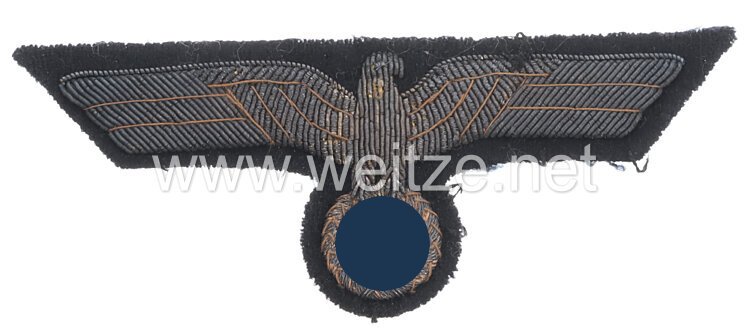
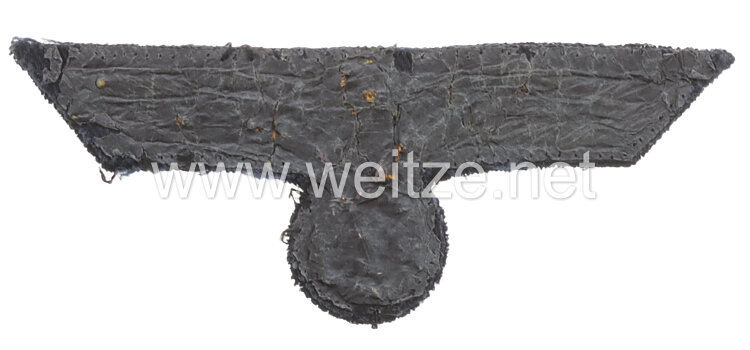
Kriegsmarine Breast Eagle for Naval Officers

Hand-embroidered metallic thread on dark blue wool, condition 2
463592
165,00

Kriegsmarine Breast Eagle for Naval Officers

The breast eagle for Naval officers of the Kriegsmarine represents a significant insignia of the German Navy during the National Socialist period. This hand-embroidered badge made of metal thread on a dark blue background embodies the maritime tradition and military hierarchy of the German naval forces between 1935 and 1945.

The Kriegsmarine was officially established on May 21, 1935, through the Reich Law on the Introduction of General Conscription, thereby replacing the Reichsmarine of the Weimar Republic. With this reorganization, new uniform regulations and insignia were introduced that aligned with National Socialist symbolism while preserving maritime traditions of the German Navy.

The breast eagle was worn on the right breast of the uniform jacket and served as the central national emblem. For officers of the Kriegsmarine, these were crafted with elaborate handiwork, with metal threads embroidered onto a dark blue background. This manufacturing method clearly distinguished the officer's version from the machine-made or woven versions for enlisted men and non-commissioned officers.

The embroidery with metal thread was traditionally executed in gold or silver tones, with naval officers frequently using a silvery shade that harmonized with maritime tradition and the Navy's colors. The craftsmanship required considerable skill and was time-consuming, intended to underscore the higher status of officers. The dark blue background corresponded to the characteristic color of the naval uniform and provided strong contrast to the light metal thread.

The eagle depiction showed the national emblem with outstretched wings and an oak wreath surrounding the symbol of that era. The precise design was regulated by various dress regulations of the Kriegsmarine, which provided detailed specifications regarding the size, shape, and placement of the badge.

Various specialized manufacturers were responsible for procuring these high-quality badges. Many of these firms had been producing military effects since the Imperial era and possessed corresponding expertise in metal embroidery. Officers typically acquired their uniforms and insignia from private tailors and outfitting shops, frequently located in major naval bases such as Kiel, Wilhelmshaven, or Hamburg.

The quality of execution varied depending on the manufacturer and price range. High-quality specimens were distinguished by particularly fine embroidery work, three-dimensional representation, and careful workmanship. The indicated condition 2 suggests a well-preserved specimen that may show signs of use but remains largely intact.

The naval officers wore these breast eagles on various uniform variants, including the dark blue service dress uniform, white summer drill uniform, and other service uniforms. The position on the right breast was precisely prescribed and had to be accurately maintained during uniform fitting.

From a historical perspective, these badges are today important witnesses to naval history and uniformology. They document the craft traditions of military effects manufacturing and provide insight into the hierarchies and symbolism of that time. For collectors and military historians, such original pieces are of particular interest as they represent authentic remnants of the Kriegsmarine.

The scholarly examination of such objects requires knowledge of manufacturing techniques, materials, and variants. Authentication can be accomplished through analysis of the embroidery work, background material, and metal threads used. Original pieces differ from later reproductions through specific characteristics in workmanship and aging patina.

In modern military-historical research, such objects serve as sources for studying the everyday history of naval officers, the material culture of the military, and the development of uniform regulations. They are part of the cultural heritage that must be examined objectively and in historical context.

r