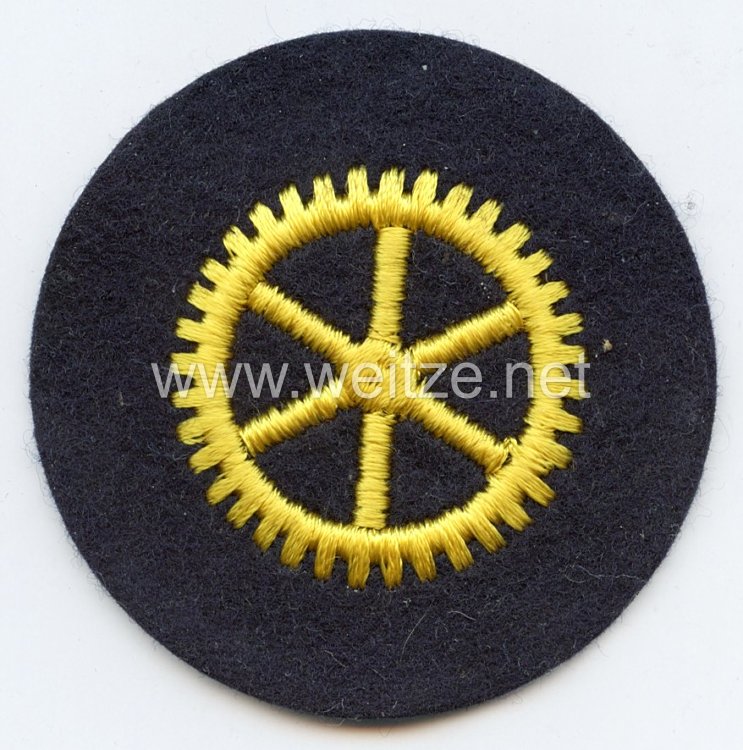
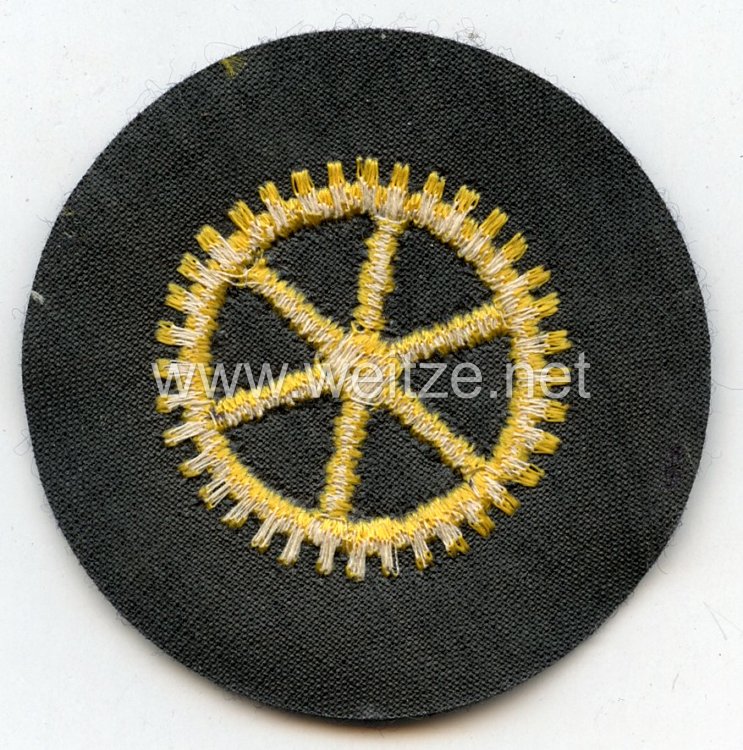
Kriegsmarine Enlisted Sleeve Insignia Machinist
The Kriegsmarine sleeve insignia for engine room personnel represents a significant example of the complex system of career and specialization identification within the German Navy during World War II. These badges served the immediate purpose of identifying a sailor's technical specialty and training level, and were an integral component of uniform regulations.
The Kriegsmarine, officially established on June 1, 1935, as the successor to the Reichsmarine, developed a comprehensive system of uniform and insignia regulations detailed in the Anzugsordnung für die Kriegsmarine (A.O.K.) or Dress Regulations for the Navy. These regulations were continuously updated and expanded to meet the growing requirements of the expanding fleet.
The sleeve insignia for machinery personnel was worn on the blue jumper, which was part of the everyday service uniform for enlisted ranks. These uniform pieces were made from dark blue wool cloth and formed the basis of working and shipboard uniforms. The machinery badges identified crew members who worked in the technical areas of a warship – in the engine rooms, maintaining propulsion systems, power supply, and other mechanical systems.
The technical training of machinery personnel was particularly intensive and demanding. Recruits designated for machinery service underwent specialized training that combined theoretical knowledge of steam turbines, diesel engines, electrical systems, and auxiliary machinery with practical experience. The Kriegsmarine's training facilities, including the Naval School Flensburg-Mürwik and various technical schools, trained thousands of specialists.
The badge itself typically consisted of an embroidered or woven symbol depicting a cogwheel or combination of cogwheel and other technical symbols. These were manufactured on dark blue base material and embroidered with light, usually silver-gray or white threads. The placement was on the right upper arm of the jumper, approximately halfway between shoulder and elbow. The precise position and design were exactly specified in the uniform regulations.
The hierarchy within machinery personnel ranged from the simple Maschinengefreiter (Machinery Able Seaman) through the Maschinenobergefreiter (Machinery Leading Seaman) to the Maschinenhauptgefreiter (Machinery Petty Officer Third Class). Different badge regulations applied to non-commissioned and commissioned officers. Machinery service personnel constituted a substantial proportion of ship crews, as the complex propulsion systems of warships, submarines, and auxiliary vessels required permanent maintenance and monitoring.
During the course of the war, millions of such badges were produced, both by military tailoring facilities and civilian suppliers. Quality varied depending on the time of manufacture and producer. Early war productions often showed finer handwork and higher quality materials, while later examples were simplified due to material shortages and time pressure.
The wearers of these badges served on all ship types of the Kriegsmarine – from the large battleships such as Bismarck and Tirpitz, through cruisers and destroyers, to the submarines of various types. Particularly in the U-boat force, machinery personnel were critically important, as the reliability of diesel and electric motors could determine the life and death of the crew.
After the war ended in 1945, these badges lost their official function. The Kriegsmarine was dissolved, and wearing its symbols was prohibited by the Allies. Today, such sleeve insignia are historical documents that provide insight into the organization, hierarchy, and daily life of German naval warfare. They are studied in museums, collections, and by military historians to better understand the structures and lives of naval personnel of that era.
The condition of such textile badges varies greatly. Factors such as storage, moisture, light exposure, and pest damage affect durability over decades. Well-preserved examples with clear embroidery and intact base fabric are rare today and of particular interest to collectors and institutions.
These insignia serve as tangible reminders of the intricate organizational structure of the Kriegsmarine and the vital role played by technical specialists in naval operations. They represent not just military hierarchy, but the recognition of specialized skills essential to the operation of increasingly complex naval vessels in the mid-20th century.