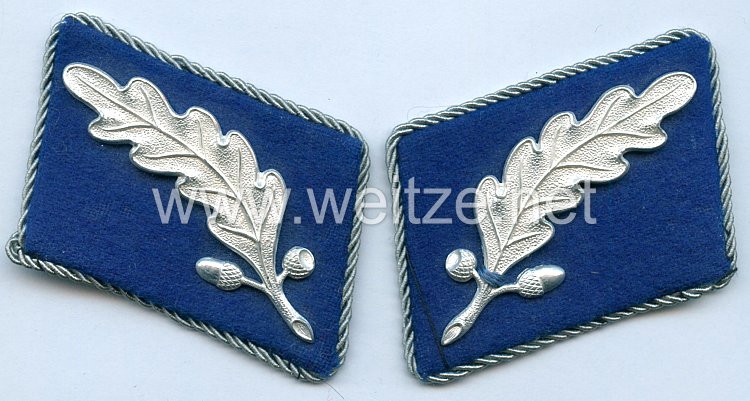
SA Pair of Collar Tabs for a Standartenführer of SA-Gruppe Hessen
The SA collar tabs for a Standartenführer of SA-Gruppe Hessen represent a significant example of rank insignia within the paramilitary organization of the Sturmabteilung (SA) during the National Socialist era in Germany. These specific collar tabs date from before 1939 and display the typical execution for a senior SA leader in the regional division of Hesse.
The Sturmabteilung, originally founded in 1920 as the security detail of the NSDAP, developed into a massive paramilitary organization. After the seizure of power in 1933, the SA grew to several million members. The organization was divided into various SA-Gruppen (SA Groups) that corresponded geographically to German regions. The SA-Gruppe Hessen was one of these regional units with headquarters in Frankfurt am Main.
The rank of Standartenführer corresponded to a colonel in the regular army and represented a significant leadership position within the SA hierarchy. A Standartenführer typically commanded a Standarte, a unit of approximately 1,000 to 3,000 men, comparable to a regiment. This rank was introduced on April 1, 1932, and remained in use until the end of the SA structure in 1945.
The described collar tabs show the characteristic oak leaf design in aluminum execution on a blue background, surrounded by a silver cord. The oak leaf motif was a traditional German symbol of bravery and strength, used in various military contexts. The coloring and design of the collar tabs were strictly regulated by the SA uniform regulations, which were first comprehensively codified in 1933.
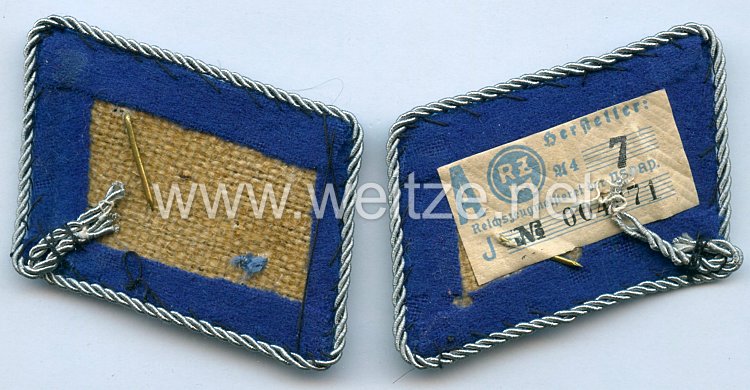
Particularly noteworthy is the presence of an RZM label. The Reichszeugmeisterei (RZM) was established in 1929 as the central procurement and inspection office of the NSDAP. From 1933 onwards, it controlled the manufacture and distribution of all party badges, uniform parts, and equipment items. The RZM system served quality assurance and the prevention of counterfeits. Manufacturers had to register with the RZM and received a specific manufacturer number. Products with RZM marking were considered officially approved.
The use of aluminum for the oak leaf embroidery was typical for SA rank insignia of middle and higher ranks. While simple SA members often wore cotton embroidery, leaders from the rank of Sturmbannführer upwards used metallic versions. The silver cord framing the collar tab was another distinguishing feature for leadership ranks.
The blue background of the collar tabs is historically significant. The various SA groups and branches used different background colors for their collar tabs to indicate regional or functional affiliation. Blue was not a standard color for all SA groups but could indicate specific periods of use or special units.
The date specification “before 1939” is relevant as it marks the end of the SA's peak phase. After the Röhm Affair of June 30, 1934, also known as the “Night of the Long Knives,” the SA lost significant political power. The SA leadership under Ernst Röhm was eliminated, and the organization was subordinated to the SS. Although the SA continued to exist and fulfilled certain functions during the war, its importance was greatly reduced after 1934.
The wear patterns and condition of the collar tabs – with one missing pin replaced by a thread – indicate actual use. This distinguishes them from pure collector pieces that were never worn. Such traces of use are of particular interest to historians and collectors as they provide evidence of authentic usage.
In military historical research, such objects serve as important primary sources for understanding the structure, organization, and visual culture of paramilitary organizations in National Socialist Germany. They document the pronounced hierarchy and rank system that the SA developed along military lines, as well as the central role of uniforming and insignia in the Nazi movement for creating identity and belonging.