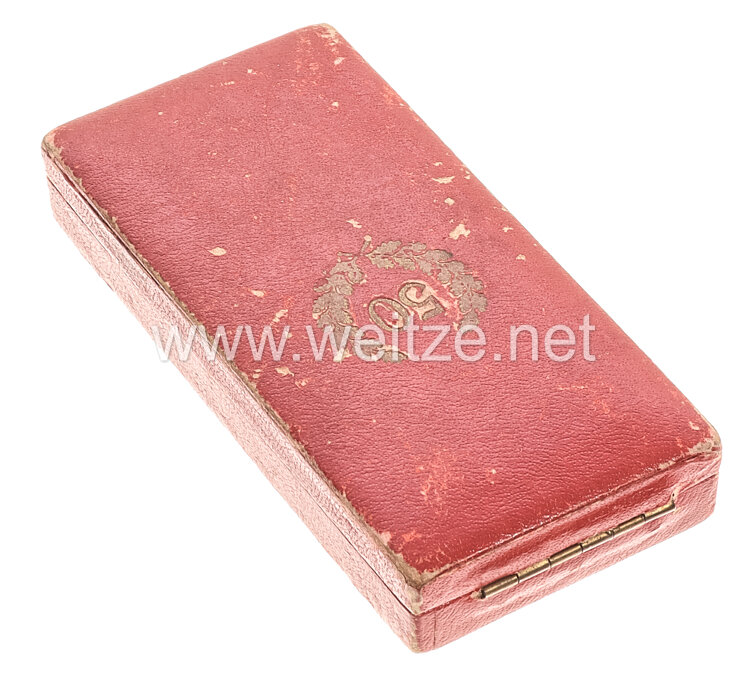
Faithful Service Award Special Grade for 50 Years
The Faithful Service Award (Treudienst-Ehrenzeichen) for 50 years represents the highest grade of a series of decorations instituted in the Third Reich to recognize long-term service in the public sector. This special grade was introduced by decree on March 1, 1939, supplementing the existing grades for 25 and 40 years of service.
The legal foundation for this award was established by the Regulation on the Faithful Service Award of March 1, 1939, published in the Reich Law Gazette. The decoration was intended to honor civil servants, employees, and workers in Reich, state, and municipal service for their decades of faithful duty. The 50-year grade was exceptionally rare, as it required half a century of uninterrupted service.
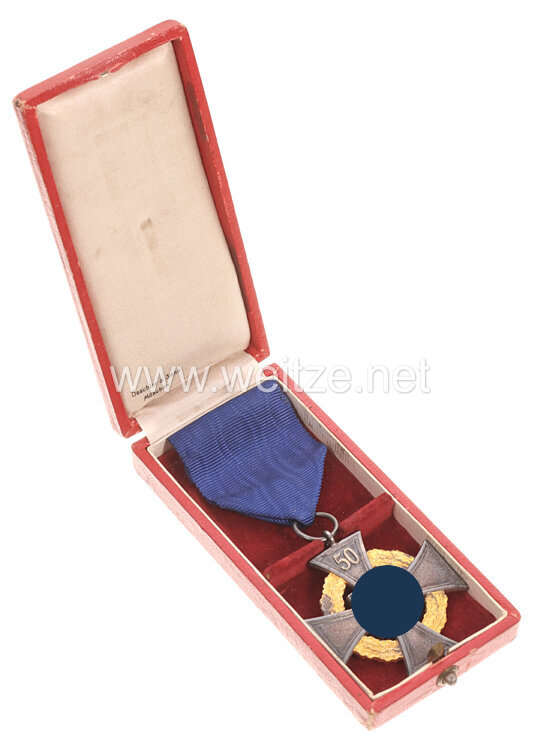
The present example was manufactured by the renowned Munich firm Deschler & Sohn, one of the most important producers of orders and decorations during the National Socialist period. The company, which had existed since the 19th century, supplied government agencies with high-quality awards and was known for its precise craftsmanship. The manufacturer's imprint in the case lining documents the authenticity and provenance of the piece.
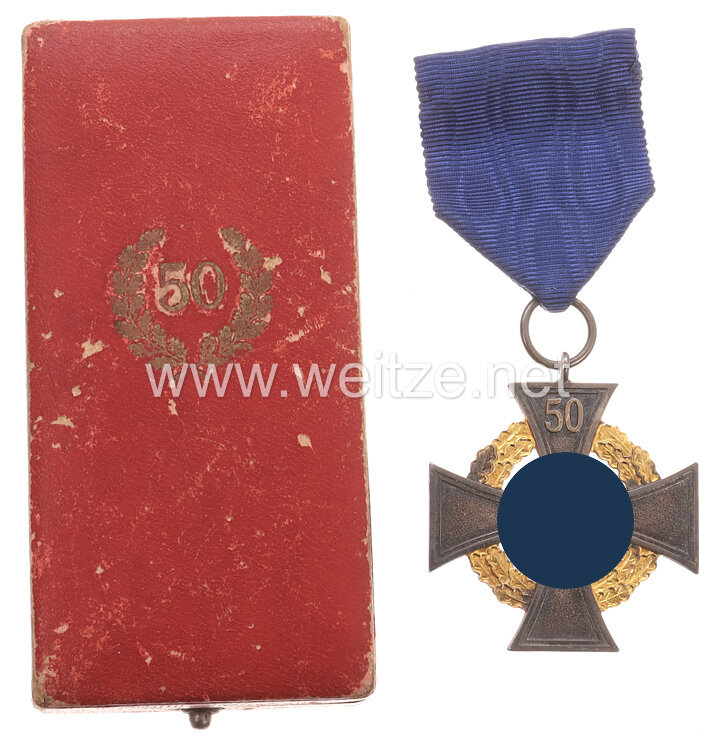
The technical execution displays the characteristic features of this special grade: the decoration consists of gold-plated base metal with partial enameling. The use of gold rather than the silver mounting of the 40-year grade underscores the special rank of this award. The design follows the typical structure of the Faithful Service Awards with the central swastika surrounded by an oak leaf wreath, a symbol that in German orders tradition represents loyalty and steadfastness.
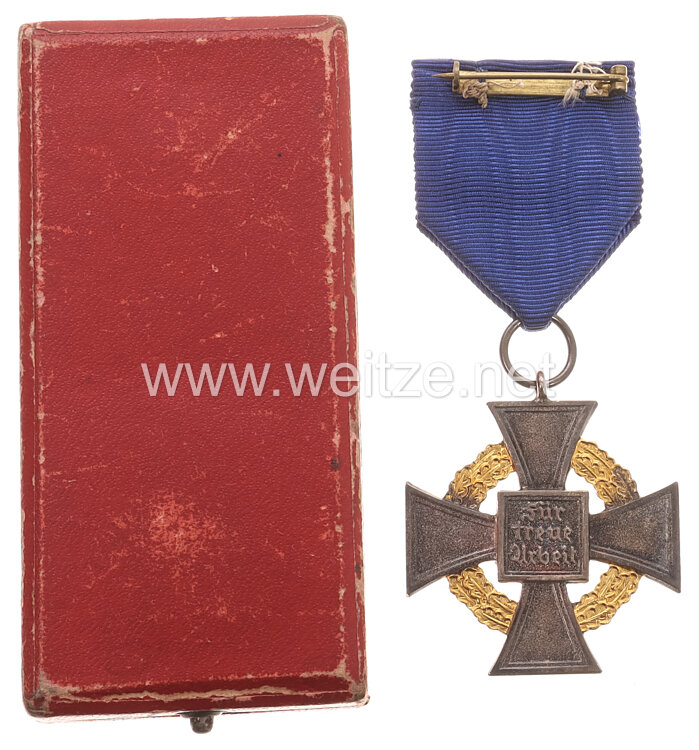
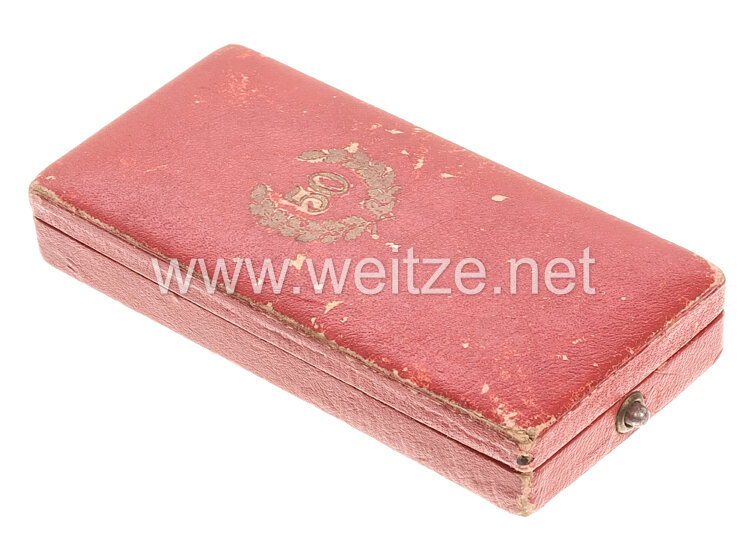
The ribbon on which the decoration was worn is attached by a pin and was sewn in place - a common practice to prevent slipping. The original case bears the imprint “50,” immediately identifying the highest grade of this award. Such cases were specially made for each grade and were part of the official presentation ceremony.
The awarding of the 50-year Faithful Service Award was subject to strict criteria. The recipient had to have not only served 50 years in public service but also demonstrate an impeccable reputation. The decoration could be awarded to both male and female civil servants, with periods of service in previous state forms (Empire, Weimar Republic) being eligible for credit.
From a historical perspective, this decoration documents the complex continuity of German administrative structures across different political systems. Many recipients of the 50-year grade had begun their careers in the Imperial era and experienced the transition through multiple state forms. This makes this award a particularly significant piece of contemporary historical evidence.
The rarity of the 50-year grade can be explained by several factors: first, the time span between its institution in 1939 and the end of the Third Reich in 1945 was relatively short. Second, only a few civil servants actually achieved 50 complete years of service. Accordingly, examples of this special grade are significantly rarer in today's collector market than the 25- or 40-year grades.
The stated Condition 2 indicates a very well-preserved example in which the gilding is largely intact and the enameling shows no significant damage. This is remarkable for an object over 80 years old that would typically show signs of wear.
From a museological perspective, the Faithful Service Award is an important document of Nazi orders practice and the honors culture of that period. It demonstrates how the regime attempted to promote loyalty and long-term commitment to the state through a graduated system of awards. At the same time, it documents the craftsmanship quality of German orders manufacturers and the systematic organization of the state awards system.
The manufacturer Deschler & Sohn played a pivotal role in the production of Third Reich decorations. Founded in Munich in the mid-19th century, the firm became one of the officially recognized suppliers and produced numerous variants of state awards. Their products were distinguished by consistent quality and adherence to official specifications. The presence of the manufacturer's mark adds significant value to the historical documentation of the piece.