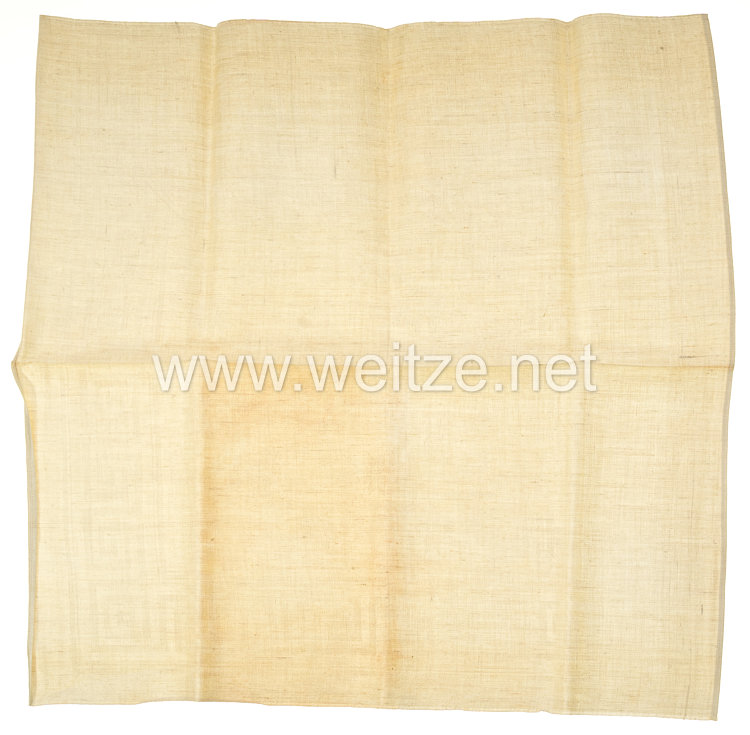
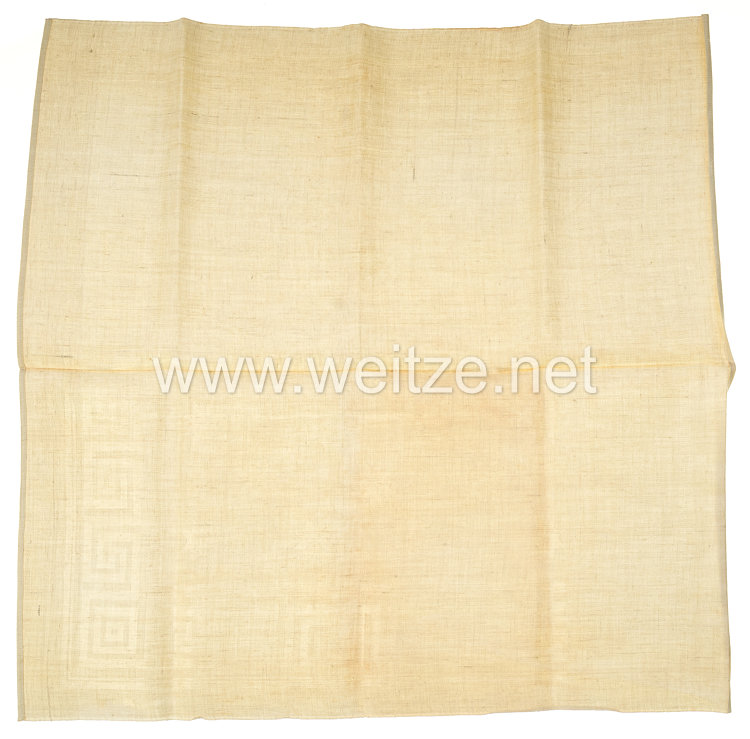
Kriegsmarine - Tablecloth for an Officers' Mess
This Kriegsmarine tablecloth for an officers' mess represents a fascinating testament to the maritime military culture of the Third Reich. With dimensions of approximately 60 x 60 cm, it belongs to the typical furnishing items used in the officers' messes and casinos of the German Kriegsmarine between 1935 and 1945.
The Kriegsmarine, officially founded on June 1, 1935, as the successor to the Reichsmarine, quickly developed a comprehensive system of traditions and customs that were strongly oriented toward the conventions of the Imperial Navy. Officers' casinos played a central role in the social life of naval officers. These exclusive spaces served not only for dining but were important places for camaraderie, tradition maintenance, and informal communication between officers of various ranks.
The furnishing of such casinos followed strict regulations and traditions. The military service regulations and corresponding naval directives specified which standards were to be maintained regarding furnishings, decoration, and table linen. Tablecloths like the present one were typically made from durable linen or cotton fabric and frequently adorned with maritime symbols or the national emblem of the Kriegsmarine.
The square format of 60 x 60 cm suggests that this was a cloth for smaller tables or as a decorative element, possibly for side tables or for use on special occasions. In the officers' messes of the Kriegsmarine, great emphasis was placed on appropriate table culture that should reflect the dignity of the officer corps.
The Kriegsmarine maintained officers' casinos both on land at various naval bases such as Kiel, Wilhelmshaven, Hamburg, or Flensburg-Mürwik, as well as aboard larger warships. On cruisers, battleships, and aircraft carriers, officers had separate mess rooms that were appropriately furnished. The furnishing of these rooms was part of maritime tradition and was meant to preserve a touch of civilization and normalcy even under wartime conditions.
The procurement and administration of such furnishing items were the responsibility of the respective supply officers or paymasters of the units. They were responsible for the procurement, care, and inventory of all items belonging to the casino. Financing typically came from the funds of the officers' community itself, with each officer contributing a monthly amount to the casino fund.
The current condition with staining is typical for textiles that were actually in use. This distinguishes them from purely representative or unused pieces. The traces of use lend the object a certain authenticity and connect it with the everyday reality of Kriegsmarine officers.
After May 8, 1945, and the unconditional surrender, the facilities of the Kriegsmarine were dissolved. Many furnishing items from officers' casinos ended up in private hands as spoils of war or souvenirs, were confiscated by Allied troops, or were simply scattered during the dissolution of the facilities. This explains why such items appear today in collections and on the militaria market.
From a cultural-historical perspective, such objects document the everyday culture and self-image of the German naval officer corps. They are testimonies of an era characterized by strict hierarchies, tradition consciousness, and the attempt to maintain certain civilizational standards even under extreme conditions. At the same time, they are inevitably connected with the history of National Socialism and World War II, which requires a differentiated consideration.
For collectors and historians, such textiles offer important insights into the material culture of the Kriegsmarine and complement the picture we gain from documents, photographs, and uniforms. They remind us that behind the military machinery were people who, even in wartime, held on to traditions and rituals.