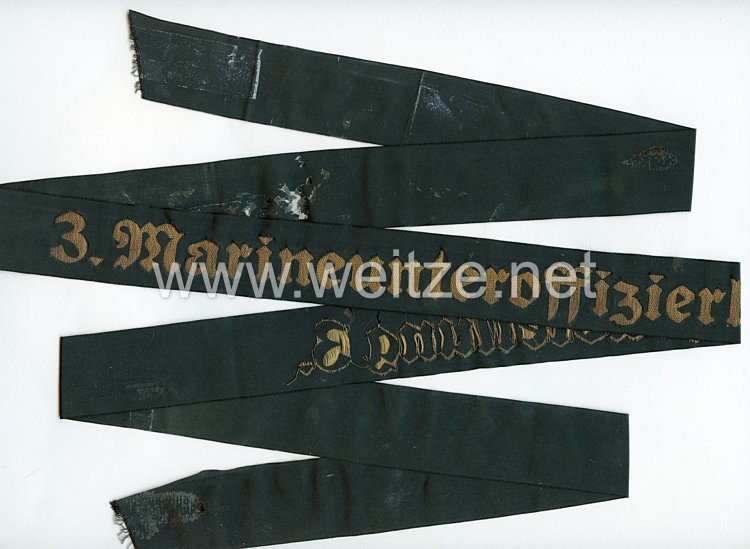
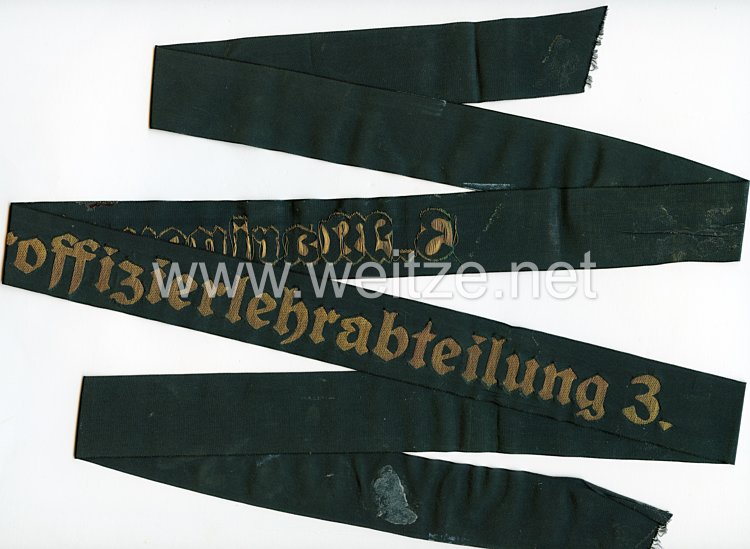
Kriegsmarine Cap Tally "3. Marineunteroffizierlehrabteilung 3."
The present cap tally of the 3rd Marine NCO Training Division 3 represents an important component of the uniform of the German Kriegsmarine during World War II. Cap tallies were not merely functional elements of the naval cap but served primarily for identification and contributed significantly to unit belonging.
The Kriegsmarine, officially founded on June 1, 1935, was the naval warfare branch of Nazi Germany from 1935 to 1945. It emerged from the renaming of the Reichsmarine and represented an open breach of the military restrictions of the Treaty of Versailles. The uniform traditions of the Kriegsmarine deliberately connected to the Imperial Navy and adopted many of its traditions and uniform components.
The cap tally was worn on the peaked cap (Tellermütze), which belonged to the standard uniform of the Kriegsmarine. The tallies were typically made of black material and bore the name of the ship, unit, or training facility in gold or silver lettering. The present example in metal thread embroidery corresponds to the high-quality manufacturing standard typical for official Wehrmacht uniforms.
The Marine NCO Training Divisions (Marineunteroffizierlehrabteilungen) were central training facilities of the Kriegsmarine where non-commissioned officers received their technical and military education. These training divisions were part of the navy's comprehensive training system, which included both theoretical instruction and practical exercises. NCO training lasted several months and covered areas such as navigation, weapons technology, seamanship, and military leadership.
The designation “3rd Marine NCO Training Division 3” indicates a specific organizational structure. During the war, several such training facilities were established at various locations along the German coast to meet the increasing demand for trained personnel. The Kriegsmarine expanded considerably during the war and constantly required a supply of qualified non-commissioned officers for its growing fleet of surface vessels, submarines, and coastal installations.
The manufacture of such cap tallies was carried out by specialized companies licensed as army clothing suppliers. Metal thread weaving was an elaborate technique in which gold or silver metal threads were woven into the black base fabric. This manufacturing method guaranteed durability and a representative appearance. The length of approximately 150 cm corresponds to the standardized measurements prescribed for Kriegsmarine cap tallies.
Cap tallies were attached to the cap using various methods. The mentioned adhesive traces on the present specimen indicate subsequent attachment, which is not unusual for historical objects. Originally, the tallies were knotted through the characteristic bow at the back of the head or attached with small stitches.
According to Kriegsmarine uniform regulations, wearing the correct cap tally was mandatory and part of service regulations. The cap with tally belonged to the dress uniform and was worn at official occasions. Unlike combat vessels, which often bore their names on the tallies, training units such as instruction divisions displayed their institutional designation.
The Kriegsmarine's training system was hierarchically organized. After basic training, prospective non-commissioned officers went through various specialization courses. The Marine NCO Training Divisions formed the backbone of this system and ensured that navy standards were maintained. Graduates of these courses were subsequently deployed on ships or in other naval units.
From a collector-historical perspective, cap tallies from training units are rarer than those from famous warships. They document an important but often overlooked aspect of naval organization. The preservation condition of such textiles is often problematic as they suffer from use, light, and moisture. The present tally in condition 2-3 shows typical signs of use but is still well preserved.
After the war ended in 1945, the Kriegsmarine was dissolved, and its uniforms and equipment were largely destroyed or scattered. Preserved cap tallies are today historical witnesses of a defunct military organization and serve scientific research and historical understanding of this era.