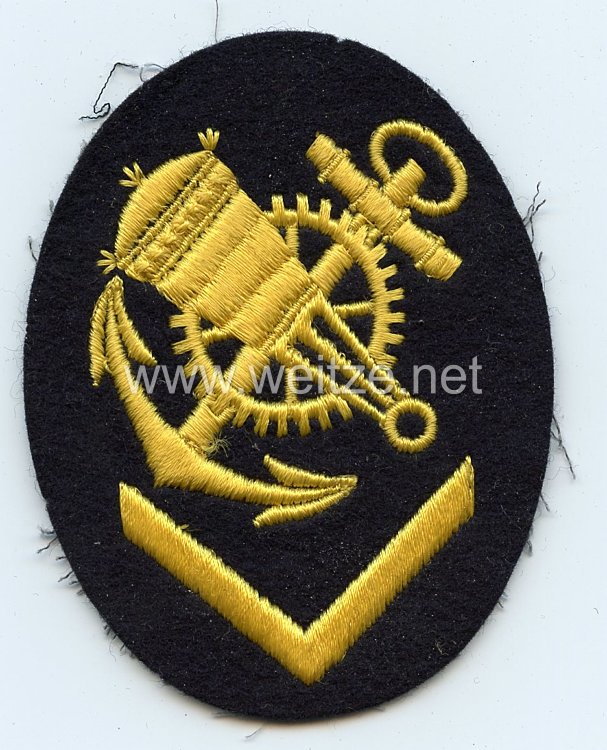
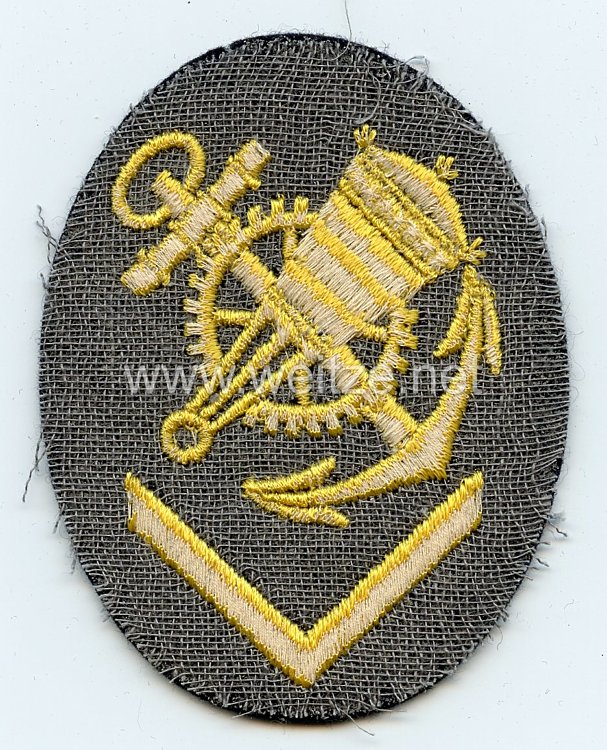
Kriegsmarine Sleeve Insignia Career Path Barrage Weapons - Obermechanikermaat (Chief Mechanic's Mate)

for the blue blouse, condition 2-.
376590
12,00

Kriegsmarine Sleeve Insignia Career Path Barrage Weapons - Obermechanikermaat (Chief Mechanic's Mate)

This Kriegsmarine sleeve insignia for the Sperrwaffen (Barrier Weapons) career branch, indicating the rank of Obermechanikermaat (Senior Mechanic Petty Officer), represents a significant artifact documenting the complex rank insignia and organizational structure of the German Kriegsmarine during World War II. This badge was worn on the blue service blouse and represents a highly specialized technical career path within the naval forces of the Third Reich.

The Kriegsmarine, founded in 1935 as the successor to the Reichsmarine, developed a sophisticated system of career insignia to visibly distinguish the various specializations and ranks of its personnel. The Sperrwaffen career branch was one of the most technically demanding specializations. It encompassed personnel involved with the installation, maintenance, and deployment of naval mines, mine barriers, net barriers, and other maritime defense installations. This weapons technology played a central role in German naval warfare, both for offensive operations to blockade enemy ports and for defensive measures to protect German coasts and waters.

The rank of Obermechanikermaat designated an experienced petty officer in technical service. The Kriegsmarine's rank hierarchy was strictly organized: from the simple sailor (Matrose) through the Maat (equivalent to a lance corporal in the army) to various levels of petty officers and commissioned officers. The Obermechanikermaat stood above the simple Mechanikermaat in this hierarchy and already bore considerable responsibility for the technical maintenance and deployment of complex weapons systems. This position required several years of training and practical experience.

The sleeve insignia of the Kriegsmarine followed precise regulations set forth in various uniform ordinances, particularly in the Dress Regulations for the Kriegsmarine (M.Dv. Nr. 54) and subsequent amendments. The insignia for the Sperrwaffen career branch typically displayed a symbolic representation indicating the specific function. The sleeve insignia were worn on the blue uniform, the service dress uniform of the Kriegsmarine, which existed in various versions: the blouse for duty on land and aboard ship.

The material execution of these badges varied over the course of the war. Early examples were often produced in high-quality hand embroidery on dark blue cloth, while later wartime productions increasingly resorted to machine manufacturing and simpler materials. The insignia were attached above the sleeve braids that indicated rank. For an Obermechanikermaat, these would have been specific braids marking his petty officer rank.

The strategic importance of the Sperrwaffen services cannot be overstated. The Kriegsmarine deployed various types of mines during World War II, from simple moored mines to highly developed ground mines with magnetic, acoustic, or pressure fuses. The German Bight, the Baltic Sea, and Norwegian waters were protected by extensive minefields. Simultaneously, the Kriegsmarine conducted offensive mine-laying operations in British waters, off the Soviet coast, and in other theaters of war. Personnel of the Sperrwaffen career branch were responsible for the technical preparation, transport, and proper deployment of these weapons.

Training as a Sperrwaffen mechanic took place in specialized Kriegsmarine schools, where theoretical and practical knowledge about complex fusing mechanisms, safety regulations, and deployment tactics were taught. Working with mines and explosives was dangerous and required the highest precision and discipline. An Obermechanikermaat often had responsibility for a team of mechanics and had to demonstrate both technical skill and leadership qualities.

Such sleeve insignia are today important objects of study for military historians and collectors. They document not only uniform history but also the organizational structure and technical specializations of the Kriegsmarine. The condition is evaluated in collector terminology with condition grades, where “Condition 2-” designates a well-preserved example with light signs of wear. This indicates that the badge was actually worn and thus represents an authentic witness to its time.

The historical contextualization of such military equipment items always requires a critical and objective perspective. They are material witnesses to a criminal regime and a devastating war that cost millions of people their lives. At the same time, they are indispensable sources for scholarly engagement with this era and help to understand the structures, technologies, and daily life of the armed forces of that time.