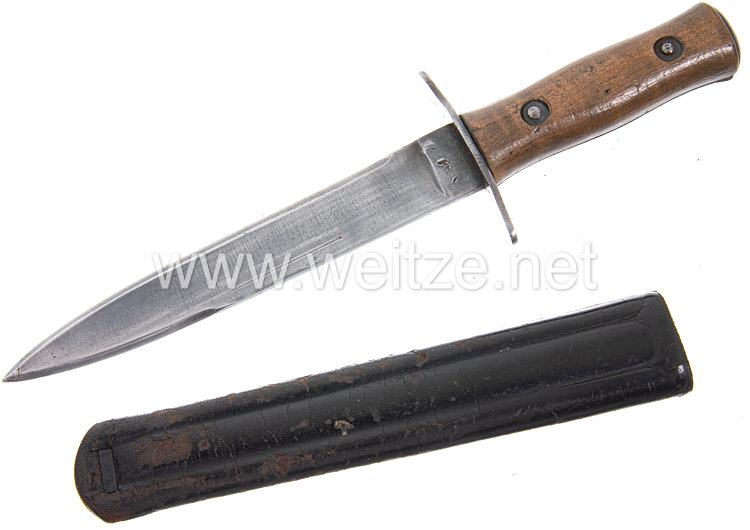
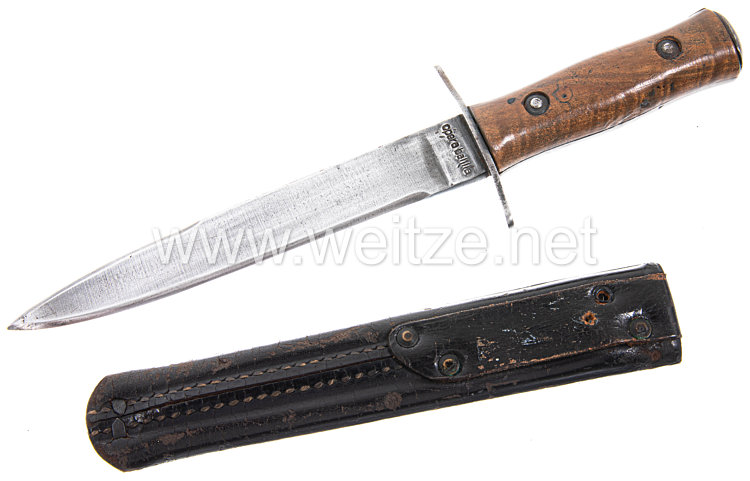
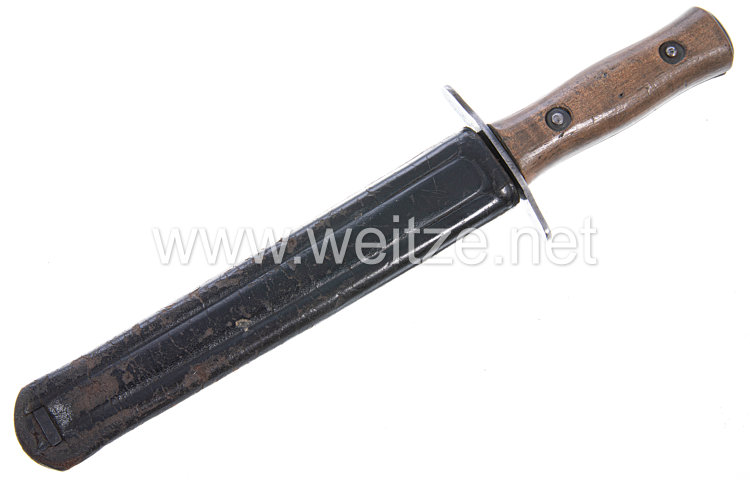
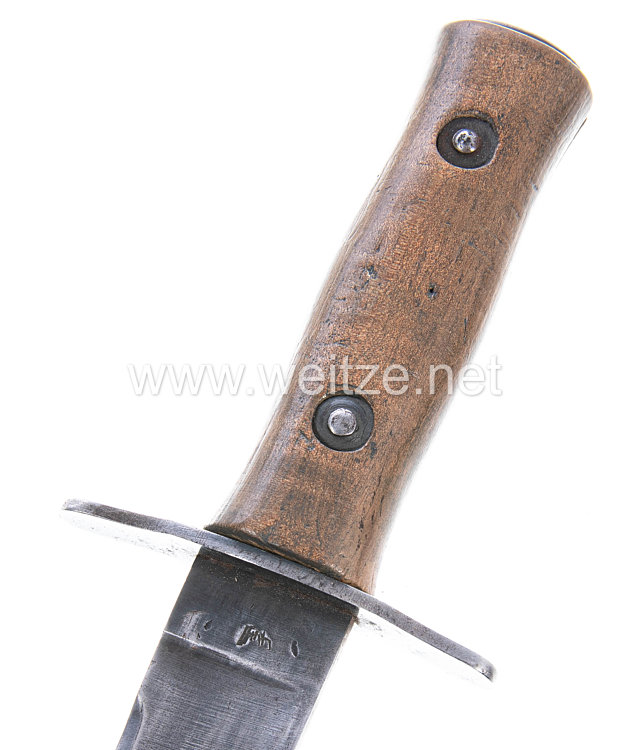
Italian Combat Knife of the Italian Youth Organization. M1936/37.
Very rare!!!
The Italian combat knife M1936/37 of the Opera Nazionale Balilla represents a fascinating testament to the fascist youth organization in Benito Mussolini's Italy. This knife embodies not only a piece of military equipment but also the ideological indoctrination and paramilitary training of Italian youth during the 1930s.
The Opera Nazionale Balilla (ONB) was founded in 1926 under Mussolini's fascist government and named after the Genoese hero Giovan Battista Perasso, known as “Balilla.” The organization aimed to educate Italian youth in the spirit of fascism and prepare them physically and militarily. Boys aged 8 to 18 were systematically enrolled in this organization and trained according to military principles.
The combat knife described here was issued to members of the organization from the mid-1930s onwards, specifically in the model variants of 1936 and 1937. The technical characteristics of the knife reflect its dual-functional character: the blade is initially single-edged, then transitions to a double-edged form in the lower half. This construction enabled both cutting work and use as a thrusting weapon, corresponding to the military training character of the Balilla organization.
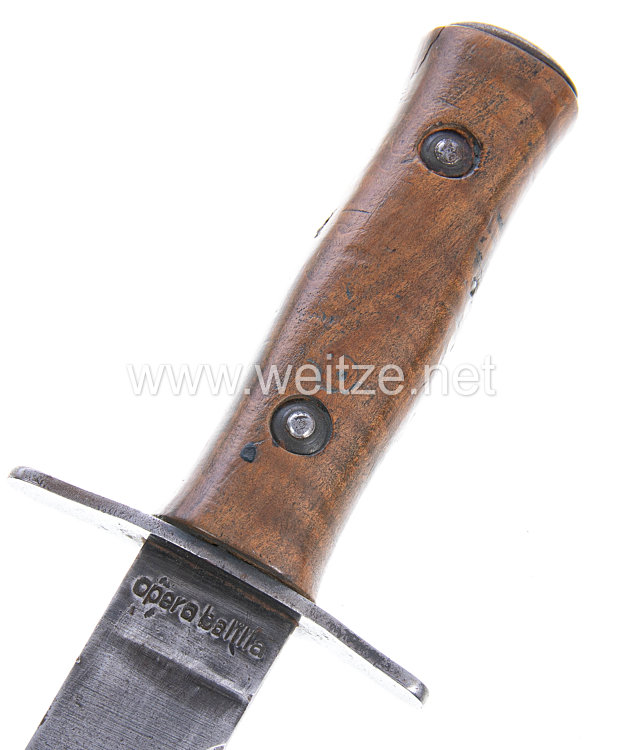
Particularly noteworthy is the stamp “Opera Balilla” on the false edge of the blade. This marking served to clearly identify the organization and underscores the official character of these equipment items. The wooden grip scales were attached with rivets, a robust and cost-effective construction suitable for mass production. The iron crossguard with downward-bent ends provided hand protection and corresponded to the contemporary design of military side arms.
The black leather sheath with belt loop allowed wearing on the belt, as intended for uniformed youth of the organization. Balilla members wore characteristic uniforms with black shirts and fez caps, and such knives were part of the equipment for older age groups.
In historical context, the Opera Nazionale Balilla must be understood as part of the comprehensive totalitarian system of Italian fascism. The organization was transferred in 1937 to the newly founded Gioventù Italiana del Littorio (GIL), with the paramilitary orientation being further intensified. The issue of weapons and military equipment to young people served early militarization and preparation for expected wartime deployment.
The rarity of such knives today is explained by several factors: After the collapse of the fascist regime in 1943/45, many equipment items of fascist organizations were destroyed, hidden, or stripped of their markings. The association with fascism led many Italians to not want to preserve such objects. Additionally, these knives were utilitarian items that wore out or were lost.
From a collector's historical perspective, well-preserved specimens with clear markings such as the “Opera Balilla” stamp are particularly sought after. They document a significant, albeit dark, chapter of Italian history. The described specimen in lightly worn condition is particularly remarkable as it has preserved its original characteristics and markings.
Research into such objects contributes to understanding the mechanisms of totalitarian systems, particularly regarding the instrumentalization and militarization of youth. The M1936/37 knife of the Opera Balilla stands exemplary for the material culture of Italian fascism and its efforts to ideologically and militarily shape children and adolescents from an early age.