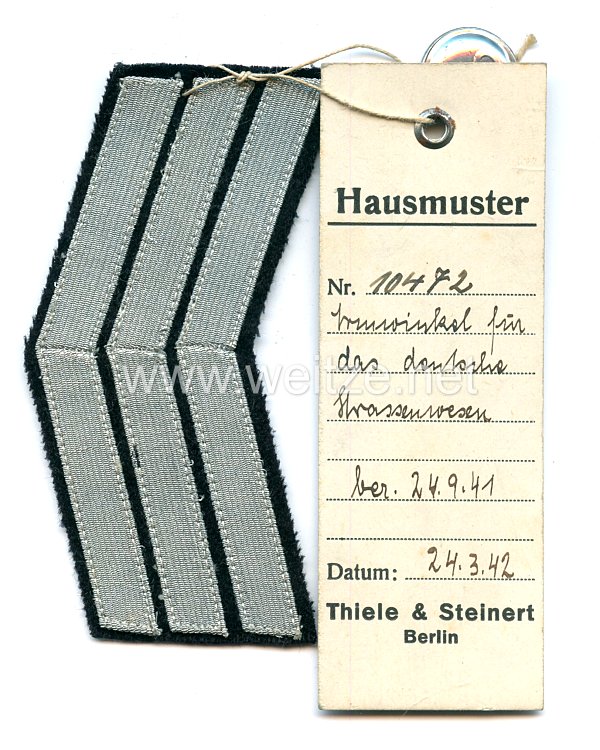
Third Reich Armband for the German Road Service

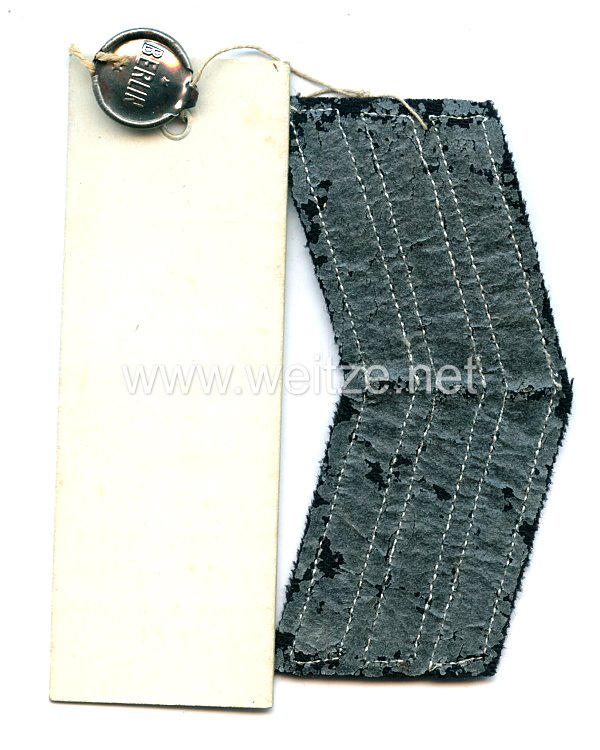
Dark green cloth. Sample piece by the manufacturer “Thiele & Steinert”, sealed as a house sample, inscribed and dated 24.3.1942. In mint condition.
356390
150,00

Third Reich Armband for the German Road Service

The arm chevron for the German Road Service from the Third Reich represents a fascinating example of the comprehensive uniformization and organizational structure that characterized National Socialist Germany during the 1930s and 1940s. This particular specimen, a sample piece produced by the renowned firm Thiele & Steinert and dated March 24, 1942, documents not only the textile craftsmanship of the period but also the bureaucratic precision with which even seemingly minor uniform components were regulated.

The German Road Service under National Socialist rule was far more than a mere administrative unit for transportation routes. It was an integral component of the regime's infrastructure policy, serving both civilian and military purposes. The construction and maintenance of the Reich autobahn network, considered Adolf Hitler's prestige project, as well as the organization of the entire road system, required a large number of officials and employees. These workers were identified as part of the state apparatus through specific uniform elements, including arm chevrons.

The present arm chevron is made of dark green cloth, a color choice typical for technical and administrative services in the Third Reich. Green hues were frequently used for organizations connected with forestry, agriculture, or transportation. The color coding served for immediate visual identification of affiliation to a specific service branch.

The company Thiele & Steinert was one of several established manufacturers of military and paramilitary uniform components and insignia during the Nazi period. Such companies worked closely with state authorities and had to comply with strict quality and design specifications. The fact that this piece was sealed, inscribed, and dated as a house sample underscores the importance of standardization. Sample pieces served as references for ongoing production and required approval from the responsible authorities.

The date March 24, 1942 falls within a phase of World War II when the German Reich had reached the zenith of its territorial conquests but was simultaneously facing increasing challenges of a total war economy. Infrastructure, particularly the road network, was of crucial importance for supplying the Wehrmacht and transporting troops and materials. The civilian employees of the road service thus played an important role in war logistics.

The identification of personnel through arm chevrons and other insignia was ubiquitous in the National Socialist state. It served multiple purposes: first, identification and hierarchization within the organization; second, demonstration of state authority to the civilian population; and third, creation of a sense of belonging among wearers. The system of rank insignia, service grade badges, and specialization markings was extraordinarily complex and minutely regulated.

The mint condition of this specimen is remarkable. The fact that it is a sample piece presumably explains its excellent preservation, as it was never worn in daily service. Such sample pieces were stored in archives or production facilities and used only for reference purposes. Today they are of particular value to collectors and historians because they display the original quality and design without traces of wear.

The study of such objects is significant for understanding National Socialist governance practices. They illustrate the penetration of all areas of life with ideological and organizational structures. The meticulous regulation of even the smallest details of uniformization demonstrates the totalitarian claim of the regime to control and shape all public life.

For military historians and collectors, such arm chevrons provide important insights into the material culture of the Third Reich. They document manufacturing processes, material procurement, and the organization of the armaments industry in the broader sense. The existence of dated sample pieces also enables precise chronological classification of uniform components and assists in authenticating objects.

In conclusion, it should be noted that scholarly engagement with such objects must always occur with awareness of historical responsibility. They are testimonies to a criminal regime and should serve as sources for researching this dark period of German history, not as objects of glorification.