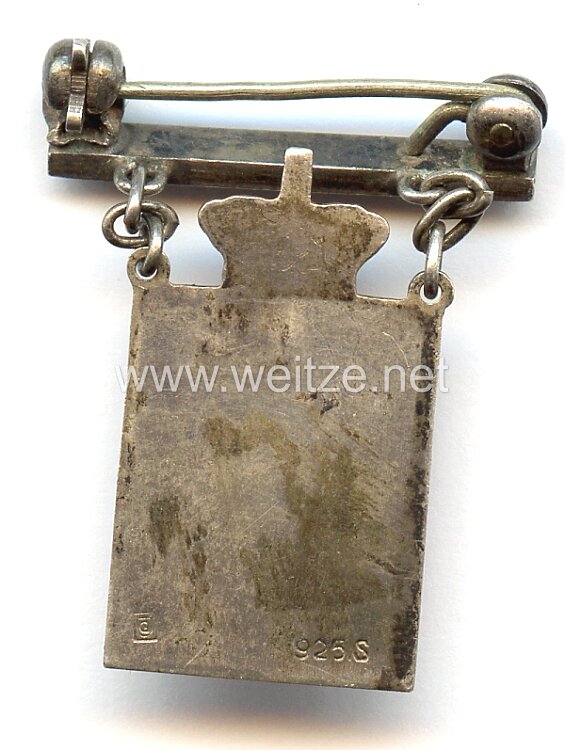
Denmark - Commemorative Badge for the 70th Birthday of King Christian X, 1870-1940

, enameled pendant in 925 sterling silver, with suspension bar and pin, condition 2.
257490
30,00

Denmark - Commemorative Badge for the 70th Birthday of King Christian X, 1870-1940

The commemorative badge for the 70th birthday of King Christian X represents a significant testament to Danish monarchical history in the 20th century. This badge, crafted from 925 sterling silver and featuring enamel work, was issued to mark the Danish king's seventieth birthday in 1940, a year marked by dramatic historical events for Denmark.

King Christian X was born on September 26, 1870, as the son of King Frederick VIII and Queen Louise. He ascended the Danish throne in 1912 and reigned during one of the most turbulent periods in European history. His reign encompassed both World Wars and the interwar period, an era of fundamental political and social changes across Europe.

The issuance of jubilee badges for royal birthdays was an established tradition in Scandinavian monarchies. These badges served multiple purposes: they honored the monarch, strengthened the bond between crown and people, and documented important dynastic milestones. In the case of Christian X, his 70th birthday held particular significance as it was celebrated amid the greatest crisis of Danish sovereignty in centuries.

The year 1940 marked a dramatic turning point in Danish history. On April 9, 1940, just months before the royal birthday in September, Denmark was occupied by German forces as part of Operation Weserübung. The German Wehrmacht crossed the Danish border with virtually no resistance, and the Danish government found itself compelled to accept the occupation to avoid greater destruction. In this historical context, the king's jubilee acquired additional symbolic dimensions.

During the German occupation, Christian X evolved into a symbolic figure of Danish resistance and national identity. His daily horseback rides through Copenhagen without military escort became a powerful symbol of dignity and quiet resistance against the occupying power. Although many stories about his resistance to the Germans have been romanticized over time, it remains undisputed that the king represented a source of hope and national pride for many Danes.

The craftsmanship of the badge reflects the high quality of Danish silversmithing. The sterling silver with a fineness of 925/1000 corresponds to the international standard for high-quality silver jewelry and guarantees longevity and lasting value. The enameling, a technically demanding art form, gives the badge color and visual depth. The clasp with pin allowed the badge to be worn on uniforms or civilian clothing.

Such commemorative badges were typically produced in limited editions and awarded to members of the court, government officials, military personnel, and distinguished citizens. They document the connection between the wearer and the crown and today represent important collector's items that provide insight into the ceremonial culture of European monarchies.

The period from 1870 to 1940, mentioned in the badge's title, spans an era of extraordinary changes. Christian X was born at a time when Denmark was still marked by territorial losses following the Second Schleswig War of 1864. His reign saw the reunification of North Schleswig with Denmark after World War I in 1920, an event of immense national significance. However, his 70th birthday fell during the nation's darkest hour during the occupation.

After World War II, Christian X remained king until his death on April 20, 1947. He is remembered as a symbolic figure of Danish resilience during the occupation years. His memory is still held in high regard in Denmark today, and objects like this jubilee badge serve as a material connection to this significant period of Danish history.

For collectors and historians, such monarchical memorabilia offer valuable insights into political culture, the iconography of power, and the ways in which monarchies expressed their legitimacy and continuity through material culture. The present badge in good condition represents an authentic testimony to a dramatic epoch of European history.

The badge's design, execution in precious metal, and official character underscore the importance that the Danish monarchy placed on maintaining visible symbols of continuity and tradition, even during times of national crisis. As Denmark faced occupation and uncertainty about its future, such commemorative items took on heightened significance as affirmations of Danish sovereignty and royal authority.