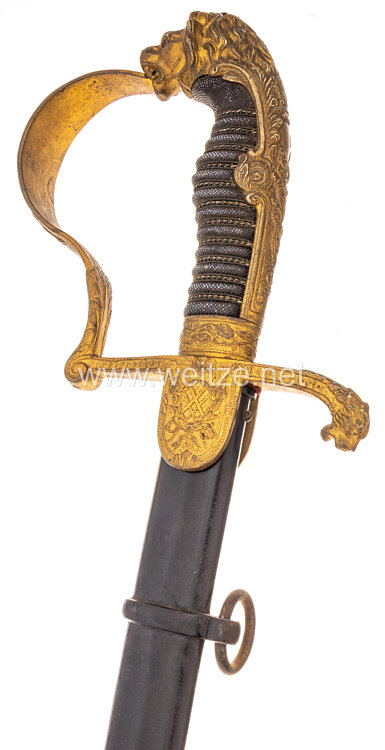
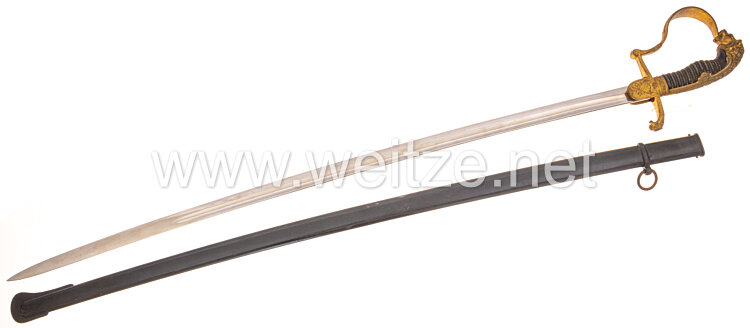
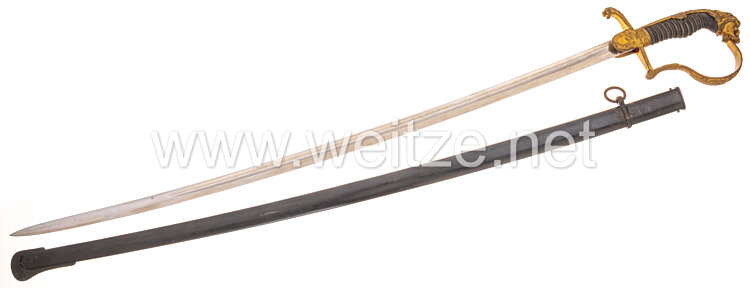
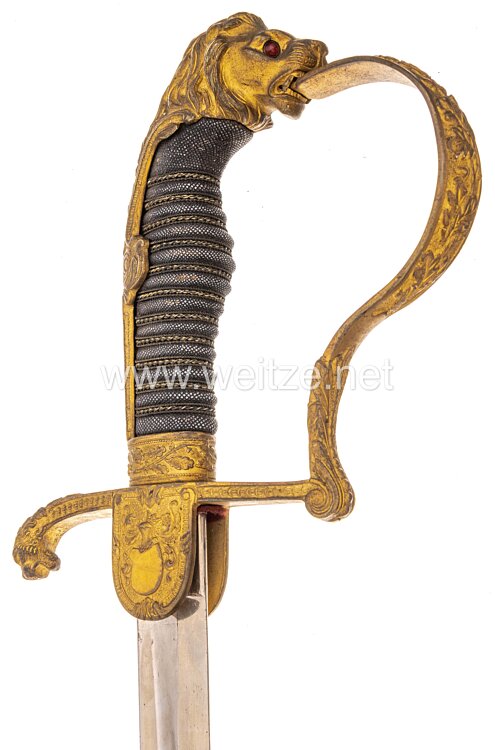
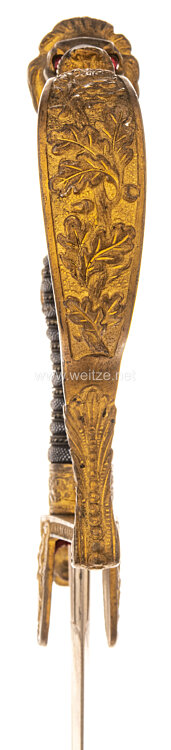
Prussian Cavalry Officer's Saber
Blade length approximately 800mm
Overall length approximately 980mm
The Prussian cavalry officer's sabre represents a significant weapon type of the German Empire and Prussian military tradition. These elegant edged weapons served not only as combat instruments but also as status symbols and expressions of military hierarchy within the Prussian-German officer corps.
The development of the Prussian cavalry officer's sabre dates back to the military reforms of the early 19th century. After the Wars of Liberation against Napoleon (1813-1815), equipment regulations were systematically revised. The All-Highest Cabinet Order of 1817 established uniform standards for officer edged weapons for the first time. The characteristic lion's head grip became a hallmark of Prussian officer sabres, symbolizing courage and strength.
The Waffenfabrik WKC (Weyersberg, Kirschbaum & Cie) from Solingen was among the most renowned manufacturers of military edged weapons in the German Reich. The company, formed in 1883 through a merger, supplied both the Prussian army and later the Reichswehr with high-quality sabres and swords. Solingen blade production enjoyed an excellent worldwide reputation based on centuries-old forging tradition.
The construction of the cavalry officer's sabre followed standardized specifications. The slightly curved blade with a length of approximately 800 mm enabled both cutting and thrusting actions from horseback. The gilt brass hilt with the characteristic lion's head and red glass eyes was typical for higher-ranking officers. The shagreen grip (sharkskin) with wire binding provided secure hold even in adverse conditions and was a quality feature of superior equipment.
Particularly noteworthy is the symbolism on the crossguard: The crossed lances and sabres indicated cavalry affiliation and the various weapon types within this branch. The Prussian cavalry was divided into cuirassiers, dragoons, hussars, and uhlans, with each unit maintaining its specific traditions and equipment details.
The black steel scabbard with original lacquer corresponds to service regulations for cavalry officers. Unlike infantry officers, who often carried leather scabbards, cavalrymen required more robust metal scabbards that could withstand the demands of mounted service. The black lacquer finish served as corrosion protection and corresponded to the aesthetic ideal of Prussian military equipment.
In the military routine of the German Empire (1871-1918), the officer's sabre was a mandatory component of the uniform. It was worn during parades, guard duties, and naturally in combat. Although the importance of edged weapons diminished with the development of modern firearms, the sabre retained its ceremonial and symbolic value. Even in World War I, cavalry officers carried their sabres, although their practical combat value against machine guns and artillery was limited.
The craftsmanship quality of such sabres reflects the high standards of the German arms industry. The blades were forged from premium steel, hardened, and polished. The hilt was manufactured through elaborate handwork, gilt, and fitted with appropriate emblems. Assembly required specialized expertise that was passed down through generations in Solingen manufactories.
After the end of the German Empire in 1918 and the dissolution of the old army through the Treaty of Versailles, these sabres lost their military function. Many officers kept their weapons as personal mementos. In the Reichswehr and later the Wehrmacht, modified versions continued to be used, but the typically imperial features gradually disappeared.
Today, Prussian cavalry officer's sabres are sought-after collector's items that document an important chapter of German military history. They bear witness to an era when military equipment was still strongly influenced by craft tradition, symbolic meaning, and appropriate representation of rank. The preservation of such objects is of cultural-historical significance, as they represent material evidence of a vanished military culture.