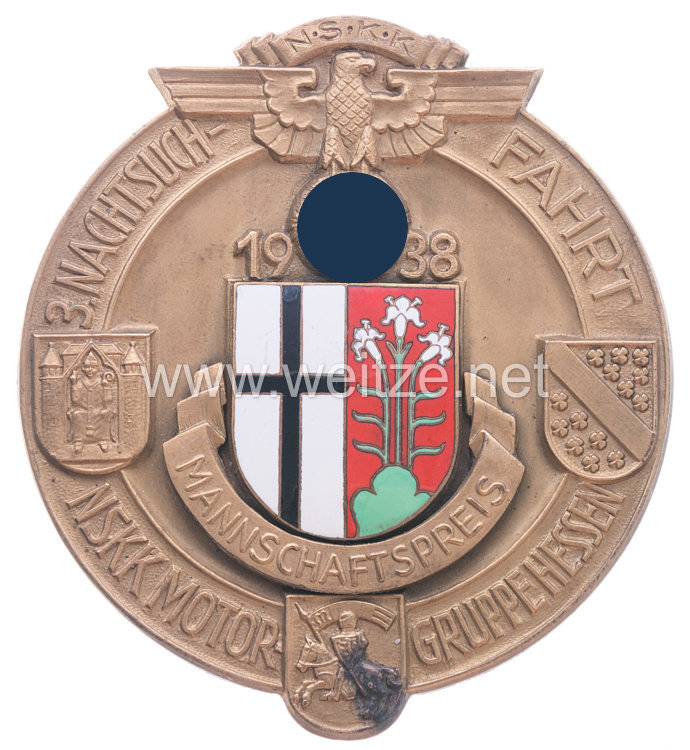
NSKK - Large Non-Wearable Winner's Plaque “NSKK Team Prize 3rd Night Navigation Competition NSKK Motorgruppe Hessen 1938”
This victory plaque of the National Socialist Motor Corps (NSKK) represents a remarkable testament to organized motorsport activities in National Socialist Germany. This gold-plated light metal plaque was awarded as a team prize for the 3rd Night Navigation Rally of the NSKK Motor Group Hesse in 1938.
The NSKK was initially founded on May 1, 1931, as a sub-organization of the SA and developed into an independent formation of the NSDAP from 1934 onwards. Under the leadership of Corps Leader Adolf Hühnlein, the NSKK grew into one of the largest paramilitary organizations of the Third Reich, numbering approximately 500,000 members by 1939. The primary mission of the NSKK was motor vehicle training and preparation for motorized warfare, with sporting events playing a central role.
The Motor Group Hesse was one of the regional subdivisions of the NSKK. The Corps was divided into several motor groups that were oriented along territorial boundaries. Hesse represented an important region, as significant industrial centers such as Frankfurt am Main were located there. The motor groups regularly organized driving sport events, orientation rallies, and night navigation rallies, which promoted both sporting competition and practical training of members.
Night navigation rallies were demanding orientation drives conducted in darkness, requiring special driving skills and navigation abilities. Participants had to complete predetermined routes under difficult conditions, locate control points, and safely navigate their vehicles through the night. These events served not only sporting competition but also military preparation, as the ability for nocturnal navigation was of crucial importance in wartime.
The year 1938 marks a significant point in the history of the NSKK and the Third Reich. This year saw the motorization of the Wehrmacht reach a new peak, and the NSKK played a central role in training drivers for the expanding armed forces. Sporting events became increasingly systematized and served to select and promote particularly talented drivers.
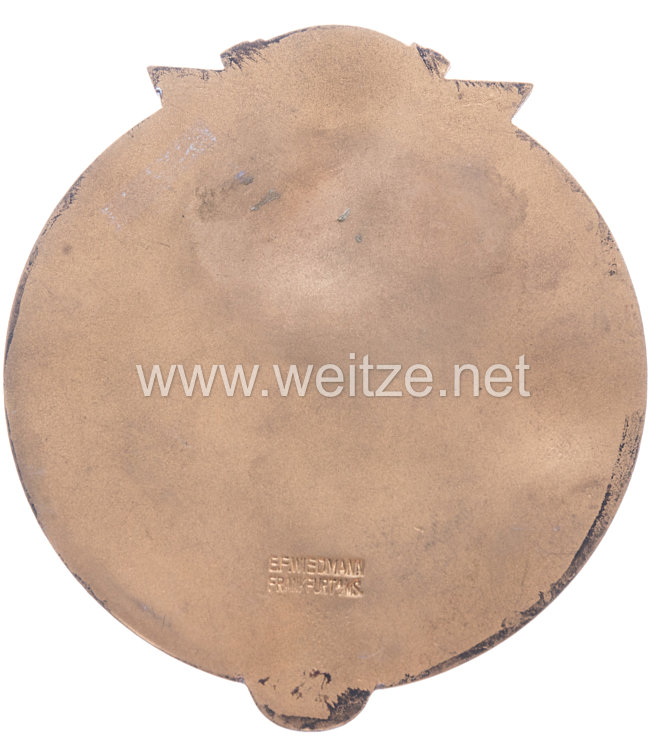
The plaque was manufactured by the renowned maker E.F. Wiedmann of Frankfurt am Main. The Wiedmann company was among the leading manufacturers of orders, decorations, and plaques in the Third Reich. The firm produced numerous state awards and sports prizes for various National Socialist organizations. The craftsmanship quality of Wiedmann products was generally recognized, which is reflected in the careful design and execution of this plaque.
The gold-plated light metal construction with enameled city coat of arms demonstrates the typical manufacturing method of such awards during this period. Light metal alloys, usually zinc-based, allowed cost-effective production while maintaining an attractive appearance through gilding. The enameled coat of arms refers to the urban or regional connection of the event and emphasizes the local character of NSKK activities.
With a height of 100 millimeters, this is a representative, non-wearable plaque that was likely displayed in a cabinet or on a shelf. Such team prizes were not intended for wearing on uniforms but served as memorabilia and trophies meant to strengthen the sense of community within NSKK units.
The designation as the 3rd Night Navigation Rally indicates that this event already had a certain tradition and was held at least for the third time. This underscores the continuity and organization of NSKK activities at the regional level. Such recurring events promoted not only driving skills but also esprit de corps and identification with the organization.
From a historical perspective, such objects are important testimonies to everyday culture and organizational structure in National Socialism. They document how sport and leisure were instrumentalized for ideological and military purposes. The NSKK skillfully combined the fascination for motorsport with preparation for war, creating a system that integrated hundreds of thousands of young men into a paramilitary organization.
The maker E.F. Wiedmann maintained high standards of production, and items bearing this mark are recognized for their quality craftsmanship. The company's location in Frankfurt am Main, a major industrial and commercial center, positioned it well to serve the demands of various Nazi organizations for ceremonial and sporting awards.
Today, such artifacts serve as material evidence of the extensive organizational apparatus of the Third Reich and the way in which seemingly innocent sporting activities were integrated into the broader framework of military preparation and ideological indoctrination. They remind us of how totalitarian regimes permeate all aspects of society, including leisure and sport.