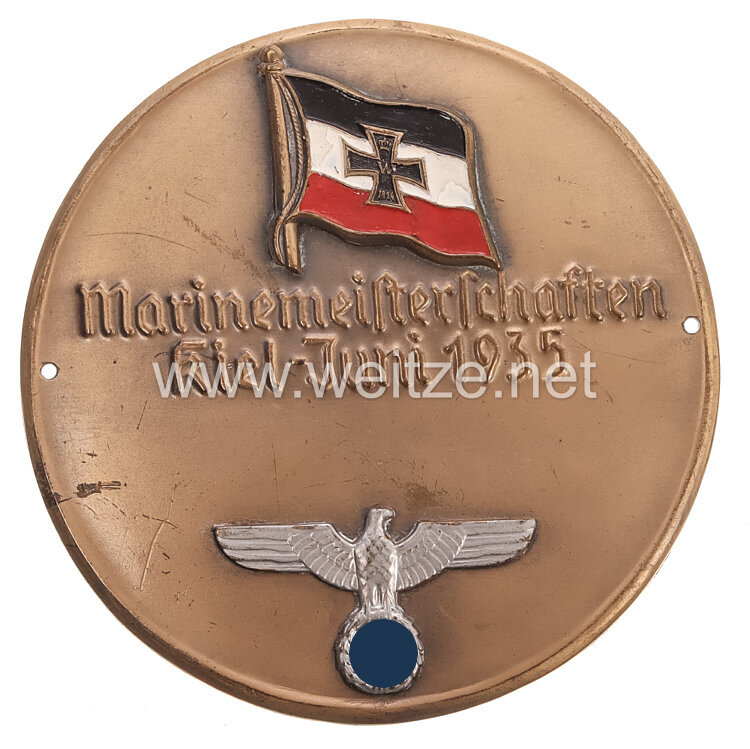
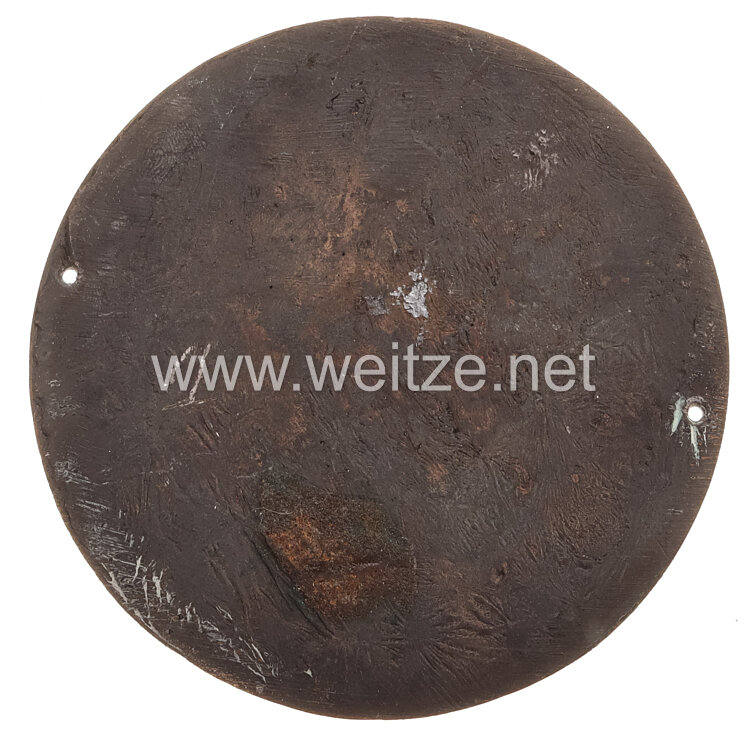
Kriegsmarine Non-Portable Victory Medal of the Naval Championships Kiel - June 1935
These plaques were intended as awards for naval cutters or sailing boats and were mounted on board.
The Kriegsmarine non-portable victory medal of the Naval Championships Kiel from June 1935 represents a fascinating chapter in maritime sporting history during National Socialist Germany. This non-portable plaque made of solid, bronzed metal with colored lacquer documents the tradition of sailing competitions within the German Kriegsmarine during the interwar period and the early years of World War II.
The Naval Championships in Kiel had a long tradition dating back to the Imperial Navy. Following the rearmament of the German Navy in the 1930s, these competitions were revived and served both the physical training of crews and propagandistic purposes. The city of Kiel, as a traditional naval base and home to the Naval School Mürwik, provided the ideal setting for such events.
In June 1935, the year of this championship, the Kriegsmarine was in a phase of intensive expansion. The Anglo-German Naval Agreement of June 18, 1935, permitted Germany a navy of up to 35 percent of the tonnage of the British Royal Navy. This meant considerable expansion of naval forces and was accompanied by an increased emphasis on seamanship and maritime traditions.
This particular plaque differs from conventional decorations through its function as a non-portable victory medal. With a diameter of 85 millimeters and lateral drill holes for mounting, it was expressly designed to be attached to the naval cutter or sailing boat itself. This reflects a maritime tradition in which not the individual sailor but the victorious boat as a whole was honored – an emphasis on team spirit and collective achievement that corresponded to the military ideals of the time.
Sailing training was an integral part of maritime education in the Kriegsmarine. Sailboats and cutters were used not only for competitions but also for the basic training of officers and crews. The practical seamanship acquired through sailing was considered an indispensable foundation for every naval serviceman, regardless of the increasing mechanization of modern warships.
The bronzed surface and colored lacquer of these plaques served both aesthetic and practical purposes. The bronzing gave the award a dignified, traditional character, while the lacquer provided some protection against harsh maritime conditions. Nevertheless, these plaques were exposed to the elements due to their mounting on board, which explains why well-preserved examples are rare today.
The Naval Championships encompassed various disciplines, including cutter rowing, sailing, and other nautical competitions. These events promoted not only physical fitness and maritime skills but also strengthened esprit de corps and identification with the Kriegsmarine. They were often conducted with considerable ceremonial effort and attended by high-ranking officers.
The period around 1939, from which this plaque presumably dates, marks a caesura in the history of the Kriegsmarine. With the outbreak of World War II in September 1939, the character of such sporting events changed fundamentally. While in peacetime they primarily served training and community building, they now had to give way to the demands of war.
The historical significance of such objects today lies primarily in their testimonial value for the everyday culture and traditions of the Kriegsmarine. They document aspects of military life beyond pure combat operations and show how sport and competition contributed to the formation of military identity. For collectors and historians, they offer insights into the material culture and award practices of the German Navy during this period.
The preservation of such maritime awards is often problematic, as they were designed for use on board and therefore exposed to the elements. Examples in good condition are therefore of particular historical and collector value and document a specific chapter of German naval history between tradition and modernity.