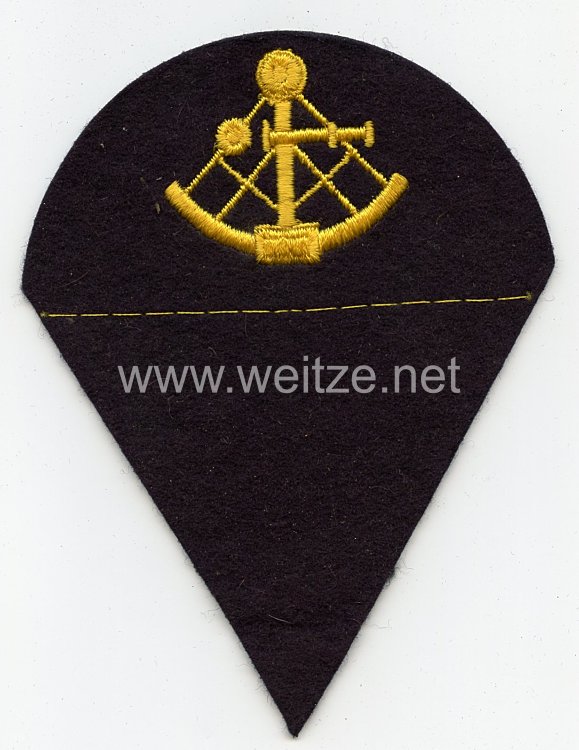
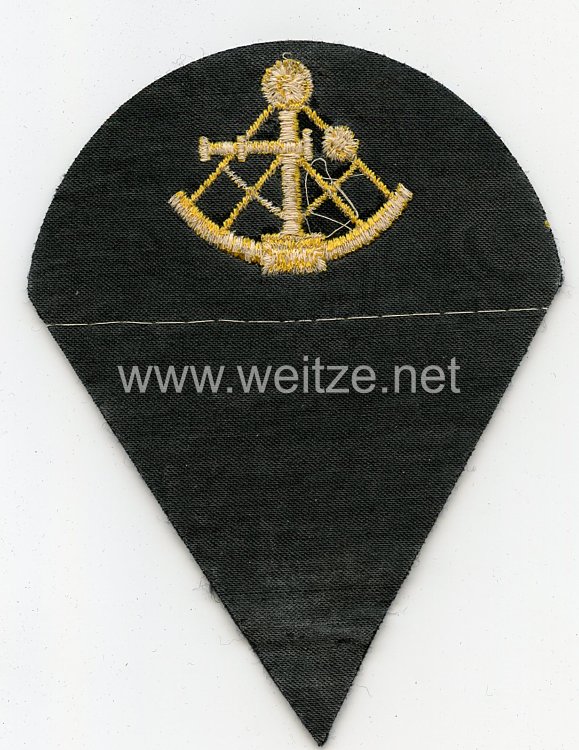
Kriegsmarine Enlisted Personnel Sleeve Insignia for Survey Career Path
The Kriegsmarine sleeve badge for enlisted men in the surveying career path represents an interesting and comparatively rare example of German naval uniforms from World War II. These specialized career badges were introduced to identify the various technical and scientific specializations within the Kriegsmarine and formed an important part of the complex system of military rank insignia and qualification indicators.
The Kriegsmarine, which existed from 1935 to 1945 as the official naval force of National Socialist Germany, developed a sophisticated system of uniform insignia that extended far beyond traditional rank badges. The Laufbahnabzeichen (career or specialization badges) were worn on the left upper arm of the uniform jacket and indicated the specific specialty or area of activity of the wearer. These badges were particularly important in a technically highly specialized navy that encompassed numerous scientific and technical functions in addition to traditional naval duties.
The surveying career path (Vermessungslaufbahn) was one of these specialized fields within the Kriegsmarine. Personnel in this career path were entrusted with hydrographic tasks, cartography, nautical surveying, and the creation and updating of nautical charts. These activities were of essential importance for naval warfare, as precise maps and surveying data were indispensable for navigation, mine-laying, submarine operations, and amphibious landings. The survey ships and units of the Kriegsmarine conducted systematic surveys in the Baltic and North Seas as well as in other operational areas.
The present specimen is manufactured in the enlisted version, which means it was intended for the lower ranks of the navy, as opposed to officer or petty officer versions. This distinction was typical of the German military system, which reflected strict hierarchical separations even in uniforms. Enlisted badges were usually made on a dark blue background (the so-called cloth base) with lighter embroidery or appliqués.
The description mentions the execution for the Kollani, which refers to a specific type of uniform jacket used in the Kriegsmarine. The Kolani was a working jacket or service jacket made of blue cloth, worn during daily service. This differed from the parade jacket in its more practical design and was used more frequently in everyday situations.
The presence of foxing (mold stains or age spots) is not uncommon in textile militaria from this period. These result from decades of storage, often under less than optimal conditions, especially with fabrics exposed to moisture. Foxing consists of microbiological discolorations caused by fungi or bacteria and typically appears as brownish or yellowish spots. Their presence confirms the age of the object but can also present conservation challenges.
The uniform regulations of the Kriegsmarine were established in various service regulations and dress codes that precisely regulated when and how which badges were to be worn. The Dress Regulations for the Kriegsmarine (Anzugsordnung or A.V.O.) specified in detail which career badges existed and how they were to be affixed. These regulations were updated and adapted several times during the war.
The production of such badges was carried out by specialized military effects companies authorized by the navy. The quality and execution could vary depending on the manufacturer and the time of production. Towards the end of the war, when material shortages prevailed, the quality of uniform parts was often reduced and simplified versions were introduced.
Today, such career badges are sought-after collectibles for militaria collectors specializing in the Kriegsmarine. The surveying career badges are relatively rare, as the number of personnel in this specialization was significantly lower compared to other career paths such as artillery, torpedoes, or navigation. This makes authentic specimens particularly interesting for historical collections and museums.
The research and documentation of such uniform parts contributes to understanding the organizational structure and specialization within the Kriegsmarine and helps to paint a more complete picture of German naval history from this period.