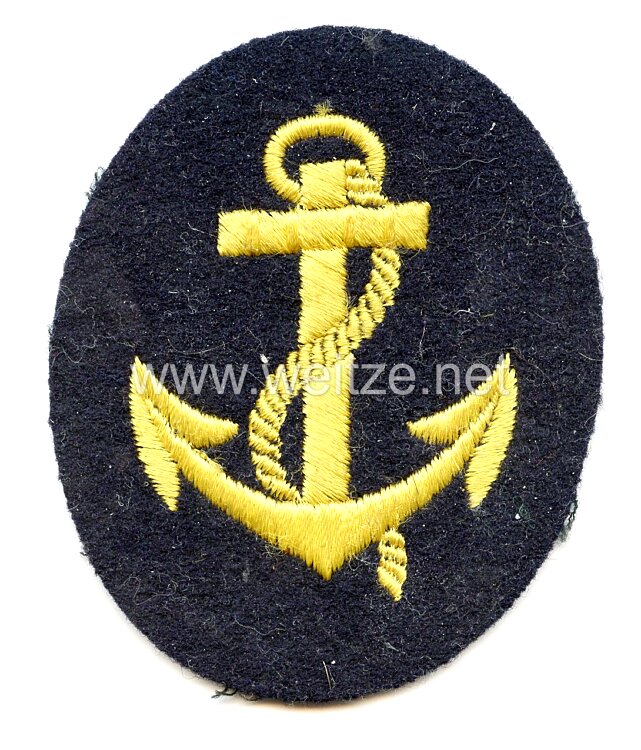
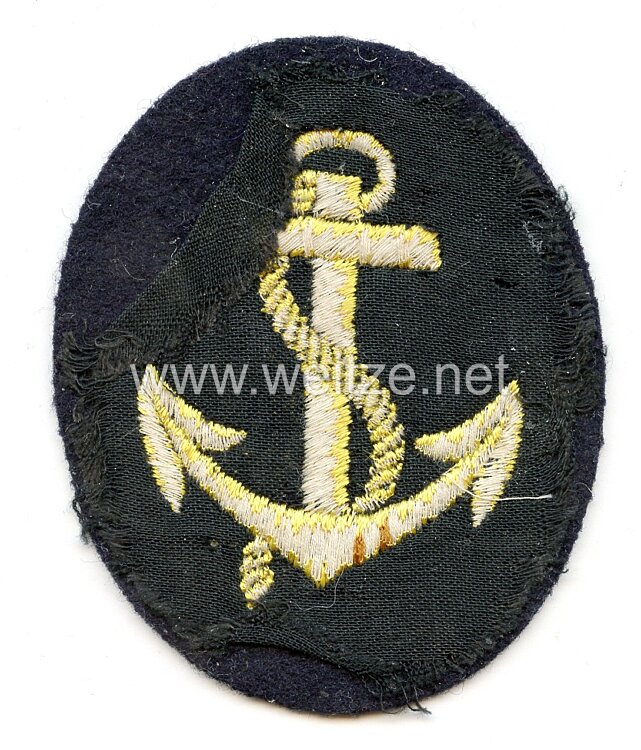
Kriegsmarine Sleeve Insignia Career Path Boatswain's Mate

For the white blouse, machine-embroidered, condition 2.


449989
20,00

Kriegsmarine Sleeve Insignia Career Path Boatswain's Mate

The Kriegsmarine Career Sleeve Insignia for Bootsmannsmaat represents an important element of uniform identification in the German Kriegsmarine during World War II. These badges served to identify the career path (professional branch) and rank of a naval serviceman and were an essential component of the maritime uniform regulations of the Third Reich.

The Kriegsmarine, officially established on June 1, 1935, adopted and further developed the rank insignia system of the Reichsmarine. The career insignia system was introduced to clearly identify the various specializations within the Navy. The Bootsmann career path belonged to the traditional deck careers and included enlisted men and non-commissioned officers responsible for seamanship, navigation, signaling, and general ship operations.

The rank of Bootsmannsmaat corresponded to the second enlisted rank, comparable to a Private First Class in the Wehrmacht. In the hierarchy, the Bootsmannsmaat stood above the simple Matrose (seaman) and below the Obermatrose (able seaman). This rank structure followed Prussian-German military traditions and was precisely regulated in the uniform regulations of the Kriegsmarine.

The execution described here for the white blouse is particularly noteworthy. The Kriegsmarine used various uniform variants depending on season and occasion. The white uniform was worn mainly during summer months or in tropical deployment areas. It consisted of white cotton or drill fabric and represented an important variant of service dress, especially for crews in the Mediterranean, Black Sea, or on overseas deployments.

The machine embroidery of these sleeve insignia was common during the war. While early and high-quality specimens were often hand-embroidered, production increasingly shifted to machine manufacturing for economic and production reasons. The insignia were typically made on dark blue or black cloth backing and displayed characteristic symbols for the Bootsmann career path, usually in the form of an anchor or other nautical emblems.

The manner of wearing was precisely specified in the uniform regulations M.Dv. Nr. 53 (Marine Service Regulations). Career insignia were worn on the right upper arm, while rank insignia were placed on both sleeve cuffs. On the white uniform, the insignia had to contrast in color to remain visible, which is why they were often applied on dark fabric backing.

The significance of these insignia went beyond mere identification. They expressed military order and the hierarchical structure that was strictly maintained in the Kriegsmarine. Grand Admiral Erich Raeder and later Karl Dönitz placed great emphasis on traditional maritime customs and distinctive uniforming that distinguished the Kriegsmarine from other Wehrmacht branches.

The production of these insignia was carried out by various manufacturers throughout the German Reich. Many textile manufacturers and specialized military effects factories were involved in production. With increasing war duration and material shortages from 1943 onwards, simplified versions were often produced, with quality and workmanship varying.

From a military-historical perspective, such sleeve insignia document the organizational complexity of the Kriegsmarine. With over 450,000 members at its peak in 1944, the Navy required a sophisticated system for personnel identification. Career insignia made it possible to recognize at a glance the responsibility and qualification of a naval member.

After the war ended in 1945, these insignia, along with all other NS militaria, were collected, destroyed, or passed into private ownership. Today they are important study objects for military historians and are preserved in museums and private collections. They serve historical research and help understand the structure and organization of the Kriegsmarine without glorifying the political past.