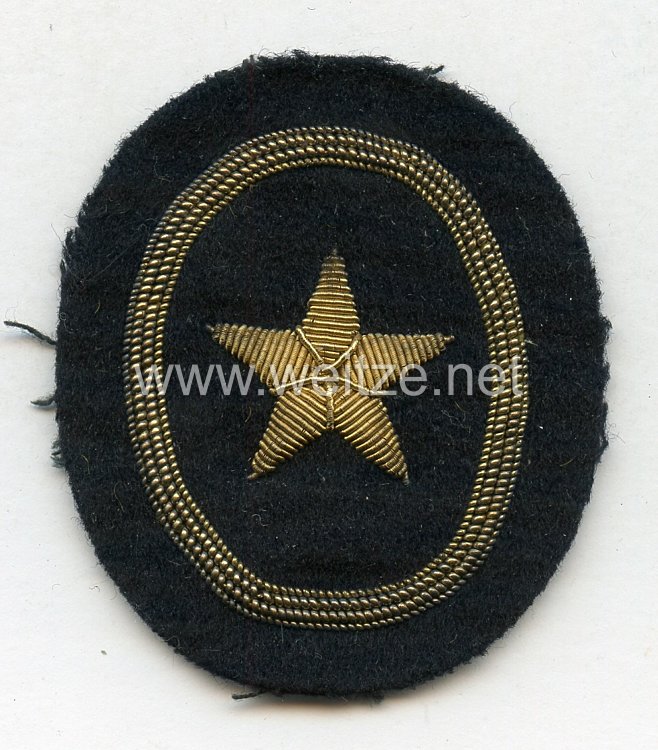
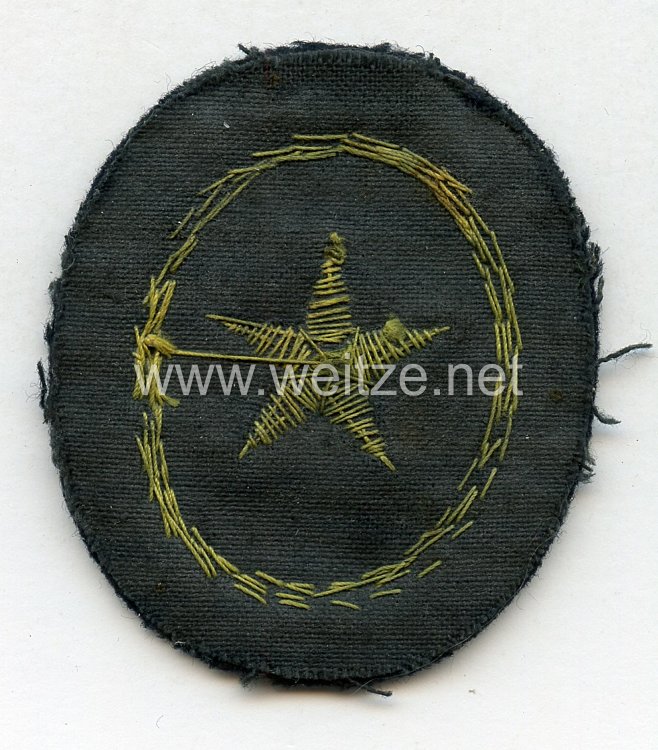
Kriegsmarine Sleeve Insignia Cadets Seaman Career Track
The sleeve insignia for cadets of the seamanship career path in the Kriegsmarine represents a fascinating example of German naval uniforms during the National Socialist era. This particular version in metal thread belongs to the characteristic rank insignia that reflected the complex hierarchical system of the Kriegsmarine.
The Kriegsmarine was officially established on June 1, 1935, when the German Reich, in violation of the Treaty of Versailles, advanced its rearmament program. It replaced the existing Reichsmarine and developed into one of the most significant branches of the Wehrmacht. The training of officer candidates had the highest priority, with distinctions made between various career paths.
The seamanship career path formed the traditional core of naval officers. Cadets in this path underwent comprehensive training in navigation, seamanship, tactics, and leadership. They were destined for operational command of warships and differed from other career paths such as engineering, medical, or administrative branches.
Training to become a naval officer typically began with basic training as a Seekadett (sea cadet), followed by practical seafaring experience and theoretical instruction at naval academies in Mürwik-Flensburg and later at other locations. The training lasted several years and included both practical service aboard training vessels and academic studies.
The sleeve insignia described here was worn on the sleeve of the service jacket according to the Kriegsmarine dress regulations. The use of metal thread indicates a high-quality version typical for officers and officer candidates. While ordinary enlisted men often wore insignia made of cloth or printed material, cadets and officers used hand-embroidered variants with metal threads.
The rank insignia of the Kriegsmarine followed a precise system introduced in 1935/36 and modified several times in subsequent years. Cadets wore specific markings that clarified their position within the training hierarchy. The insignia differed according to career path, making it immediately recognizable which specialization a cadet was pursuing.
The production of such insignia was carried out by specialized companies authorized by the Kriegsmarine. Well-known manufacturers included firms such as Erel, BEVO, and various local passementerie workshops. Quality varied depending on the manufacturer and time of production, with increasing material shortages toward the end of the war leading to simpler versions.
Metal thread embroidery required craftsmanship and typically consisted of gold-plated or silver-plated wire applied to a fabric backing. This technique had a long tradition in military uniform studies and gave the insignia not only a representative appearance but also a certain durability.
In the context of naval history, such cadet sleeve insignia are today important collector's items and objects of study. They document not only uniform history but also the training structures of a historical era. For military-historical research, they provide insights into organizational structures, manufacturing techniques, and the material culture of the time.
The stated condition 2 indicates, according to common collector grading, a well-preserved example that may show normal signs of use but is in overall good condition. This is remarkable for textiles from this period, as many pieces were lost due to war damage, improper storage, or natural decay.
The scientific examination of such objects contributes to understanding naval-historical development without glorifying the political and military contexts of the time. They serve as material witnesses to a historical period that must be researched and documented with critical awareness.