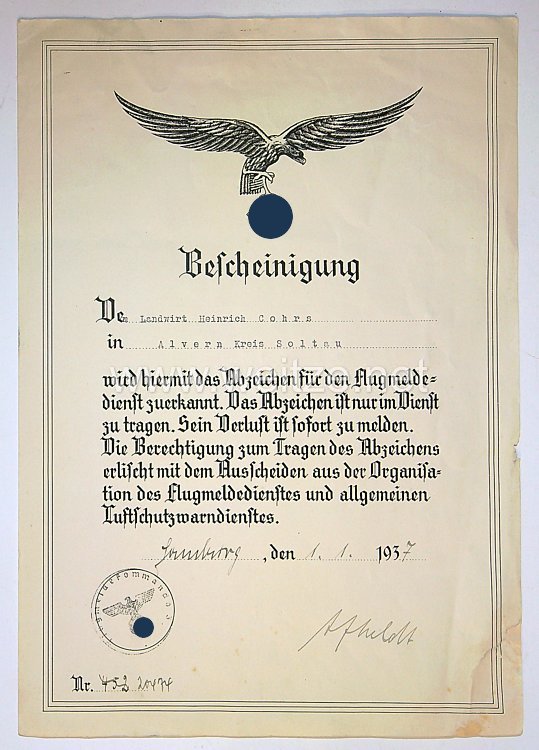
Certificate for the Aircraft Warning Service Badge

for a farmer in Alvern, Soltau district, issued in Hamburg on January 1, 1937, some signs of use and lower right corner has been repaired. Condition 2-
451389
120,00

Certificate for the Aircraft Warning Service Badge

The Certificate for the Aircraft Warning Service Badge represents a fascinating document from the era of Nazi Germany, documenting the complex organization of civil air defense in the years before World War II. This particular specimen was issued on January 1, 1937, in Hamburg for a farmer from Alvern in the Soltau district, illustrating the systematic integration of the civilian population into military surveillance tasks.

The Flugmeldedienst (Aircraft Warning Service) was an integral component of the German air defense system developed during the 1930s. Following the Nazi seizure of power in 1933, the German Reich began systematic rearmament, which included preparation for a possible air war. The Reichsluftschutzbund (RLB - Reich Air Protection League), founded in 1933, coordinated civilian air defense measures, while the Aircraft Warning Service represented a specialized component.

The task of the Aircraft Warning Service was to detect and report enemy aircraft early. In an era before modern radar systems, the human eye was the most important instrument for airspace surveillance. Volunteer helpers were posted at strategically important points, often in rural areas with good visibility, to observe the sky. Reports were then transmitted via a telephone network to central collection points, which compiled a situational picture of the airspace.

The Badge for the Aircraft Warning Service was introduced by an ordinance of the Reich Aviation Ministry and could be awarded to persons who had proven themselves in this service. Recipients had to complete special training that included knowledge of aircraft recognition, operation of reporting equipment, and military discipline. The badge itself was a visible sign of recognition intended to strengthen the motivation of volunteer helpers.

The fact that the recipient of this certificate was a farmer from Alvern is characteristic of the organizational structure of the Aircraft Warning Service. Particularly in rural regions, farmers and other residents were deployed as observers because they had stationary workplaces and were familiar with local conditions. The Soltau district in the Lüneburg Heath offered good visibility conditions for aircraft observation with its relatively flat topography and was located in an area of significance for the air defense of northern Germany.

The issuance of the certificate in Hamburg on January 1, 1937, falls during a phase of intense rearmament. In 1936, the Wehrmacht had occupied the demilitarized zone in the Rhineland, and preparations for a possible conflict were being systematically advanced. The Aircraft Warning Service was expanded in this context as an important component of homeland defense.

Documents such as this certificate followed a standardized format and were issued by the responsible offices of the Reich Aviation Ministry or its subordinate authorities. They typically contained the bearer's name, place of residence, date of award, and the signature and stamp of the issuing office. The certificate served as official proof of authorization to wear the badge and had to be presented during inspections.

The condition of the document with signs of use and a repaired corner indicates that it was actually used and kept by the owner. This is not unusual for military documents from this period, as many owners placed great value on these awards but simultaneously exposed them to the hardships of daily life and the war years.

After the outbreak of war in 1939, the Aircraft Warning Service gained even greater importance as the danger of Allied air raids increased. The system was continuously expanded and refined, with helpers trained in the pre-war years forming an important foundation. Many badge holders remained in service throughout the entire war and contributed to civil defense.

Today, such certificates are important historical sources providing insight into the mobilization of the civilian population in Nazi Germany. They document the systematic preparation for war and the integration of even rural regions into military structures. For collectors and historians, these documents are of interest because they connect the personal history of individual people with the larger history of World War II.

The geographical context is also significant. Hamburg, where the certificate was issued, was Germany's most important port city and a major industrial center, making it a crucial location for air defense coordination. The bureaucratic apparatus necessary to train, certify, and organize thousands of volunteer observers across northern Germany was centered in such urban administrative hubs.

r