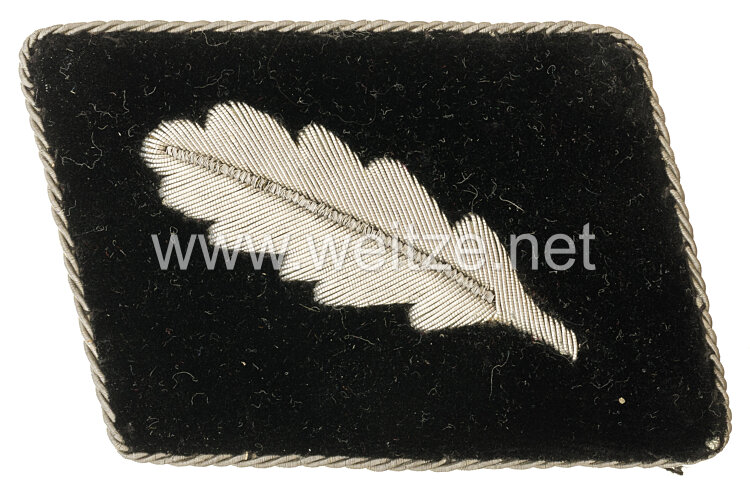
Waffen-SS Single Collar Tab for an SS-Standartenführer

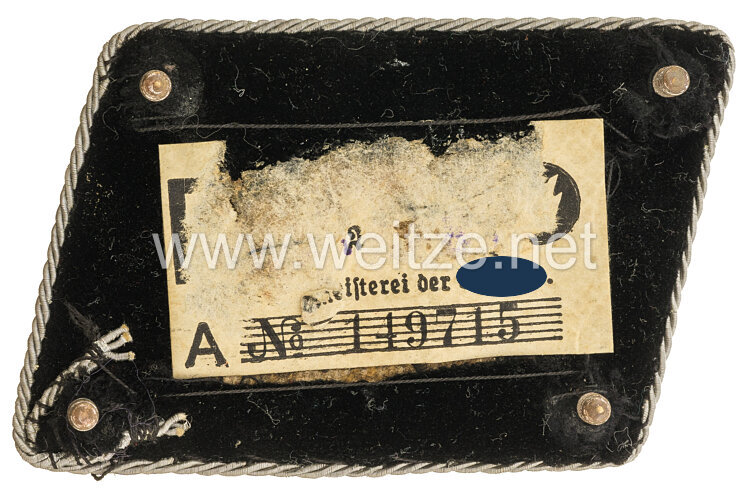
1st Pattern until 1941. This is the right collar side. Metal thread hand-embroidered execution on black velvet cloth, reverse with remnants of the SS/RZM paper label "D", with 4 nuts for screwing onto the collar. Lightly worn, Condition 2.
458288
1.650,00

Waffen-SS Single Collar Tab for an SS-Standartenführer

This single collar tab for an SS-Standartenführer of the Waffen-SS represents a significant rank insignia from the early phase of the National Socialist military organization. This collar tab corresponds to the first model, which was in use until 1941, and represents the right collar side – an essential detail, as SS uniforms featured asymmetrical collar tabs.

The Waffen-SS evolved from the armed units of the Allgemeine SS and became a military formation with several divisions during World War II. The rank structure and associated insignia were complex and underwent several developmental stages. The rank of SS-Standartenführer corresponded to that of a colonel in the Wehrmacht and was a high officer rank within the SS hierarchy.

The technical execution of this collar tab displays the characteristic features of early production. The embroidery was hand-stitched with metal thread, indicating high-quality manufacturing. Black velvet cloth served as the base material, which was typical for SS uniforms and provided a distinct contrast to the silver-colored rank insignia. The four oak leaves of the Standartenführer were applied to the velvet through elaborate handwork.

Particularly noteworthy is the reverse SS/RZM paper label marked with “D”. The Reichszeugmeisterei (RZM) system was the central procurement and quality control organization of the NSDAP and its affiliates. The RZM licensed private manufacturers and controlled the production of uniform parts and insignia. The letter “D” identified a specific manufacturer within the RZM system. These labels served not only for quality assurance but also for production traceability.

The attachment method with four nuts for screwing onto the collar was typical for early collar tabs. This construction allowed secure attachment and, when necessary, replacement of the insignia, such as during promotions or when switching to a new uniform. Unlike later wartime productions that often used simplified attachment methods, this execution still shows the careful workmanship of the pre-war and early war period.

The first model of SS collar tabs, to which this specimen belongs, was introduced around 1934 and used until 1941. That year saw a significant reform of SS uniforms and insignia, motivated in part by wartime requirements and material shortages. Later models often showed simplified production methods, including machine embroidery and cheaper materials.

The SS rank insignia followed a complex system: while rank insignia were attached to the right collar side, the left side bore the SS runes or specific unit insignia. For an SS-Standartenführer, this meant four oak leaves on the right side – a symbol hierarchically positioned between the SS-Obersturmbannführer (three oak leaves) and the SS-Oberführer (four oak leaves with additional rank insignia).

The described lightly worn condition indicates that this collar tab was actually used in service. This gives the object immediate historical authenticity. The signs of wear tell of real use during one of the darkest periods in German history.

From a conservation perspective, the state of preservation is considered good. The presence of remains of the original label is particularly valuable, as these paper elements were often lost over time or destroyed by moisture and aging. The metal thread embroidery appears to have largely retained its integrity, which is remarkable for textiles over 80 years old.

In military-historical research, such objects serve as important material witnesses for understanding organizational structures, production methods, and the material culture of totalitarian regimes. They document the meticulous hierarchy and the need for distinction of the SS organization, which visualized its internal order through a complex system of rank insignia, uniforms, and badges.

It is important to emphasize that the historical documentation of such objects serves education and remembrance, not glorification. The Waffen-SS was deeply involved in war crimes and crimes against humanity, and its members bore responsibility for countless atrocities during World War II and the Holocaust.

r