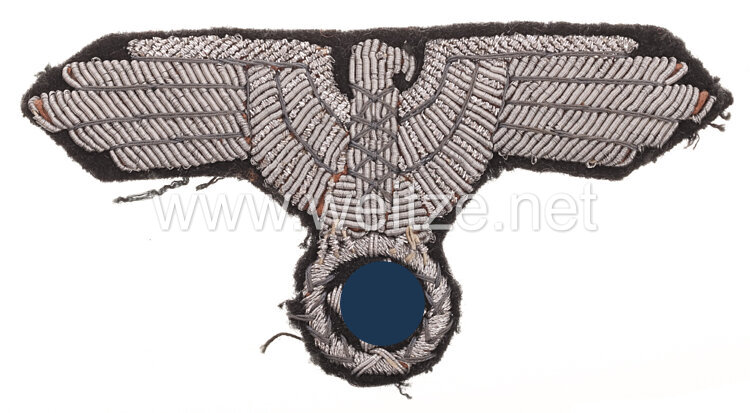
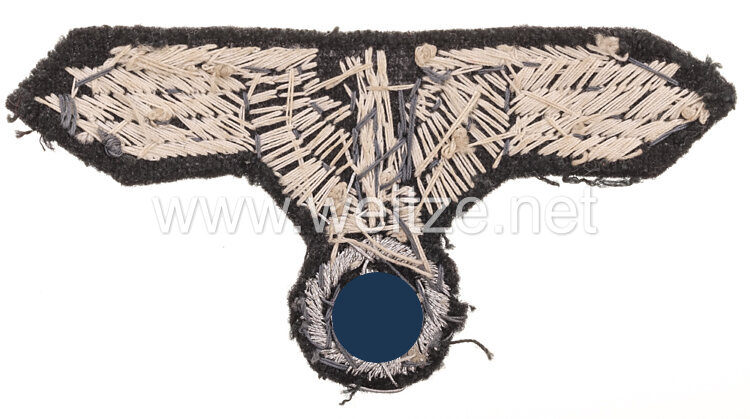
Waffen-SS Sleeve Eagle for Officers

Foreign manufacture, hand-embroidered metal thread. Lightly worn, removed from uniform, in good condition. Very rare.
458488
1.200,00

Waffen-SS Sleeve Eagle for Officers

The Waffen-SS Arm Eagle for Leaders represents a significant example of the complex uniform regulations of National Socialist military organizations during World War II. This particular insignia was worn by leaders (non-commissioned and commissioned officers) of the Waffen-SS on the left upper arm of their uniforms and served as an important rank insignia within the hierarchical structure of this organization.

The Waffen-SS, officially established as the armed wing of the Schutzstaffel (SS), developed from 1939 into a military formation that operated parallel to the Wehrmacht. The uniform regulations and insignia of the Waffen-SS were governed by various service regulations, with the arm eagle being a central element of uniform design. Unlike enlisted ranks who wore woven eagles, leaders from the rank of SS-Unterscharführer upward received hand-embroidered versions of superior quality.

The specimen described here shows characteristic features of foreign manufacture. During the war, especially from 1943 onward, uniform parts and insignia were increasingly produced outside Germany. This occurred for various reasons: the overload of domestic production capacities, the relocation of manufacturing facilities due to Allied bombing raids, and the recruitment of foreign volunteers, for whose equipment local workshops were often utilized. Known production sites for SS insignia were located in occupied territories, particularly in Belgium, the Netherlands, France, and later in the Baltic states.

The hand embroidery with metal thread characterizes the higher quality level of these insignia. While simple enlisted ranks wore machine-woven eagles on field-grey or black backgrounds, leader badges were more elaborately manufactured. The metal thread typically consisted of aluminum or silver-plated wire embroidered onto a black or field-grey cloth background. The eagle itself followed the characteristic SS design: a left-facing eagle with spread wings, holding a swastika in its talons.

The fact that the piece was lightly worn and removed from the uniform corresponds to the fate of many such insignia. After the war ended in 1945, many former SS members removed their badges to conceal their affiliation, as SS members were subject to special scrutiny when captured by the Allies. The characteristic blood group tattoo under the left arm, however, often made SS members identifiable nonetheless.

The rarity of such leader badges is explained by several factors. First, leaders were numerically far less represented than enlisted ranks. Second, fewer hand-embroidered specimens survived the turmoil of war and the post-war period. Third, after 1945, Nazi memorabilia was systematically destroyed in many countries or its possession prohibited. The foreign manufacture makes this specimen additionally interesting for military-historical research, as it provides insight into the decentralized production structures and the international dimension of the Waffen-SS.

From today's perspective, such objects are important historical sources for researching the Nazi era, uniform studies, and the military history of World War II. They document the organizational structures, production methods, and material culture of a criminal organization. The scholarly engagement with such artifacts occurs in the context of critical examination of the National Socialist past and serves historical understanding, not glorification.

The “good” condition despite wear and removal speaks to the quality of manufacture and careful preservation in the decades since the war's end. Such objects are today found in museums, scholarly collections, and with private collectors, with their trade regulated differently in various countries. In Germany, for example, trade in Nazi memorabilia is generally permitted as long as unconstitutional symbols are made unrecognizable or the trade occurs within the framework of art, science, or historical education.

The study of these insignia contributes to our understanding of the material aspects of the Nazi regime and serves as a tangible reminder of a dark chapter in human history. They remain subjects of academic study, helping historians piece together the complex organizational and operational structures of the Waffen-SS, while serving as educational tools to ensure that the lessons of history are not forgotten.

r