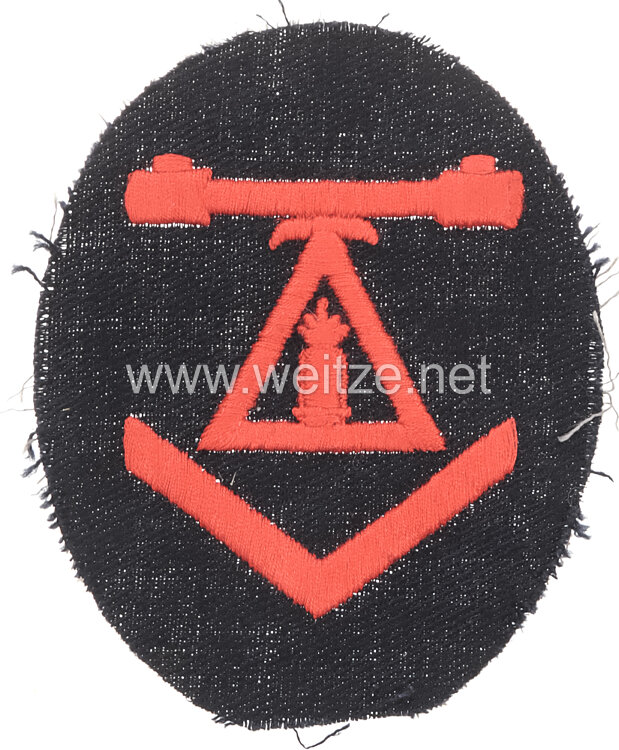
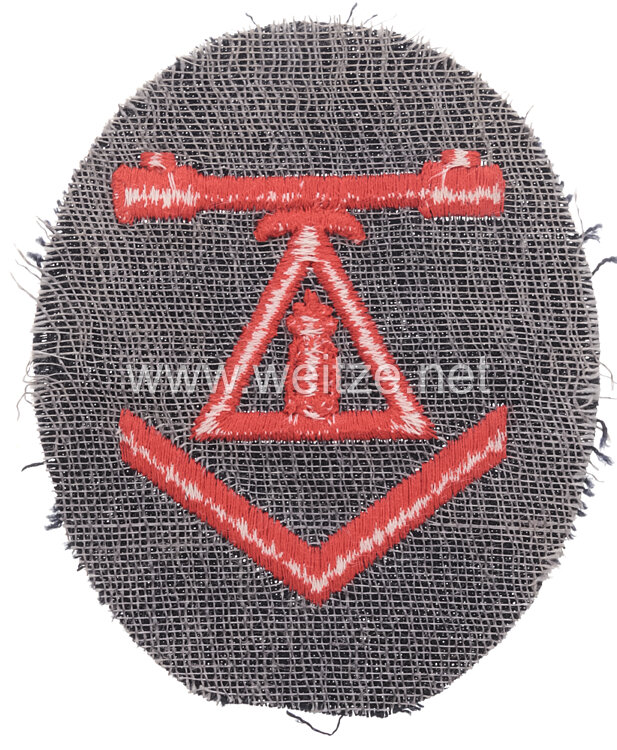
Kriegsmarine Sleeve Insignia for Specialized Training Rangefinder with Naval Target and Rangefinder Training
The Kriegsmarine Sleeve Badge for Special Training in Range Finding with Sea Target and Range Measurement Training represents a significant training insignia of the German Kriegsmarine during World War II. These special sleeve badges were introduced to visibly display the acquired expertise and qualifications of naval personnel in highly specialized technical fields.
The Kriegsmarine recognized early on the importance of precise range finding for the effectiveness of naval artillery. Training as a range finder operator was extremely demanding and required both theoretical knowledge and practical skills. Bearers of this badge had completed comprehensive training in two areas: sea target measurement for surface targets and E-measurement (range measurement) with optical instruments.
The introduction of such special training badges occurred within the framework of Kriegsmarine uniform regulations, which were defined in the Dress Regulations for the Kriegsmarine. These badges were worn on the blue blouse, the working and shipboard uniform of enlisted men and petty officers. The blue blouse was the standard working dress aboard warships and submarines, distinct from the white summer uniform and the dark blue walking-out dress.
Range finder operators played a central role in the Kriegsmarine's fire control system. They worked with highly precise optical instruments, the so-called range finding devices or rangefinders, which were based on the principle of stereoscopy. These devices, often with base lengths of several meters, made it possible to determine the distance to enemy ships with high accuracy – an essential prerequisite for successful artillery engagement at long ranges.
Training as a range finder operator took place in specialized Naval Artillery Schools, where recruits underwent intensive theoretical and practical instruction. The training included optical fundamentals, trigonometry, ballistics, and practical training on various range finding devices. The combination of sea target and range measurement training indicates a particularly comprehensive qualification that enabled the bearer to operate different measuring systems.
The sea target training focused specifically on measuring and tracking surface targets under various sea and weather conditions. This required the ability to accurately acquire targets under different visibility conditions, wave conditions, and atmospheric disturbances. The training also included recognizing different ship types and assessing their movements.
These sleeve badges were typically produced in hand embroidery or as woven versions. They were attached to the left upper arm of the blue blouse and indicated the respective specialized training through their specific design. The quality and execution of the badges could vary depending on whether they were privately procured or officially issued.
Within the context of the Kriegsmarine organization, range finder operators were part of the artillery division aboard warships. They worked closely with gun crews, gunnery officers, and other technical specialists. Their measurements were transmitted to the fire control stations, where they were incorporated into the calculation of firing parameters.
The importance of these specialists increased during the course of the war, as naval engagements were increasingly fought at longer ranges. At the same time, the development of radar technology led to a gradual supplement, but not complete replacement, of optical range finding. Optical instruments remained important, especially during radar jamming or in certain tactical situations.
The present badge in Condition 2 indicates a well-preserved, worn piece that has retained the authentic patina of time. Such training badges are today significant military-historical documents that provide insight into the complex training system and technical specialization of the Kriegsmarine.