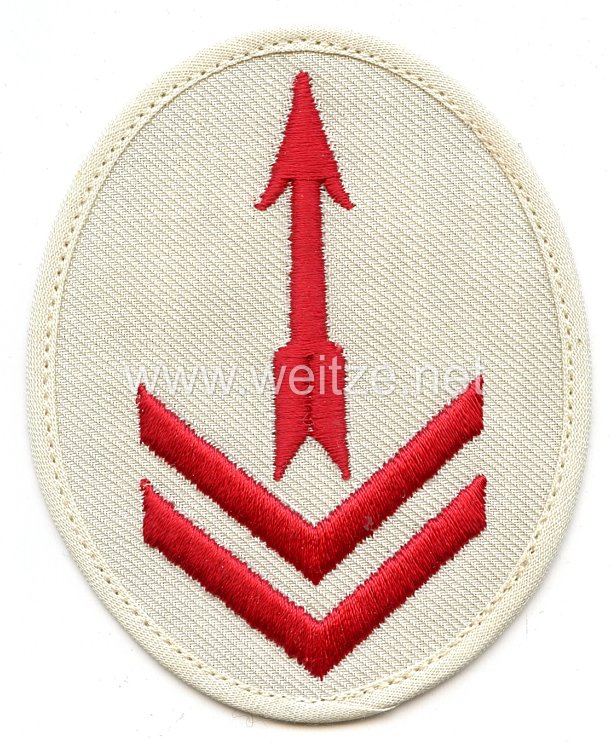
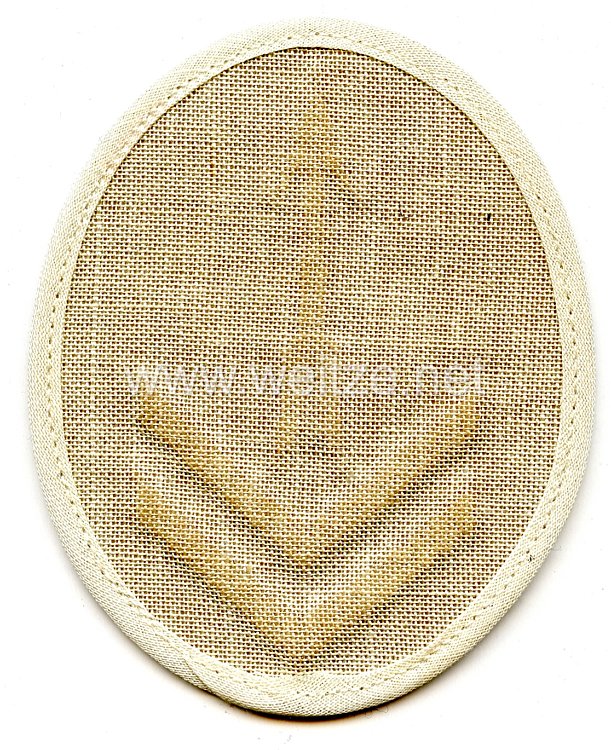
Kriegsmarine Sleeve Insignia for Special Training Flak Searchlight Director
The Kriegsmarine Sleeve Badge for Special Training in Flak Searchlight Operations represents an important aspect of specialization within the German Navy during World War II. This special badge was awarded to naval personnel who had successfully completed advanced training in anti-aircraft searchlight operations.
The Kriegsmarine recognized early the necessity of defending its ships and harbor installations against increasing air attacks. Searchlights played a crucial role in nocturnal anti-aircraft defense by making enemy aircraft visible to flak guns. Training as a Flak-Scheinwerferführer (flak searchlight operator) required specialized knowledge in optics, target acquisition, coordination with flak batteries, and the technical aspects of searchlight systems.
The badge was worn on the white tunic of the naval uniform, indicating the summer uniform. The Kriegsmarine strictly distinguished between different uniform types, and the white uniform was worn in warmer climates or during summer months. The placement of career badges and specialization insignia followed precise regulations established in the Kriegsmarine's uniform directives.
The system of special training badges was systematically developed in the Kriegsmarine to identify the diverse specializations within the navy. These badges served multiple purposes: they enabled quick identification of specialist personnel, promoted pride in acquired qualifications, and contributed to the structure of military hierarchy. Besides the flak searchlight operator badge, numerous other specialization badges existed for areas such as communications, torpedo technology, mine warfare, and many other technical fields.
The production of such badges was carried out by various authorized manufacturers who had to meet the strict quality standards of the Kriegsmarine. The badges were typically hand-embroidered using various materials such as metallic threads, wool, or cotton. Quality and execution could vary depending on the manufacturer and production period, with early war productions often showing higher quality than later wartime manufactures.
The importance of flak defense increased throughout the course of the war. With the intensification of the Allied air offensive, warships and naval bases had to continuously expand their air defense capabilities. Searchlights with diameters ranging from 60 to 150 centimeters were deployed, often in combination with sound locators and later with radar installations. Searchlight operators had to work closely with flak crews to ensure effective night defense.
Training as a flak searchlight operator included theoretical and practical components. Soldiers learned the fundamentals of ballistics, aircraft identification, optical principles, and the operation of complex searchlight systems. They needed to be capable of tracking fast-moving targets and coordinating their actions with other defensive elements. Successful completion of this training entitled the wearer to display the corresponding sleeve badge.
Today, such sleeve badges are important historical artifacts that provide insight into the organizational structure and specialization of the Kriegsmarine. They are subjects of military historical research and are preserved by collectors and museums as testimonies to naval history. The condition of such objects is evaluated according to a standardized system, taking into account various factors such as preservation, originality, and completeness.