Italian Dagger for Leaders of the Fascist Militia MVSN.
The Dagger for Leaders of the Fascist Militia (MVSN) represents a significant symbol of the political and paramilitary structure of Fascist Italy under Benito Mussolini. The Milizia Volontaria per la Sicurezza Nazionale (MVSN), also known as the Blackshirts or Camicie Nere, was officially established on January 14, 1923, and served as the military organization of the Fascist Party.
The MVSN emerged from the Squadre d'Azione, the paramilitary combat units that had played a central role during Mussolini's rise to power. After the March on Rome in October 1922, the organization was formalized and integrated into the state structure, yet remained directly subordinate to the Fascist Party. The militia swore its oath not to the King, but to Mussolini personally, which illustrated its special position within the Fascist state.
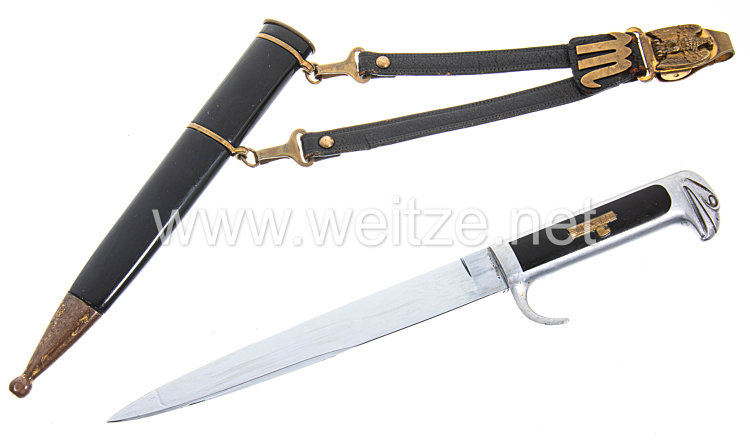
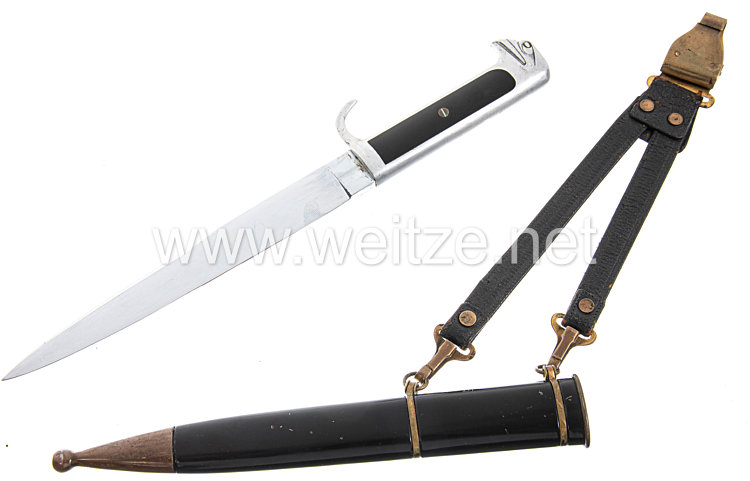
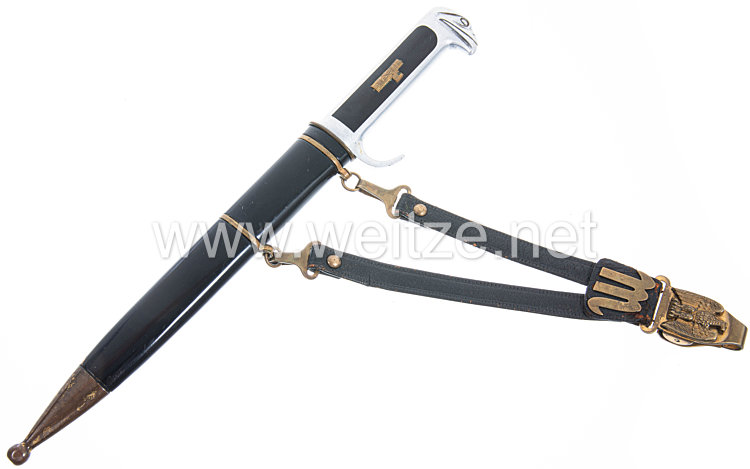
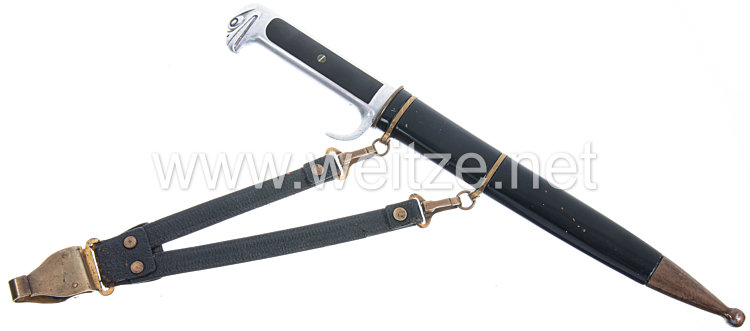
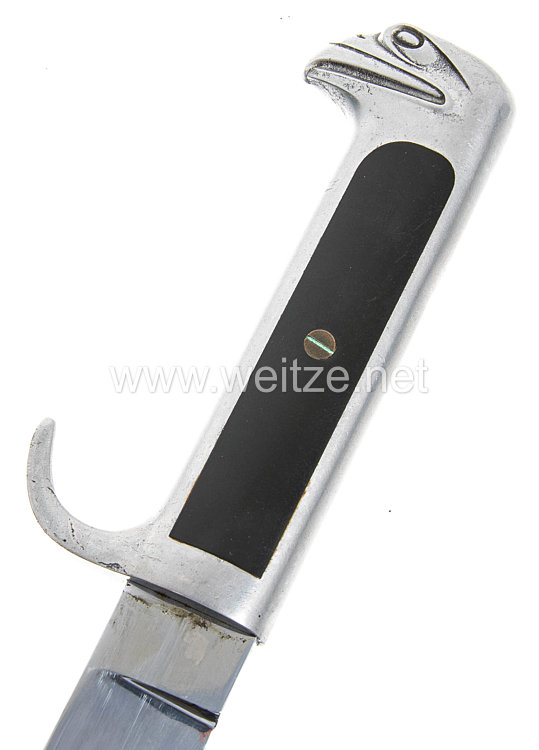
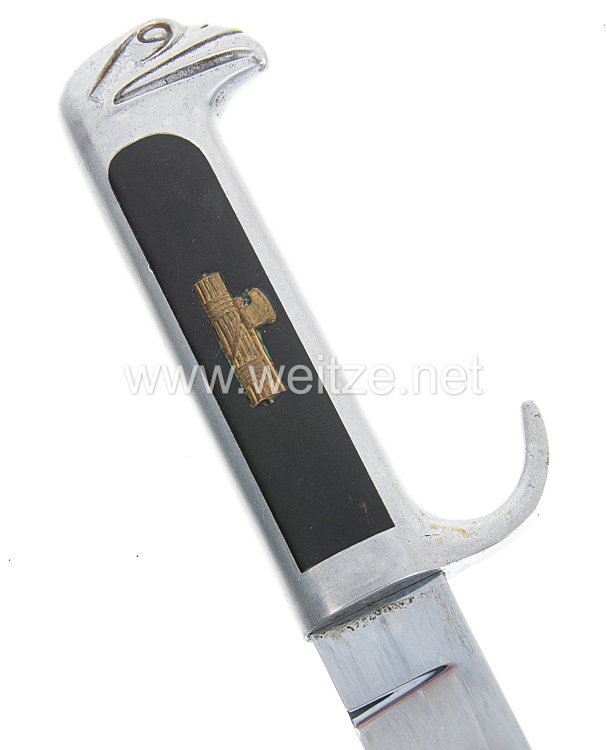
The specimen described here displays the characteristic features of an MVSN leader's dagger. The nickel-plated wedge blade corresponds to the standardized specifications prescribed for officers and leaders of this organization. The aluminum hilt with bird-head pommel is typical of Italian military tradition and symbolizes the Roman eagle, a central component of Fascist iconography that deliberately referenced the ancient Roman Empire.
Particularly significant are the black grip scales with the inlaid fasces (Fascio littorio). This symbol, consisting of a bundle of rods with an inserted axe, was the central emblem of Italian Fascism and gave the movement its name. In Roman antiquity, the lictors carried these fasces as a sign of magisterial authority before the magistrates. Mussolini adapted this symbol to embody his ideology of national unity and strength.
The black-lacquered scabbard with brass fittings conforms to the official regulations for MVSN leader daggers. The choice of black directly referenced the uniform color of the Blackshirts and became an iconic identifying feature of the organization. The brass fittings served not only practical purposes but also gave the dagger the representative character required for a leader's insignia.
The rare leather hanger with applied “M” is of particular historical significance. The “M” stood for Mussolini and made clear the personal connection between the Duce and the bearers of this weapon. The carrying clip with applied eagle reinforced the Roman-imperial symbolism and underscored the Fascist regime's claim to continue the legacy of ancient Rome.
The MVSN was organized into various ranks and hierarchies. Leader daggers of this type were typically issued to officers from the rank of Centurione (Centurion) upward. At its height, the organization comprised several hundred thousand members and played an important role in internal security, political control, and later also in military operations during the Abyssinian War (1935-1936) and World War II.
The manufacture of such daggers was carried out by various Italian weapons makers, with quality and execution varying depending on the manufacturer. The absence of a maker's mark on the blade was not uncommon, as not all producers marked their products. The craftsmanship quality and the use of specific materials such as aluminum for the hilt reflect Italy's industrial capabilities during the interwar period.
After the collapse of the Fascist regime in July 1943 and Italy's final capitulation, the MVSN was officially dissolved. Many of the daggers and other insignia were destroyed or lost. Surviving examples like the one described here are today important historical artifacts that provide insight into the material culture and symbolism of Italian Fascism.
For collectors and historians, such objects are of particular interest because they embody the connection between military tradition, political ideology, and symbolic representation. The very good condition of this specimen makes it a valuable testimony to this historical epoch.