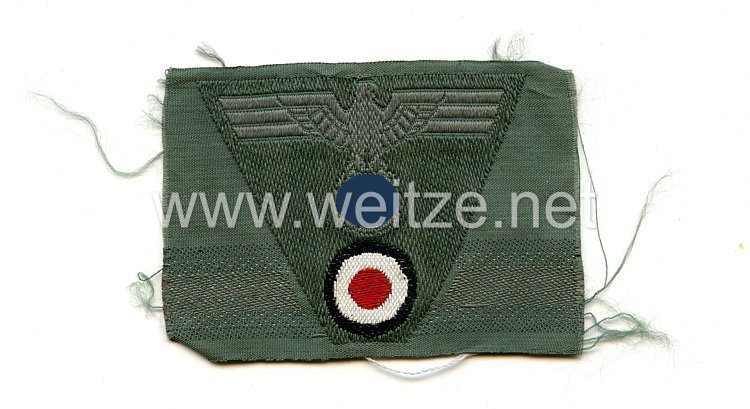
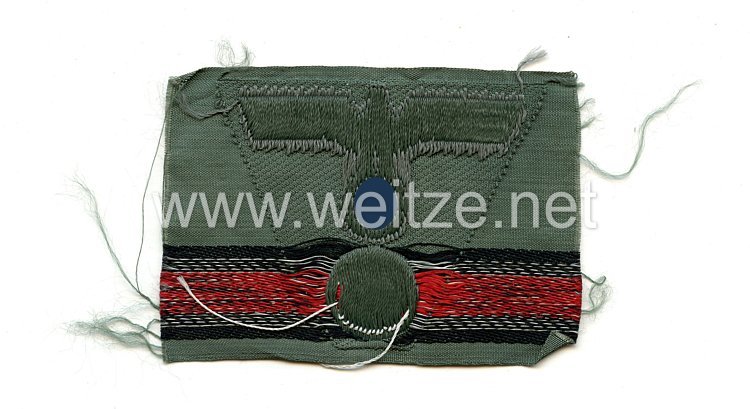
Wehrmacht Heer Cap Eagle for the Model 43 Field Cap for Enlisted Men

Bevo-woven version circa 1943. Unissued condition, condition grade 2.
422387
70,00

Wehrmacht Heer Cap Eagle for the Model 43 Field Cap for Enlisted Men

The Wehrmacht cap insignia for the M 43 field cap represents a significant piece of equipment used by German armed forces during World War II. This particular version in BeVo woven technique was manufactured around 1943 and was intended for enlisted men of the Army.

The M 43 field cap (Einheitsfeldmütze M 43) was introduced in spring 1943 as a simplified headgear designed to replace previous models. It emerged from the necessity to rationalize production and conserve materials while creating a more practical field cap. The cap was part of general efforts to simplify uniforms from 1943 onwards, as the German Reich's resources became increasingly scarce.

The cap insignia itself consisted of the national emblem – a stylized eagle with spread wings clutching a swastika in its talons. This symbol had been worn on all Wehrmacht uniform items since 1935 and represented state authority. For enlisted men, soldiers without non-commissioned officer rank, the design was typically simpler than that for officers.

The BeVo weaving technique was a special manufacturing method named after the Barmer Elberfelder Vereinigte Textilwerke AG (BeVo). This technique made it possible to weave complex patterns and emblems directly into the fabric rather than embroidering them. The process was more cost-effective and faster than traditional embroidery and was increasingly employed from 1943 onwards, when war production demanded maximum efficiency. BeVo emblems were characterized by their flat structure and distinctive weave, often using gray or white threads on field-gray or dark green backing.

The M 43 field cap itself was a development of the earlier M 42 field cap and differed from the older side cap (Schiffchenmütze). It had a characteristic shape with a longer visor and ear flaps that could be folded down when needed. The cap offered better protection against weather conditions and was more practical in combat situations than earlier models.

The cap insignia was typically attached to the front of the cap, centered above the forehead. The exact positioning was regulated by uniform regulations that meticulously prescribed correct wearing. For attachment, the emblems were either sewn directly on or, in better-quality versions, machine-applied to a backing material that was then affixed.

The condition described as “unworn” is particularly noteworthy for such emblems, as most examples were actually used during the war and show corresponding signs of wear. Unworn pieces often remained in depots or were requisitioned at war's end before they could be put into service. The condition rating of 2 indicates a very good to mint condition according to common militaria collector classifications.

Production of such emblems occurred in various facilities throughout the Reich territory. Quality could vary depending on the manufacturer and time of production. Toward the end of the war, materials often became inferior and workmanship simpler. The present example from around 1943 dates from a period when production standards were still relatively high.

From a historical perspective, such uniform items document the development of military equipment and the economic constraints under which the Wehrmacht operated in the second half of the war. The introduction of simplified uniforms and more cost-effective manufacturing methods reflects the increasing strain on the German war economy. At the same time, they demonstrate efforts to maintain uniform and recognizable dress despite all limitations.

The context of 1943 is particularly significant. This year marked a turning point in the war, following the defeat at Stalingrad and increasing pressure on all fronts. The Wehrmacht was transitioning from offensive to defensive operations, and this shift was reflected even in uniform regulations and production methods.

Today, such emblems are important historical documents preserved in museums and collections for research and documentation of this period. They help us understand the material culture of the Wehrmacht and serve as illustrative material for military-historical research and educational work. Their study contributes to a comprehensive understanding of how military organizations functioned and how wartime economies adapted to increasing pressures.