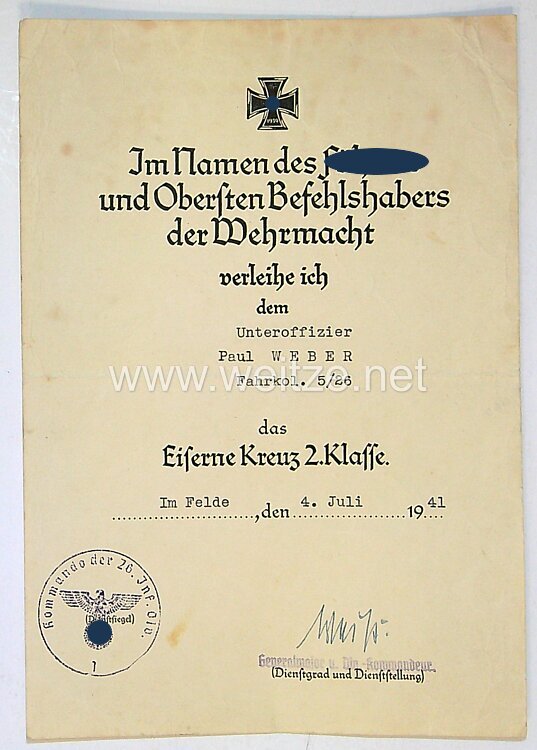
Award Document for the Iron Cross 2nd Class / Fahrkol. 5/26, Inf. Reg 26, Flensburg

For a non-commissioned officer, issued on July 4, 1941. Signed by Generaloberst Walter Weiß,- Knight's Cross (12.9.1941),- Oak Leaves (5.11.1944 646th award),- German Cross in Gold (19.2.1943).  The document is creased and folded, condition 2-
455087
150,00

Award Document for the Iron Cross 2nd Class / Fahrkol. 5/26, Inf. Reg 26, Flensburg

This award certificate for the Iron Cross 2nd Class represents an authentic document from German military history during World War II. Issued on July 4, 1941, it documents the conferral of this significant decoration to a non-commissioned officer of Fahrkolonne 5/26 (Supply Column 5/26) of Infantry Regiment 26 in Flensburg.

The Iron Cross was originally instituted in 1813 during the Wars of Liberation by King Friedrich Wilhelm III of Prussia and was renewed in modified forms in 1870/71 and 1914. On September 1, 1939, the day of the attack on Poland, Adolf Hitler renewed the decoration through a corresponding decree. The second class of the Iron Cross represented the entry-level award and was conferred significantly more frequently than the higher-ranking first class.

The military unit, Fahrkolonne 5/26 of Infantry Regiment 26, was part of the logistical support formations. Supply columns were motorized or horse-drawn transport units responsible for supplying combat troops with ammunition, rations, and other war-essential materials. Infantry Regiment 26 had its peacetime garrison in Flensburg and belonged to the 1st Infantry Division.

The award in July 1941 falls within the initial phase of Operation Barbarossa, the German invasion of the Soviet Union, which had begun on June 22, 1941. During this phase of the war, numerous decorations were conferred for participation in the initial combat operations. Logistical units such as supply columns played a crucial role in the operational mobility of German formations.

This certificate gains particular significance through the signature of Generaloberst Walter Weiß. At this time, Weiß was the Commanding General of II Army Corps, to which the 1st Infantry Division belonged. Walter Weiß (1890-1967) was a highly decorated officer who himself was awarded the Knight's Cross of the Iron Cross on September 12, 1941. He later received the Oak Leaves on November 5, 1944, as the 646th recipient, as well as the German Cross in Gold on February 19, 1943. He successively commanded various armies on the Eastern Front and was promoted to Generaloberst in 1943.

The form and design of such award certificates followed established guidelines. They were printed on high-quality paper, often with pre-printed text and handwritten entries for the recipient's personal details and the date of award. The signature of the conferring commander gave the document its authenticity and legal validity. The characteristic design frequently included symbolic elements such as the Iron Cross itself and military emblems.

The described condition of the document – creased and folded – is typical for such certificates that were carried by soldiers or kept in personal papers. This gives the document a personal dimension and emphasizes its authentic use by the recipient.

From a military-historical perspective, such award certificates are important sources for reconstructing unit histories, deployments, and individual wartime biographies. They document not only military recognition but also allow conclusions about the organization of the Wehrmacht, its command structures, and the practice of conferring decorations. The fact that a non-commissioned officer of a supply column received the Iron Cross demonstrates that members of supply units could also be decorated for special achievements or service under danger.

The historical contextualization of such documents requires critical distance. They are testimonies of a war of aggression and a criminal regime, yet simultaneously authentic sources for military-historical research. Their preservation serves historical documentation and the critical examination of this dark period of German history.