Prussia Monumental Farewell Gift for Colonel Karl von Hymmen, Aide-de-Camp to the Emperor and Commander of the Leibgarde-Husaren Regiment

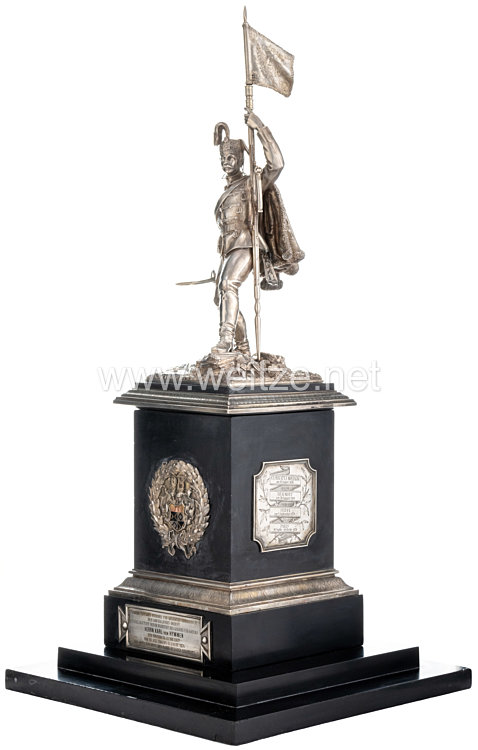
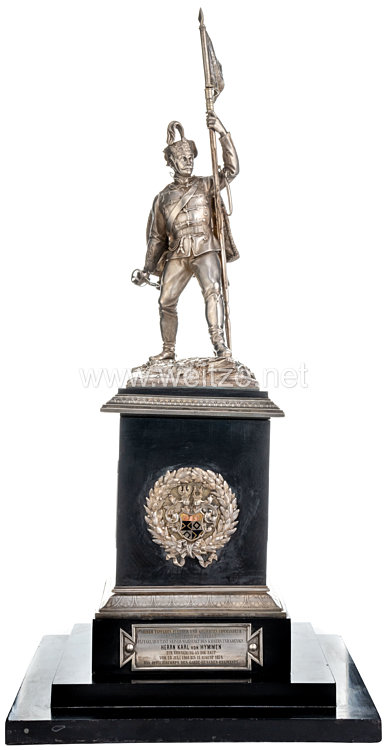
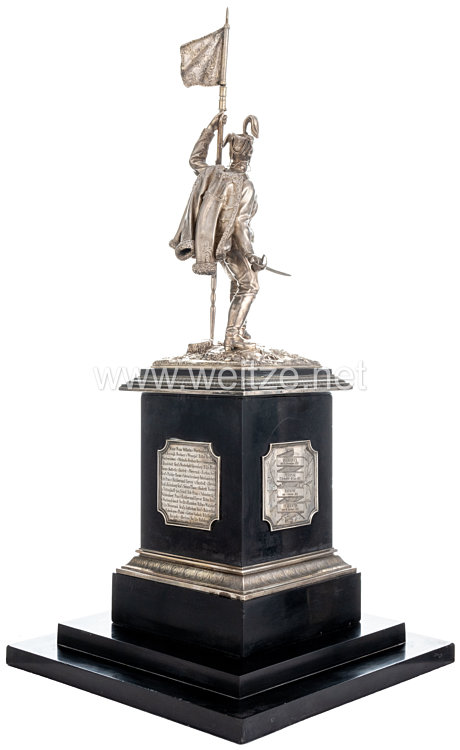
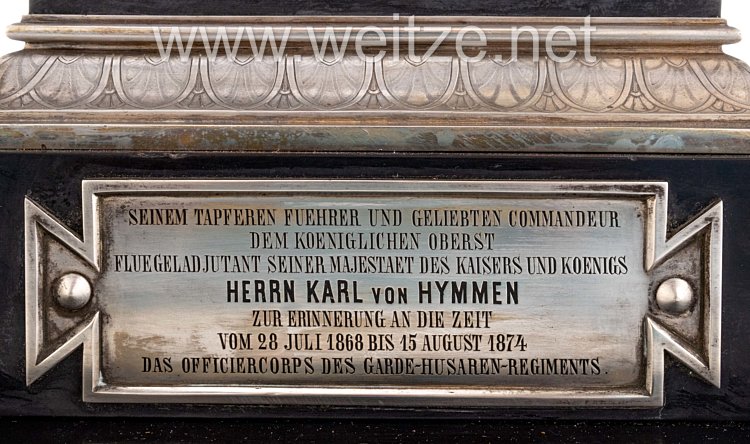
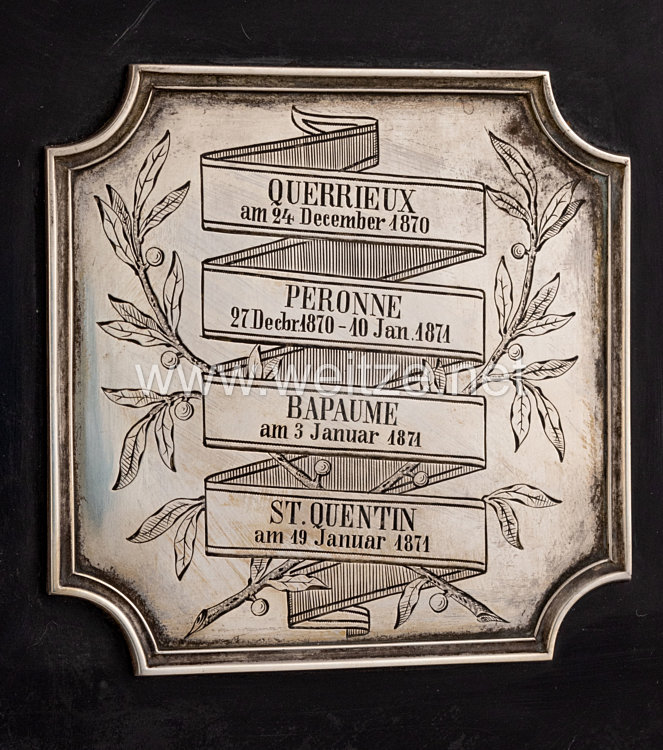
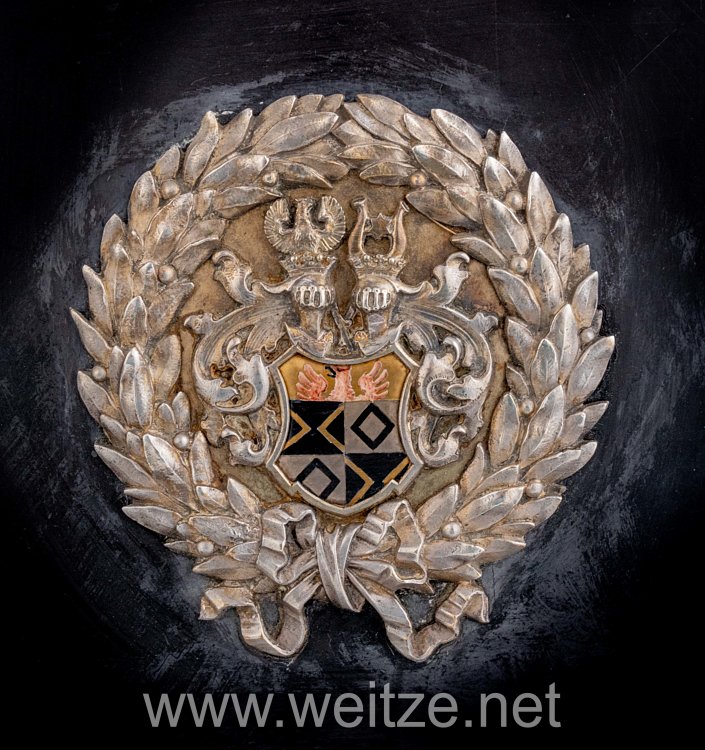
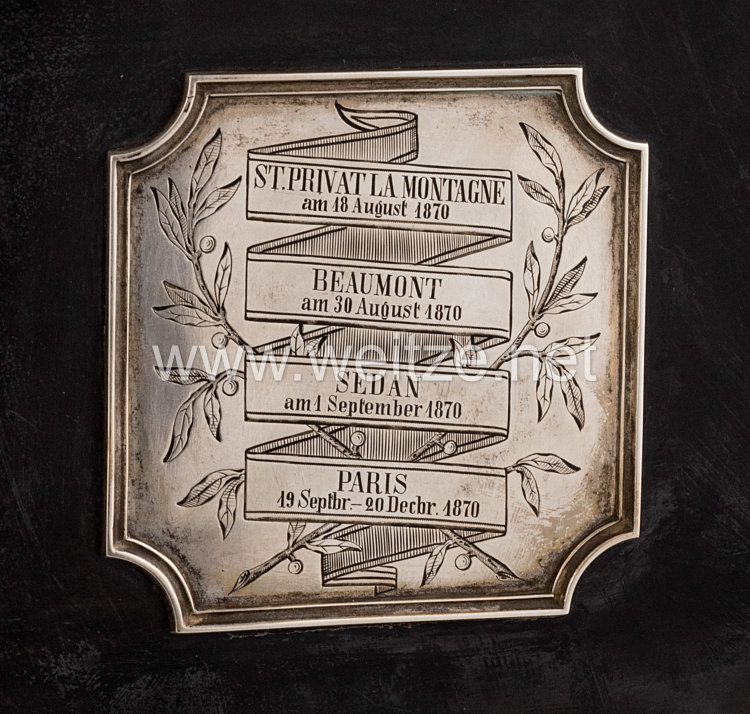
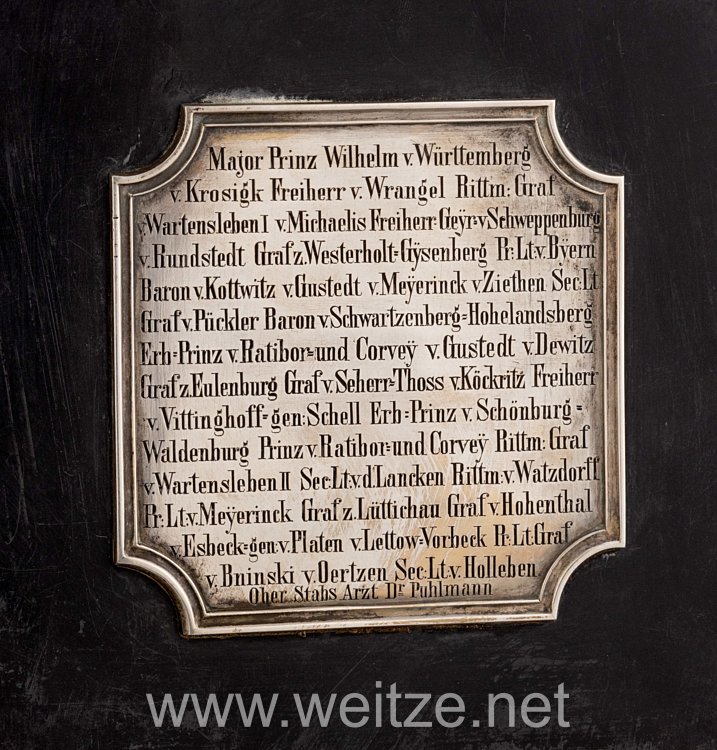
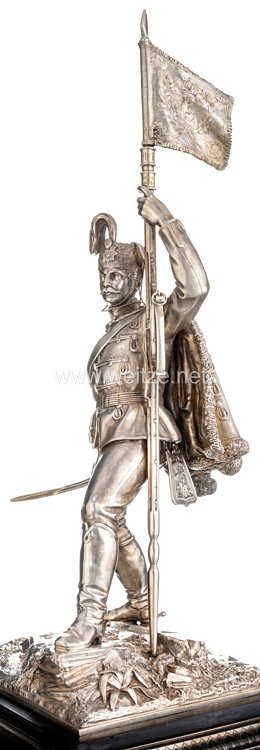
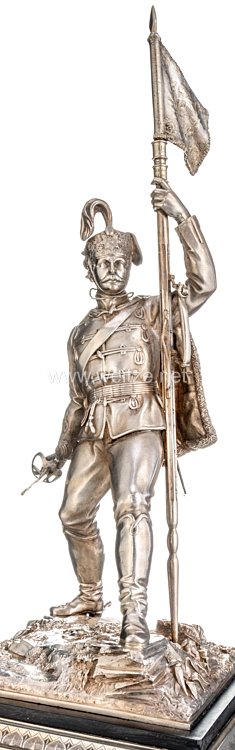
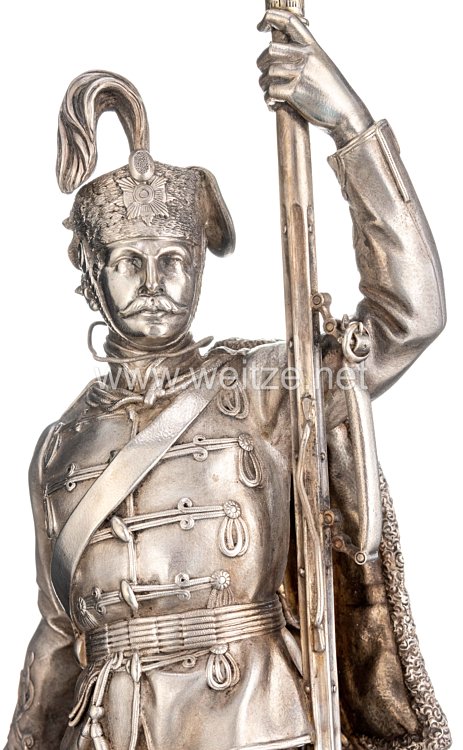
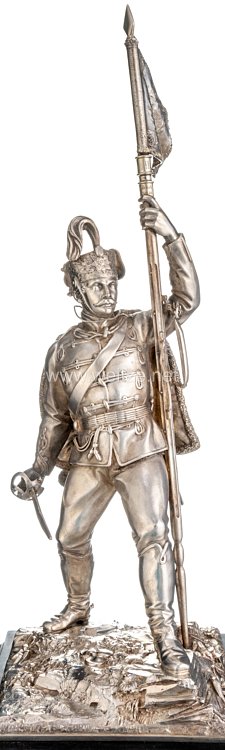
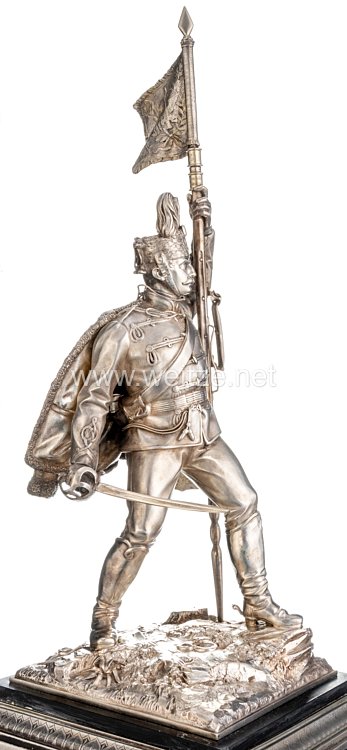
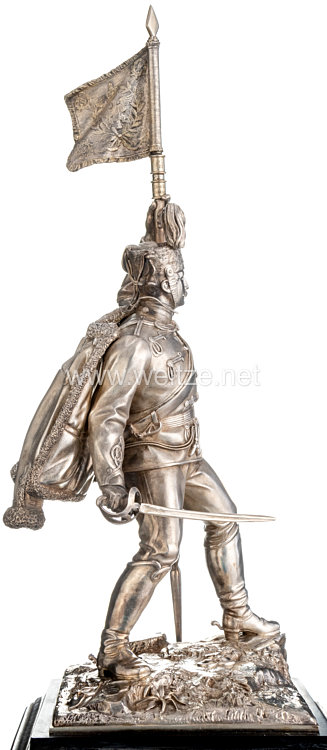
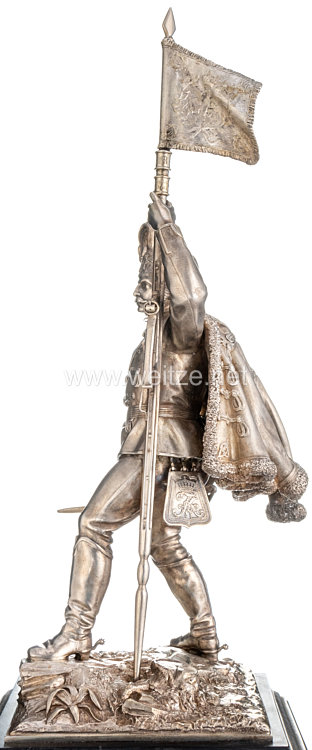
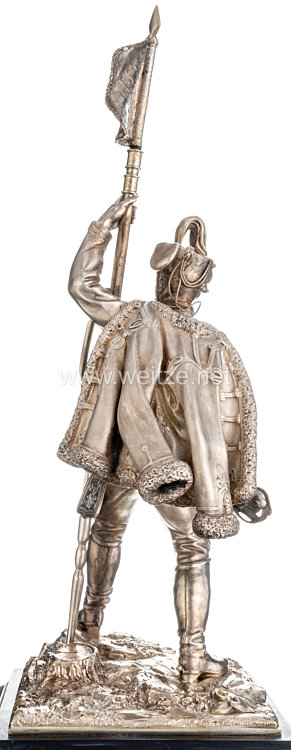
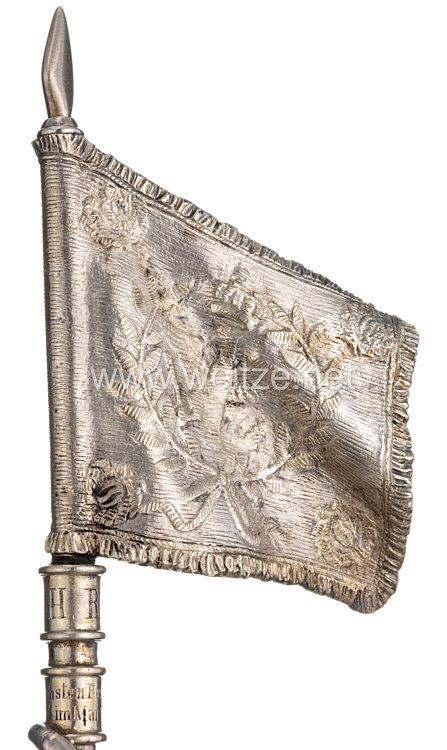
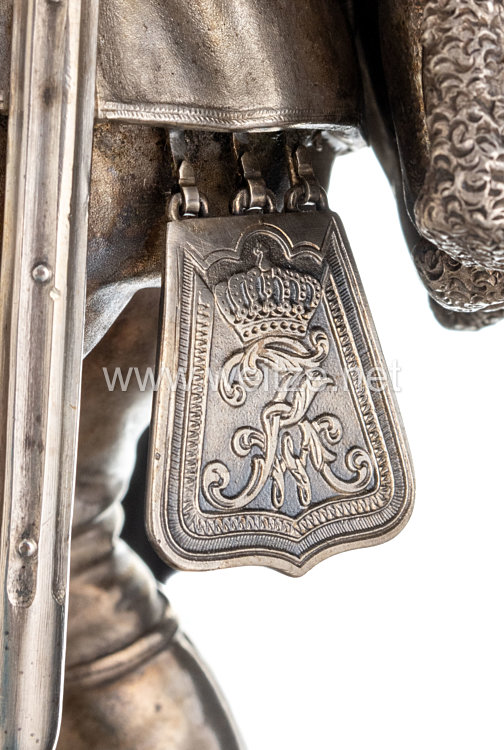
Berlin, circa 1874. This is an exceptionally fine work, likely crafted by the jeweler Wagner & Sohn, Berlin. Silver representation of the regimental standard bearer, holding the regimental standard raised in his left hand, in his right hand the drawn saber with extremely detailed depiction of the soldier, the fur cap with guard star and parade plume, the attila with shoulder belt for carrying the regimental standard, the dolman (fur) draped over the shoulder, on the left side with sabretache, the breeches with indicated hussar braiding, the boots for hussars with buckled spurs. The regimental standard faithfully detailed with all particulars: the standard cloth in finest execution, the standard staff with two double standard rings with fine engravings, the standard staff with nailing and shoulder carrying strap. The silver standard bearer stands on a tall 4-tiered black marble base, 2 base tiers mounted in silver. On the base on all 4 sides with large silver appliqués, on the front the large coat of arms of Hymmens in laurel wreath, partially enameled. On both sides left and right respectively an attached plaque with the battles participated in from the campaign 1870/71, right “St. Privat la Montagne on August 18, 1870”, “Beaumont on August 30, 1870”, “Sedan on September 1, 1870”, “Paris September 19 - December 20, 1870”, left “Querrieux on December 24, 1870”, “Peronne December 27, 1870 - January 10, 1871”, “Bapaume on January 3, 1871”, “St. Quentin on January 19, 1871”. On the reverse the large plaque with the roster of comrades “Major Prinz Wilhelm v. Württemberg, v. Krosigk, Frhr. v. Wrangel, Rittm. Graf Wartensleben, v. Michaelis, Freiherr Geyr v. Schweppenburg, Rundstedt, Graf z. Westerholt-Gysenberg, Pr. Lt. v. Byern, Baron v. Kottwitz, v. Gustedt, v. Meyerinck, v. Ziethen, Sect. Lt. Graf v. Pückler, Baron v. Schwartzenberg-Hohelandsberg, Erb-Prinz v. Ratibor und Corvey, v. Gustedt, v. Dewitz, Graf z Eulenburg, Graf v. Seherr-Thoss, v. Köckritz, Freiherr v. Vietinghoff gen. Schell, Erb-Prinz v. Schönburg-Waldenburg, Prinz v. Ratibor und Corvey, Rittm. v. Watzdorff, Pr. Lt. v. Meyerinck, Graf z. Lüttichau, Graf v. Hohenthal, v. Esberck gen. v. Platen, v. Letttow-Vorbeck, Pr. Lt. Graf v. Bninski, v. Oertzen, Sec. Lt. v. Holleben, Ob. Stabs Arzt Dr. Puhlmann”. On the lower base on the front with large dedication plaque “To our brave Baron and beloved Commander, the Royal Colonel Aide-de-Camp to His Majesty the Emperor and King, Herr Karl von Hymmen, in remembrance of the time from July 28, 1868 to August 15, 1874 - The Officer Corps of the Garde-Husaren-Regiment”.
Overall height 66 cm, weight 26 kg, the standard finial was renewed in earlier times, otherwise with light patina in very fine condition.
An impressive officer's gift, absolutely unique in this size and execution!


419287

Prussia Monumental Farewell Gift for Colonel Karl von Hymmen, Aide-de-Camp to the Emperor and Commander of the Leibgarde-Husaren Regiment

This monumental gift embodies Prussian officer culture of the nineteenth century in its most impressive form. Produced in Berlin in 1874, the presentation was given to Colonel Karl von Hymmen by his officers when he relinquished command of the Garde-Husaren-Regiment after nearly six years of service. Von Hymmen held an extraordinary dual position: he served not only as regimental commander but simultaneously as Flügeladjutant to the Kaiser, a position of the highest trust that was awarded only through personal selection by the monarch.

The von Hymmen family was a Prussian noble family that had been ennobled in the eighteenth century. Karl von Hymmen led the regiment from 28 July 1868 to 15 August 1874 through one of the most significant periods in German military history. The Garde-Husaren-Regiment was founded on 21 February 1815 and was initially stationed in Berlin, then from 1823 onwards in Potsdam. As part of the Gardekorps, it belonged to the elite units of the Prussian Army. The regiment existed until 1919, when it was dissolved following the armistice of Compiègne and the end of the First World War along with the monarchy.

The campaign chronicle engraved on the side faces of the base documents the regiment's participation in the Franco-Prussian War of 1870-71. The right side records the battles of St. Privat la Montagne on 18 August 1870, Beaumont on 30 August 1870, Sedan on 1 September 1870, and the siege of Paris from 19 September to 20 December 1870. The left side lists Querrieux on 24 December 1870, Péronne from 27 December 1870 to 10 January 1871, Bapaume on 3 January 1871, and St. Quentin on 19 January 1871. These engagements represent the central role of Prussian cavalry in the decisive phases of the war.

The rear plaque preserves the names of the comrades who served under von Hymmen's leadership: Major Prince Wilhelm of Württemberg, Cavalry Captain Count Wartensleben, Baron Geyr von Schweppenburg, Rundstedt, Count zu Westerholt-Gysenberg, and many other members of the Prussian high nobility who served as officers in this prestigious regiment. The list concludes with Senior Medical Officer Dr. Puhlmann, underscoring the comprehensive representation of the officer corps.

The silver figure of the standard bearer displays the characteristic parade uniform of the Garde-Husaren with extraordinary attention to detail: the pelzmütze (fur cap) with garde star and parade plume, the attila with hanging bandolier for the regimental standard, the dolman (fur) draped over the shoulder, the sabre pouch on the left side, the trousers with indicated embroidery, and the typical hussar boots with strapped spurs. The regimental standard itself is rendered with every detail: the flag cloth, the flag pole with two double flag rings bearing fine engravings, the nail decoration, and the shoulder carrying strap.

Standing on a four-tiered black marble base, the monument reaches a total height of 66 centimeters with a weight of 26 kilograms. Two tiers of the base are mounted in silver. The front bears the large, partially enameled coat of arms of the von Hymmen family in a laurel wreath, as well as the large dedication plaque inscribed: “Seinem tapferen Freiherr und geliebten Commandeur dem Koeniglichen Oberst Fluegeladjutant seiner Majestaet des Kaisers und Koenigin Herrn Karl von Hymmen zur Erinnerung an die Zeit vom 28. Juli 1868 bi 15. August 1874 - Das Officierscorps des Garde-Husaren-Regiments.”

The workmanship is attributed to the Berlin jeweler Wagner & Sohn, a renowned court supplier to the Prussian royal house. The firm was founded by Johann Adam Wagner and after 1873 continued by Emil August Albert Wagner, who from 1859 collaborated with François Louis Jérémie Sy. The company was located at Unter den Linden 30 in Berlin from 1869. Such farewell gifts were an integral part of Prussian officer culture, but this example is absolutely unique in its size and execution. The flag tip was renewed at an earlier time.

r