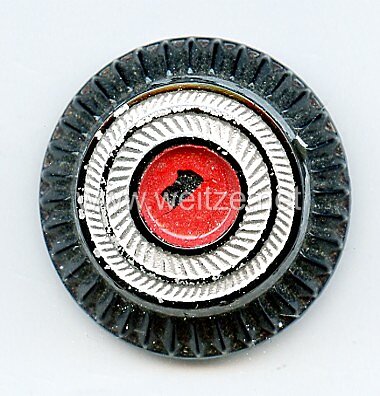
Kriegsmarine Cockade for Enlisted Men's Visor Cap
The Kriegsmarine cockade for the peaked cap represented an essential insignia of the German Navy during World War II. This specific cockade for enlisted personnel represented national identity and membership in the maritime force of the Third Reich.
The traditional cockade in the German national colors of black-white-red had a long history in the German Navy. Similar cockades were already used in the Imperial Navy, and this tradition continued through the Reichsmarine of the Weimar Republic to the Kriegsmarine. With the seizure of power in 1933 and the renaming of the Reichsmarine to Kriegsmarine in 1935, uniform regulations were revised.
The cockade described here dates from the late war period around 1943/44 and exhibits a special material characteristic: it was manufactured from glass. This unusual material choice reflects the economic situation of the German Reich in the final phase of the war. While earlier cockades were typically made from metal, enameled, or from other traditional materials, the increasing shortage of raw materials forced the German armaments industry to seek substitute solutions.
From 1943 onwards, resource scarcity intensified dramatically. Metals such as aluminum, brass, and other alloys were needed as a priority for war-essential equipment. The use of glass for uniform insignia was a substitute material solution typical for this period. The glass was painted with colored lacquer to represent the characteristic colors of the national flag: the black core, surrounded by a white ring and an outer red ring.
The peaked cap (also called service cap) was the official headgear for members of the Kriegsmarine in service and walking-out dress. For enlisted personnel, the cockade differed in size and partly in execution from those of non-commissioned officers and officers. The cockade was attached above the cap band bearing the inscription “Kriegsmarine.”
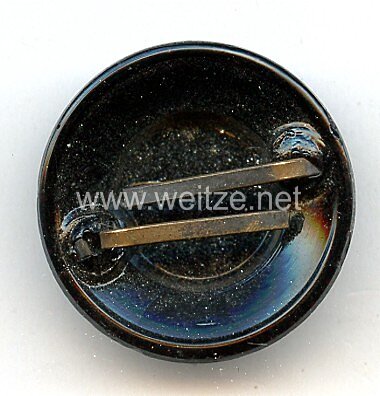
The rear attachment using two fastening prongs was the standard method for such insignia. These prongs were pushed through the cap cloth and bent over on the inside to securely fix the cockade. This type of fastening ensured a firm hold even under the demanding conditions of naval service.
The stated unworn condition of this specimen is remarkable. Many uniform items from this late war phase were immediately used or were lost in the chaos of the war's end. Unworn pieces made of glass are particularly rare, as the material was fragile and could easily be damaged during improper storage.
The production of uniform insignia was subject to strict regulations in the Kriegsmarine. The Dress Regulations for the Kriegsmarine (A.O.K.) detailed the appearance and wearing of all uniform items. Various supplier companies produced these insignia, with quality and materials varying depending on the time of manufacture.
In the context of maritime uniform history, this cockade represents an important transition from traditional craftsmanship to wartime emergency solutions. It documents not only military hierarchy and identity, but also the economic constraints of the late war years. The use of glass as a substitute material demonstrates the adaptability of the German armaments industry, but also the increasing desperation in the face of dwindling resources.
Today, such glass cockades from the final phase of World War II are sought-after collectibles and important historical artifacts. They offer insights into material economy, uniform history, and the general military organization of the Third Reich. For military historians and collectors, they represent valuable primary sources documenting the development and decline of the Kriegsmarine.