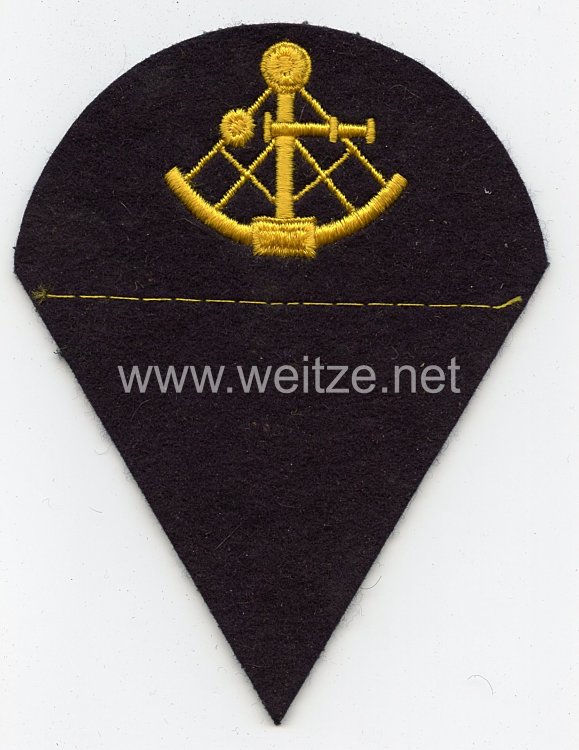
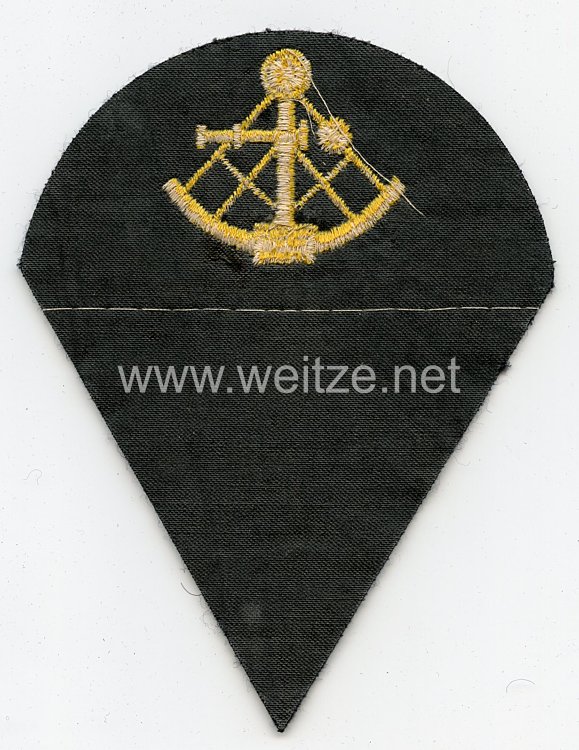
Kriegsmarine Enlisted Ranks Sleeve Insignia for Survey Career Path

Version for the colani uniform, with foxing, condition 2-3.
376687
20,00

Kriegsmarine Enlisted Ranks Sleeve Insignia for Survey Career Path

The Kriegsmarine sleeve badge for enlisted personnel of the surveying career path (Vermessungslaufbahn) represents a fascinating example of the detailed specialization insignia within the German Navy during World War II. These badges served for immediate identification of naval personnel with specific technical qualifications and were an essential component of the Kriegsmarine's complex uniform system.

The Vermessungslaufbahn (surveying career) was a highly specialized profession within the Kriegsmarine, dealing with hydrographic surveys, cartography, and nautical measurements. Survey personnel were responsible for creating and updating nautical charts, measuring ocean depths, currents, and other maritime data. These tasks were critically important for fleet navigation, particularly for submarine operations and amphibious landings.

The introduction of specialized career badges occurred gradually within the framework of the Kriegsmarine's uniform regulations. Following the re-establishment of the German Navy in the 1930s, a comprehensive system of career and specialist badges was developed, oriented toward the traditions of the Imperial Navy while also considering modern requirements. The surveying career received a distinctive symbol that typically depicted nautical measuring instruments or cartographic elements.

The specimen described here was manufactured in the version for Kolani, referring to the dark blue uniform cloth. The Kriegsmarine distinguished between various uniform types: Kolani was the traditional navy blue fabric for service uniforms, while white tropical uniforms and other variants existed for special deployment areas. Sleeve badges were manufactured in matching color versions, with embroidery on dark backgrounds typically executed in light colors such as yellow, silver, or white.

The wearing of these badges was precisely regulated in the Kriegsmarine's uniform regulations. Career badges for enlisted ranks were usually worn on the right upper arm, above the elbow. The exact position and number of badges depended on rank and qualifications. While officers often indicated their specialization through sleeve stripes and other insignia, embroidered cloth badges were standard for enlisted ranks.

The manufacture of such badges was carried out by specialized military equipment factories and civilian suppliers. Quality varied considerably depending on the manufacturer and production period. Early wartime productions often showed finer handwork and higher-quality materials, while later examples from the period after 1943 frequently featured simplified versions with machine production and substitute materials. Embroidery could be executed in various ways: applied directly to uniform cloth or on a separate base fabric that was then sewn onto the uniform.

The historical context of these badges is inseparably connected with the expansion of the Kriegsmarine in the late 1930s and early 1940s. With the growth of the fleet, the need for specialized personnel also increased. Survey vessels such as the “Meteor” and other research and survey units played an important role in preparing military operations. The hydrographic data collected by survey personnel were invaluable for planning U-boat campaigns in the Atlantic and for operations in coastal waters.

The mentioned foxing stains are typical aging effects on textiles from this period. They result from moisture and microbial growth during storage over decades. The indicated condition grade 2-3 corresponds to a good to satisfactory state of preservation in collector evaluation, with the badge showing signs of use but still retaining all essential details.

For collectors and military historians, such sleeve badges offer important insights into the organization and structure of the Kriegsmarine. They document not only the military hierarchy but also the technical complexity of naval warfare. Each career badge represents a specialized field of activity that was necessary for operating a modern war fleet. The surveying career, though less well-known than combat specialists, was essential for the operational effectiveness of the entire navy.

Today, authentic Kriegsmarine sleeve badges are sought-after collector's items that should be carefully documented and conserved. They are material witnesses of a significant historical period and help complete the complex picture of the military organization of the Third Reich.