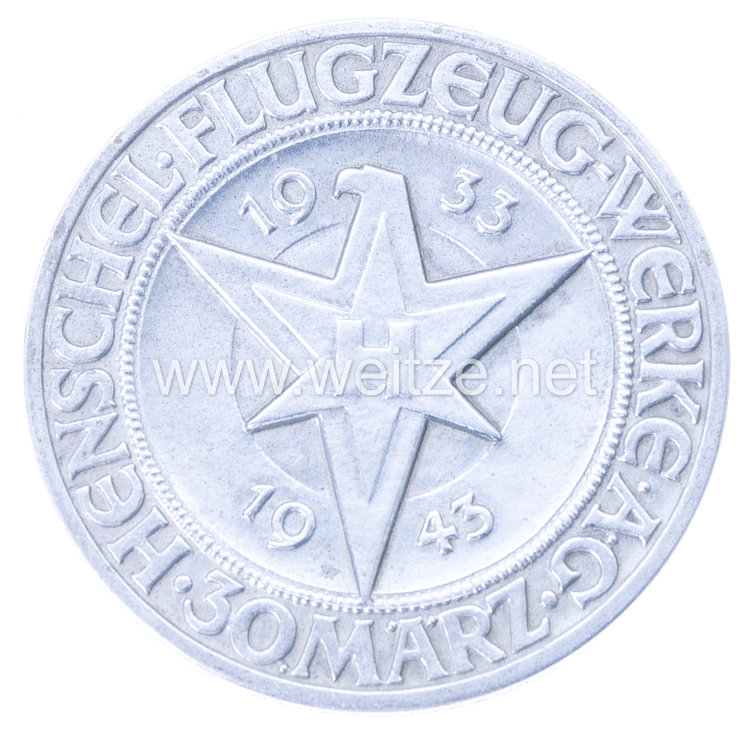
Henschel Flugzeugwerke Non-Portable Commemorative Medal for the 10th Anniversary 1943
The commemorative medal of Henschel Flugzeugwerke AG from 1943 represents a fascinating testament to the German armaments industry during World War II. This aluminum medal was issued to celebrate the tenth anniversary of the aircraft division of the traditional company Henschel, which was among the most significant German armaments producers of the Nazi era.
Henschel & Sohn GmbH was originally a company founded in Kassel in 1810, initially specializing in locomotive construction. With the Nazi seizure of power in 1933 and the massive rearmament of the Wehrmacht, Henschel expanded into aircraft production. On March 30, 1933, Henschel Flugzeugwerke AG was established as an independent division, as documented on the obverse of the medal.
Military aircraft production quickly became a central business field for Henschel. The company developed and manufactured various aircraft types, including the famous dive bomber Henschel Hs 123, the ground-attack aircraft Hs 129, and especially the Henschel Hs 293, one of the world's first radio-guided glide bombs. These technological innovations made Henschel an important player in German air armament.
The medal itself is made of aluminum, a material that was strictly rationed during the war due to its importance for aircraft production. The choice of this material for a commemorative medal is symbolic and underscores the connection to aircraft construction. With a diameter of 40 millimeters, it corresponds to the common formats for company and commemorative medals of that era.
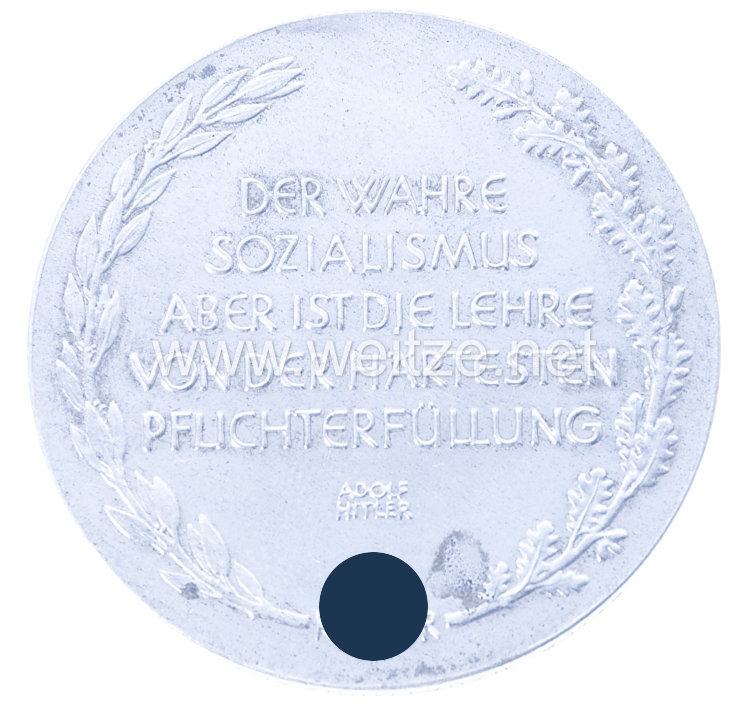
Particularly noteworthy is the reverse inscription featuring the Adolf Hitler quotation: “True socialism, however, is the doctrine of the hardest fulfillment of duty.” This quote reflects the National Socialist ideology of the Volksgemeinschaft (people's community) and unconditional commitment to the regime. The use of such propaganda slogans on company medals was common in the Third Reich and demonstrated the close intertwining of economy and Nazi ideology. The surrounding oak and laurel wreath and the swastika are typical National Socialist symbols representing strength, victory, and the regime's rule.
The year 1943, when this medal was issued, marks a turning point in World War II. After the defeat at Stalingrad in February 1943 and the increasing Allied bombing raids on German industrial facilities, the German Reich was already in a defensive position. Nevertheless, armaments production was massively intensified under Reich Minister Albert Speer. Henschel played a central role in this phase of “total mobilization.”
Such anniversary medals were typically awarded to deserving employees, senior staff, and important business partners. They served to motivate the workforce and demonstrate company loyalty at a time when workers were under enormous pressure. The designation “non-portable” means that this medal was not worn as a decoration on a uniform but was intended to be kept in a case or as a table medal as a memento.
Production at Henschel increasingly relied on forced laborers and prisoners of war during the war. Like many German armaments companies, Henschel was integrated into the criminal system of forced labor, revealing the dark side of this seemingly innocuous commemorative medal.
After the war, aircraft production at Henschel ceased, and the company refocused on vehicle and machinery construction. Today, such medals are important historical documents providing insight into corporate culture, propaganda, and the economic organization of the Nazi regime. They are collector's items of military-historical interest but must always be viewed in the context of the criminal dictatorship in which they were created.