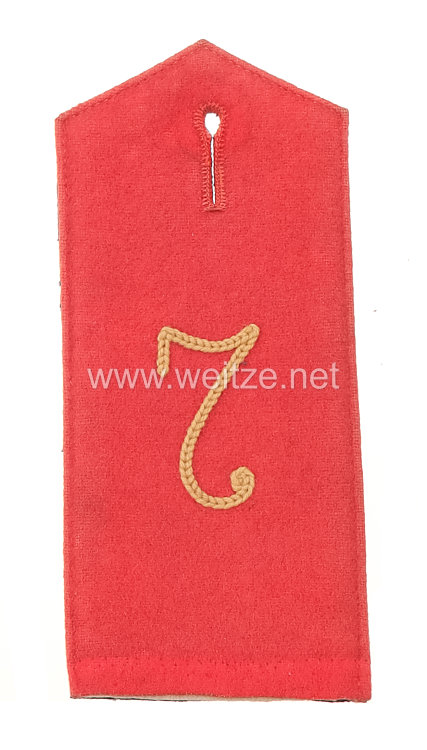
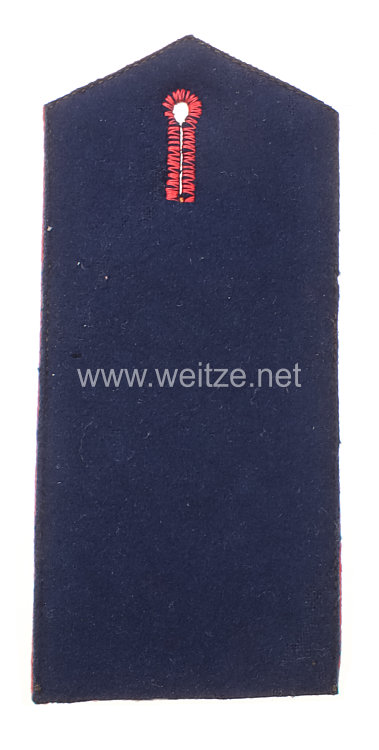
Prussia Single Shoulder Strap for Enlisted Men of Dragoon Regiment General-Feldmarschall Prinz Leopold von Bayern (Westfälisches) Nr. 7
The shoulder strap for enlisted men of the Dragoon Regiment General Field Marshal Prince Leopold of Bavaria (Westphalian) No. 7 represents a fascinating testament to Prussian military history in the late Imperial era. This regiment, stationed in Saarbrücken, embodied the close connection between Prussia and Bavaria within the German Empire.
The Dragoon Regiment No. 7 was originally established as a Westphalian regiment and received its traditional designation through the conferral of the regimental name in honor of Bavarian General Field Marshal Prince Leopold of Bavaria (1846-1930), who pursued a significant military career in the German Army. This practice of naming Prussian regiments after distinguished military personalities was common, serving to honor their achievements and underscore the federal structure of the German Empire.
The shoulder strap as part of Prussian uniforming evolved from older epaulettes and was worn by enlisted men and non-commissioned officers without sword knot as flat insignia sewn onto the shoulder. They served for quick identification of regimental affiliation and were strictly regulated according to the uniform regulations of the Prussian War Ministry. The All-Highest Cabinet Order (AKO) of January 27, 1843, and subsequent decrees minutely regulated the form, color, and design of these distinctions.
For Dragoon Regiment No. 7, the shoulder straps were held in the branch color light blue, as prescribed for all Prussian dragoon regiments. The regimental number “7” was typically applied to the strap in red color. The single shoulder strap for enlisted men consisted of firm cloth backing with corresponding piping and was considerably simpler than officers' epaulettes.
The timeframe of around 1910 was a period of intensive armament and modernization of German armed forces. The German Empire found itself in a phase of heightened international tensions that would ultimately lead to World War I. The dragoons, originally conceived as mounted infantry, had developed into full cavalry units designated for both reconnaissance and combat operations.
The regiment in Saarbrücken was part of the VIII Army Corps and held a strategically important position in the border region with France. The Saarbrücken garrison itself was heavily influenced by heavy industry and formed an important military base in the west of the Reich. The troops stationed there were prepared for a possible confrontation with the French neighbor.
The assessment as “Rare” and the condition rating of “2+” (corresponding to very good preservation) make this object a valuable collector's item. Individual shoulder straps often did not survive the times, as they were frequently disposed of or reworked after the dissolution of the regiment, at the latest after the end of World War I and the accompanying abolition of the monarchy and restructuring of the armed forces into the Reichswehr.
The Treaty of Versailles of 1919 meant the end of the traditional Prussian military structure. The old regiments were dissolved, their traditions and insignia lost their official significance. Many of these objects became personal mementos of veterans or found their way into private collections.
For military-historical research, such shoulder straps are of considerable significance, as they document the complex organizational structure, uniforming practices, and federal nature of the imperial German Army. They enable the reconstruction of individual unit identities and provide insight into the material culture of Prussian militarism. The craftsmanship of these pieces, often manufactured by specialized military effects factories, testifies to the high importance attached to external appearance and military tradition in the Imperial era.